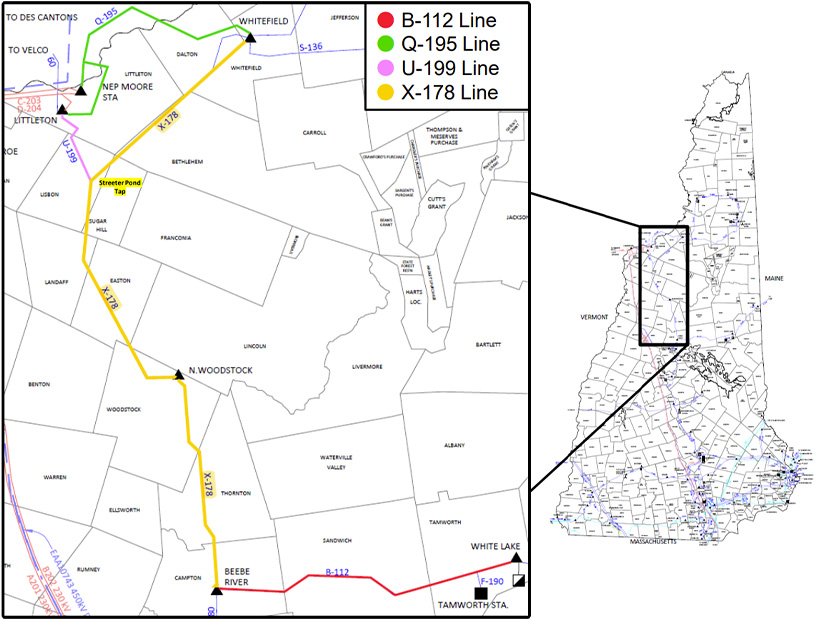
FERC has dismissed a complaint from two New Hampshire residents about a $385 million asset condition project on an Eversource Energy transmission line in New Hampshire, finding that the complaint failed to demonstrate any violations by the company (EL26-27).
Despite the dismissal, FERC left the door open to future challenges of the costs of the project. The commission said it is premature to challenge cost prudency before Eversource seeks cost recovery.
The project in question is a full rebuild of a 49-mile, 115-kV line owned by the Public Service Company of New Hampshire (PSNH), a subsidiary of Eversource. The company is scheduled to begin construction in early 2027, and the estimated in-service date is mid-2029.
In Eversource’s June 2024 presentation of the project to ISO-NE stakeholders, the company said its inspections indicate 43 of the line’s 594 structures warrant immediate replacement, while additional replacements would be needed due to uplift issues caused by the new structures.
By pursuing a full rebuild of the line, Eversource has said it will avoid additional costs and environmental impacts associated with a “piecemeal replacement of failing structures.”
Consumer advocates and the New England states have voiced strong concerns about the scope and need for the project, and some advocates say it has come to epitomize broader concerns about a lack of regulatory scrutiny on asset condition projects.
In a 2024 letter to Eversource, the New England States Committee on Electricity wrote it “is not persuaded that this investment is a reasonable use of consumer dollars,” and is “prepared to use its full resources to explore all available options to dispute the reasonableness of the investments, including but not limited to action at FERC.” (See New England States Raise Alarm on Eversource Asset Condition Project.)
In November, Kris Pastoriza, an activist who has been a vocal opponent of the project, and her mother Ruth Ward, a Republican state senator in New Hampshire, asked FERC to open an investigation into the project to ensure it is necessary and the costs are prudent.
“Eversource has avoided any scrutiny of the X-178 project,” the complainants argued. “As a result, ratepayers cannot know if the transmission charges on their monthly statements are just and reasonable as required by law.”
They also took aim at ISO-NE, arguing the RTO “failed its responsibility as the New England regional grid operator to review the X-178 to ensure that any charges to ratepayers are just and reasonable.”
They have argued the rebuild should not be exempted from ISO-NE planning procedures as an asset condition project, saying it would “more than double the line capacity,” replace existing wood structures with larger steel structures, install optical ground wire and construct permanent roads.
Responding to the complaint, Eversource argued that the complaint failed “to plead any claims upon which relief can be granted” and “grossly misrepresents the level of scrutiny” on the project.
The company added that asset condition projects undergo a “robust regional stakeholder review” at the ISO-NE Planning Advisory Committee and the NEPOOL Reliability Committee.
But for consumer advocates in the region, the existing ISO-NE review process of asset condition projects — which is not a regulatory process — is far from adequate. The transmission owners already have made several changes to the process in response to these concerns, and ISO-NE is working to establish internal capabilities to review whether the TOs have justified the need for projects and adequately evaluated alternatives. (See ISO-NE Responds to Feedback on Asset Condition Reviewer Role.)
The Maine Office of the Public Advocate (OPA) opposed Eversource’s motion to dismiss the complaint. It argued that the complaint raises “ample concerns” warranting investigation by the commission into “whether the project at issue is a system expansion and, if so, whether PSNH’s planned recovery of the cost of the X-178 project as replacement costs violates the filed rate doctrine.”
In its ruling on March 2, FERC found that the complaint “does not clearly identify or explain the action or inaction by PSNH that is alleged to violate applicable statutory or regulatory requirements.”
The commission added that, “for a complaint filed under FPA Section 206, the burden of proof is on the complainant to demonstrate that the rate is unjust and unreasonable, and we find that the broad allegations raised in the complaint are not sufficient to satisfy the complainants’ burden.”
However, FERC said interested parties will have the chance to request information and challenge project costs if Eversource seeks cost recovery for the project.
“To date PSNH has not sought to recover in rates the costs associated with the project, and until the costs of the project are proposed to be included in transmission rates, any challenges to including those costs in transmission rates are premature,” FERC wrote.
Reacting to the ruling, Andrew Landry, deputy public advocate at the Maine OPA, said he’s disappointed in FERC’s decision but is glad the commission expressed an openness to future challenges.
“We continue to believe that Eversource in particular, but some other utilities to a lesser extent, are abusing the asset condition process to move forward projects that ought to have a greater degree of review,” Landry said.
Eversource, which owns about 36% of transmission by mileage in New England, has been responsible for $3.66 billion — over 78% — of asset condition spending in the region since 2020, according to data from the TOs updated in October.
Landry said he’s hopeful the negotiations around an ISO-NE internal asset condition reviewer will lead to a more meaningful review process and greater transparency, but that he has lingering concerns about the TOs’ selection of project alternatives that are reviewed by ISO-NE.
Pastoriza noted that FERC’s dismissal does not prevent future challenges but wrote the process of allowing Eversource to build the line and then challenging costs after the fact “makes no sense, given the monumental, permanent and unnecessary environmental destruction that construction (as [Eversource] does it) would do to 50 miles of easements.”
Eversource did not respond to comment requests in time for publication. ISO-NE said TOs in the region are responsible for ensuring the prudency of their asset condition investments, and the RTO’s current authority “is only to ensure that any project placed into service does not harm the reliable operation of New England’s power system.”