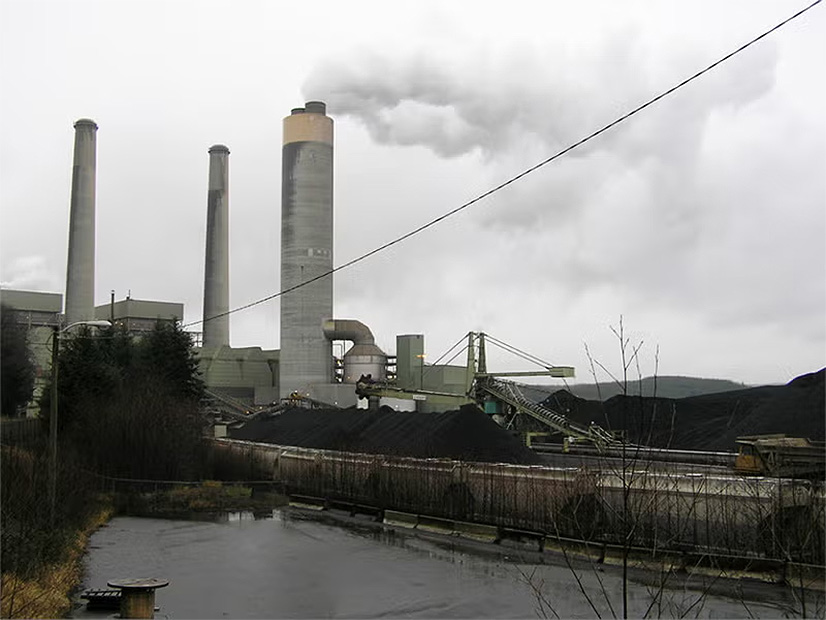
Washington’s attorney general and a coalition of public interest organizations have filed separate lawsuits to overturn the U.S. Department of Energy’s order requiring TransAlta to continue operating the state’s last coal-fired plant beyond its scheduled retirement.
Both suits were filed in the 9th Circuit Court of Appeals. They come after DOE on Dec. 16 directed TransAlta to continue running Unit 2 of the Centralia Power Plant until March 16, 2026, citing an energy “emergency” in the Pacific Northwest this winter, despite the fact that neither NERC nor WECC had identified any such emergency in their winter reliability assessments. DOE issued the order based on its emergency authority under Section 202(c) of the Federal Power Act.
The unit had been slated for closure Dec. 31 based on a 2011 Washington law and subsequent agreement between the company and the state. (See DOE Orders Retiring Wash. Coal Plant to Stay Online for Winter.)
“Trying to force Washington to restart a defunct power plant is not only illegal, but would also jeopardize public health,” Washington Attorney General Nick Brown said in statement announcing his office’s suit. “Washington state will not be bullied.”
“Our region has moved beyond reliance on coal and this plant to meet our energy needs with cleaner sources,” Patti Goldman, the Earthjustice attorney leading the suit, said in a different statement. “This illegal DOE order does the opposite of solving problems — it forces a decrepit coal plant to produce unreliable power while worsening pollution and inevitably raising energy rates for Washington residents.”
The order was one of a handful the Trump administration’s DOE issued in 2025 to extend the life of retiring fossil fuel-fired plants, including in Michigan, Pennsylvania and Colorado.
A month after the Centralia order, Brown and a coalition of environmental groups — including Earthjustice, NW Energy Coalition, Washington Conservation Action, Climate Solutions, Sierra Club and the Environmental Defense Fund — filed separate requests to rehear the 90-day order, which DOE declined. (See Wash. AG, Environmental Groups Challenge DOE’s Centralia Coal Plant Order.)
“The groups’ legal challenge asserts the Trump administration is unlawfully using Section 202(c) of the Federal Power Act, which allows DOE to order power plants to operate for short periods of time in response to imminent and unexpected shortfalls — in other words, real emergencies,” the groups said in a press release. “This DOE order exceeds that authority and instead tries to impose the administration’s preference for coal-fired power.”
The PIOs contend that “other coal plants are experiencing extremely high costs to comply with similar DOE orders,” a statement supported by the recent revelation that, in the last seven months of 2025, Consumers Energy incurred $135 million in net costs to maintain operations at J.H. Campbell coal-fired plant in Michigan, which was to retire in May 2025. (See DOE Reups Campbell Coal Plant Emergency Ops; Losses Top $135M.)
In his suit, Brown said DOE issued the order “for reasons untethered from any actual immediate or even long-range problem with the Pacific Northwest’s grid.”
He contended the order “presents no legitimate factual basis — let alone substantial evidence — to support its claim that maintaining Centralia as a coal-fired facility is necessary to ‘meet’ any emergency,” but instead undermines “the very grid stability it purports to protect in a way that will be enormously detrimental to the Northwest’s ratepayers.”
“In doing so, DOE both misreads and misrepresents the sources it cites as support for an emergency — to the point that DOE’s order can only be explained as aimed to benefit the coal industry rather than at any true ‘emergency’ in the Northwest,” Brown wrote in the suit.
The PIOs argue along the same lines in their suit, adding that “[s]tate authorities, regional entities and utilities have been carefully planning for Centralia’s retirement for over a decade, securing replacement resources and continuously tailoring plans to evolving supply and demand conditions.”
They argue also that DOE “must abide by the limitations Congress set forth in Section 202(c). This includes limitations on what the department can require even if the department substantiated its emergency claim (which it has not).”
They add that DOE’s order must be consistent with state environmental laws to the greatest extent “practicable,” minimizing “adverse environmental impacts.”
“The department does neither,” the groups wrote.
DOE did not respond to a request for comments for this article.