DALLAS — Figures in the energy industry are casting doubt on the White House’s proposal to shield ratepayers from the costs of interconnecting large loads, saying it ignores the jurisdictional responsibility between regulatory authorities.
The Ratepayer Protection Pledge secured commitments from developers to pay for the full cost of power plants and any required delivery infrastructure upgrades, whether the data centers use the power or not. The pledge asks the data centers to strengthen the grid’s resilience by making their backup generation resources available during times of scarcity to prevent blackouts and power shortages in their communities.
Leaders of seven large Big Tech companies signed the nonbinding pledge during a March 4 ceremony in Washington. (See Trump Gets Tech Execs to Sign ‘Ratepayer Protection Pledge’.)
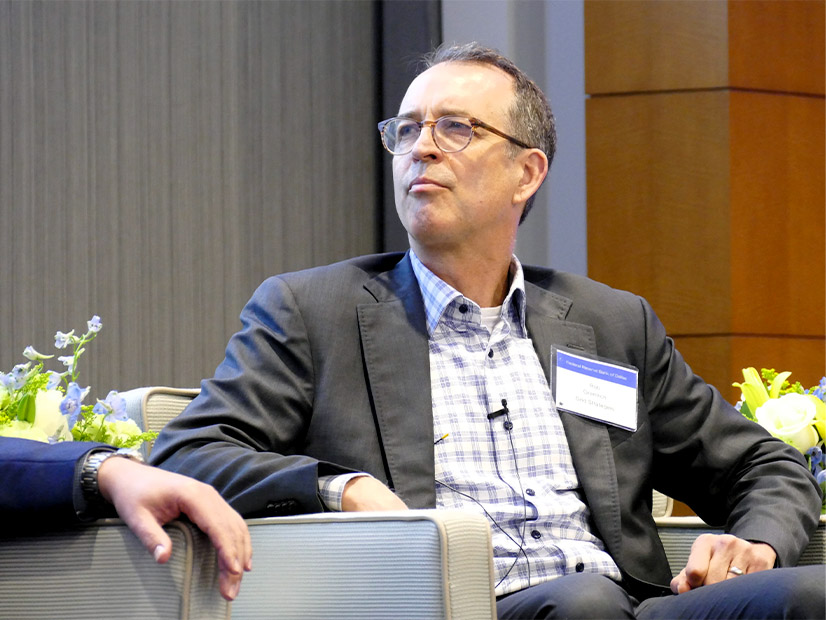
Rob Gramlich, president of the D.C.-based consulting firm Grid Strategies, said during the Federal Reserve Bank of Dallas’ Powering AI conference March 4-5 that there was a “deal to be had between the richest corporations the world has ever known” and the power sector and its end-use customers.
He found gathering regulators in the same room with the tech companies and getting the companies to agree on a “political level” to paying their “fair share” was “quite impressive.”
“That’s an important step,” said Gramlich, who served as an economic adviser to Pat Wood during the latter’s FERC chairmanship. “I know from my eight years being in a regulatory agency that having policymakers agree to, ‘Here’s the deal. Here’s kind of what we’re trying to achieve,’ and then go work out the details … that’s an important step.
“Those first two components are important and check two boxes,” he said. The third phase, implementation, is “really complicated … with a whole new set of complications,” Gramlich said, pointing to jurisdictional issues between the federal government and the states.
“Every market structure is different. Every state has a different arrangement of who’s responsible for transmission, generation, the planning and the cost allocation in ‘FERC land’ outside of Texas,” he said. “The retail-wholesale split is extremely complicated. FERC can’t right now just go and say, ‘Oh, data centers, you pay for this thing.’ Those are retail customers. FERC can’t tell what one retail customer versus another retail customer can do without the state saying that’s the way.”
Gramlich said FERC could assert jurisdiction over the states and go through seven years of litigation. “But there’s not seven years to go through that process,” he warned.
Andrew Schaap, CEO of developer Aligned Data Centers, said he is a firm believer in the necessity of the U.S. winning the artificial intelligence race.
“A lot of our adversaries are not having [these discussions]. They’re just doing it. They’re just going to go as fast as possible,” he said, noting China is building 1.5 TW of solar power a year.
“The fair rate pledge is a way to give latitude to operators like ourselves and hyperscalers to do behind-the-meter generation. I build my own power plant; I build my own systems,” Schaap said. “Is that the most efficient way to do it? Probably not. The most efficient way is to do it with the grid.”
Schaap did allow that the pledge is a “good incentive to get there faster.”
“One of the things that we’re all struggling with is there’s just not enough capacity fast enough,” he said.
Nick Elliot, who recently left the Department of Energy’s Grid Deployment Office to join the White House’s National Energy Dominance Council as a senior policy adviser, was in the room where the pledge was signed before he took a red-eye flight through thunderstorms to Dallas.
The transmission piece of the pledge was the hardest component “to get right,” he said holding a cup of coffee. The large load will have to cover 100% of the direct cost for a tie line, he explained, but connecting large generation to the facility is going to affect the entire system’s upgrade requirements.
“They will benefit you, but they’re going to benefit everyone else,” Elliot said. The hyperscalers are “willing to engage” in innovative regulatory structures, paying “full freight” or over time.
“We’ll build the highway,” Elliot said, speaking for the large loads. “And to the extent you end up building a whole bunch of other hotels on the highway, allocated to those other people later, we will backstop, and we’ll take the risk.”
“I certainly understand why Nick says that transmission is harder, because it’s harder,” said Stu Bresler, PJM’s executive vice president of market services. “The benefits of transmission do flow to many customers once it’s built. I think the challenges with allocating the cost of new generation on the system are equally difficult to transmission when there’s so much uncertainty about how much load you’re actually building for and who the customers will actually be. We have to get through all these cost allocation issues. They’re extremely foreign.”
Texas Addresses Rising Costs
Google was one of the seven companies that signed the pledge. Doug Lewin, who recently left his consultancy to join the company as the Texas lead for energy market development, made it clear that Google wants to be connected to the grid.
“You have several advantages to that, both from the data center side and from the public side,” he said. “We just have to have a historical perspective here and remember that for the entire life of the grid, over 100 years back to the earliest days, system use matters.
“It’s a simple division problem, right? Whatever your fixed costs are, can you spread that across as many users as possible that lowers the unit cost?” Lewin added. “That’s the basic economics of the grid as it has existed since the 1910s, and that principle still holds. So, we think it’s not only good for us to be connected, and this would go for any data center, but also for all customers.”
Google and Lancium, an energy technology and infrastructure firm, have filed joint comments on the Texas Public Utility Commission’s proposal to set interconnection standards for large loads (58481). They argued the proposal requires “large, upfront and nonrefundable financial commitments without providing clear study outcomes, defined interconnection timelines or a predictable path to energization.”
“This sequencing shifts significant risk onto customers before system feasibility and deliverability are known,” the companies said, referencing a flat $100,000/MW nonrefundable interconnection fee they said may result in overcollection beyond true costs.

Instead, they have suggested a five-year, 50% minimum demand charge to fund infrastructure builds and share in costs. Lewin said that is a “very tangible way” large loads can shift around costs based on ERCOT’s Four Coincident Peak (4CP) program. Under the program, industrial customers are charged a fee for 4CP based on the amount of electricity consumed during a defined period in the previous year when demand on the grid was at its highest.
“Large loads can get away from paying a transmission charge,” Lewin said. “We have come forward with other partners and said, ‘We want a minimum transmission charge.’”
Emerald AI’s Arushi Sharma Frank, Lewin’s partner on the panel, applauded the Google-Lancium proposal.
“As the load comes in, it pays for the transmission upgrades, and if the load comes before that, great,” she said. “But if upgrades come first, then the loads need to still be there to foot the bill because they are going to eventually use it.”
ERCOT General Counsel Chad Seely said these discussions are part of policy issues being discussed in Texas.
“We’re trying to figure out what the best process is to study [large loads] reliably and make sure that we’re making the best decisions as far as building out the transmission infrastructure and making sure that they have enough skin in the game,” he said. “This is really a pivotal year for ERCOT and our stakeholders to kind of put forward these policy frameworks that will have long-lasting implications as we move forward to manage this tremendous amount [of load].”