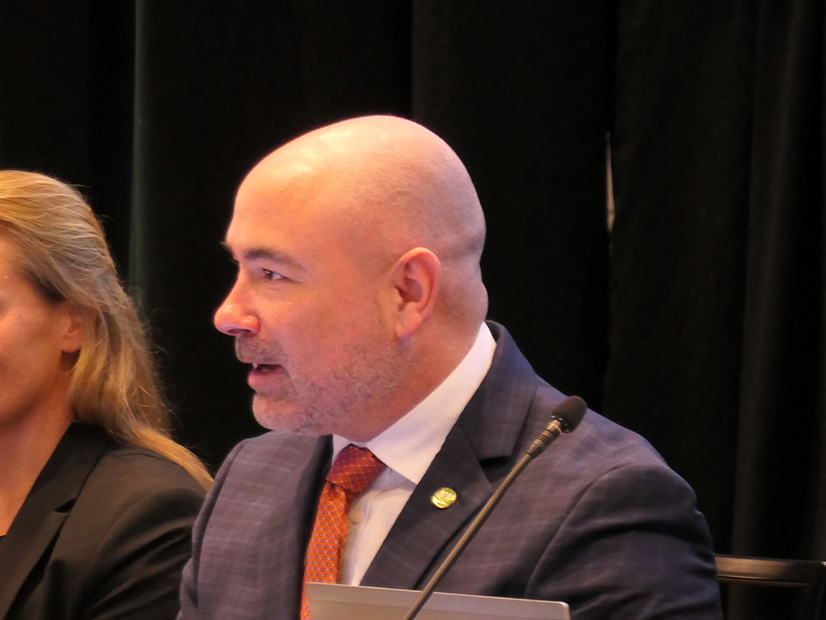
NEW ORLEANS — FERC Commissioner David LaCerte encouraged MISO players to bring their boldest ideas forward that could help return the electric industry to a more humdrum reliability baseline.
LaCerte addressed MISO’s March 25 Advisory Committee meeting ahead of a possible second Senate confirmation, this time for a full, five-year term. (See LaCerte: FERC Focused on Winning AI Race.)
He commended MISO on its initiatives to stand up more infrastructure in record time, including its interregional planning with SPP on the $1.65 billion Joint Targeted Interconnection Queue transmission portfolio.
“Interregional cooperation is not easy,” said LaCerte, adding that single-minded goals must be set aside to improve the larger grid. “The infrastructure will serve real customers, so I applaud you for that.”
LaCerte also called MISO’s temporary, fast-tracked interconnection queue lane a “focused, practical” tool to bring generation online faster.
He said if reconfirmed by the Senate, he would focus on making sure that “every action we’re taking is in furtherance of reliability and affordability.” He said both must be lifted equally and that he doesn’t prioritize one over the other.
LaCerte said he doesn’t like that the nation’s risk maps look like “McDonald’s drive-through menus” with all the vibrant, warm colors.
He repeatedly encouraged MISO, stakeholders and states to “be bold” and bring their best ideas forward to tackle grid expansion reliably. “The best ideas come from the states … not necessarily the bureaucrats in D.C.,” he said.
He said his goal is to help the industry “get back to more boring, more business as usual” so residential ratepayers are neither worried they’ll flip a light switch in vain nor nervous about how they’ll cover energy bills.
However, LaCerte told attendees that “large loads cannot be wished away.” He said “living in an era where we’re all uncomfortable” will be the standard for a while and the country must strive to be a premier environment for AI growth. “Second place is not the place you want to be in in this landscape,” he said.
He also said MISO made “smart, disciplined decisions under pressure” during the late January 2026 winter storm and that MISO deserves more recognition for steering operations during the cold snap. (See MISO: Gen Performance Lacking During January Winter Storm.)
He noted that many gas generators performed well below their capacity accreditation during the emergency.
“That’s not a coincidence; that is a pattern,” LaCerte said. He said he plans to focus on coordination of pipeline availability and electricity demand should he return to FERC for a full term.
During a later talk on what impediments the MISO footprint could soon face, multiple MISO members said gas-electric coordination will become more consequential as gas generation becomes more of a load-bearing column of the grid.
Michelle Bloodworth, of coal lobby America’s Power, said MISO should be aware of the risk of inadequate fuel supply as MISO heads toward a fuel mix shared by natural gas, wind and solar generation. She said with natural gas as the backstop, firm pipeline transportation and storage for just-in-time service becomes more essential.
Bloodworth said members are going to have to “evaluate a price tag” that comes with replacing coal with natural gas, as onsite coal piles don’t experience the dramatic price spikes that natural gas supply does during high demand.
Pelican Power’s Tia Elliott said gas generators “need firm contracts,” but added that’s a matter the states oversee.
Meanwhile, the Union of Concerned Scientists’ Sam Gomberg chimed in that MISO should formally name climate change as an operational risk.
“I think we need to be more proactive about responding to those trends,” Gomberg said. He said simultaneous intense heat waves and droughts will test the grid by driving up demand while drying up cooling water for generation.
Gomberg asked MISO to prepare a “full assessment” of what operating conditions might look like a decade down the road with a warmer planet featuring more volatile weather.