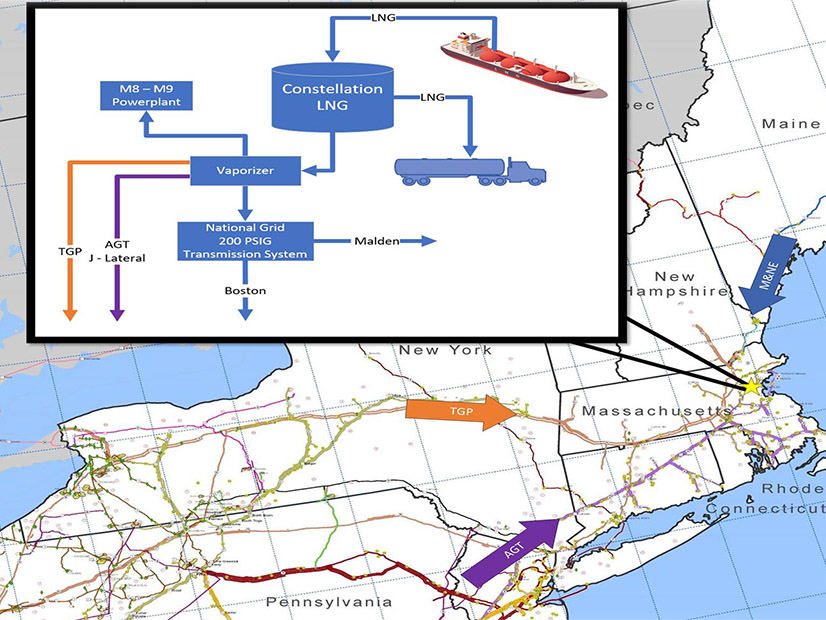
The Everett Marine Terminal (EMT) will be needed to preserve the reliability of the Boston-area gas system beyond the 2030 expiration date of the facility’s current utility contracts, gas companies told regulators in recent filings.
The LNG import facility, owned by Constellation and located just north of Boston, is strategically placed to alleviate low-pressure issues at the end of the pipeline network. It has direct injection capabilities and serves as a hub for the sendout of LNG trucks to satellite facilities.
It is under contract with Massachusetts gas utilities until the end of May 2030. The contracts took effect in 2024 following the retirement of the Mystic Generating Station, its anchor customer. In its approvals of the contracts, the Department of Public Utilities required the utilities to work to reduce their reliance on Everett and file annual reports on their efforts.
“EMT remains a critical reliability asset for Massachusetts LDCs,” Eversource wrote in its filing on April 1. “Even under aggressive assumptions regarding demand reduction and alternative infrastructure development, EMT continues to play a critical role in supporting design-winter, design-day and design-hour reliability, emergency response planning, and prolonged cold-weather operations.”
Since 2024, the Office of Energy Transformation has convened a working group intended to analyze and facilitate a transition away from Everett. The working group’s analysis indicates that “eliminating reliance on EMT for all LDCs by the end of the current contract term is not feasible,” National Grid wrote.
Another round of contracts could prove costly for ratepayers. The facility is not operating under a cost-of-service agreement, and advocates have expressed concern there is no clear limit to what Constellation could charge to keep EMT open beyond 2030. (See Conflict Brewing over Gas Transition in Massachusetts.)
In the 2024 regulatory proceedings, the Brattle Group on behalf of the Attorney General’s Office estimated the contracts would cost a combined $946 million over their lifespan. (See Everett LNG Contracts Face Skepticism in DPU Proceedings.)
The utility contracts include fixed-cost charges, LNG procurement charges and options to buy certain amounts of LNG supply. For the state’s major gas utilities, National Grid and Eversource Energy, the amount of LNG the companies are allowed to purchase increases over the span of the contracts.
The companies said a combination of supply-side and demand-side actions could help reduce reliance on Everett. These could include agreements with other LNG facilities, the addition of LNG vaporization facilities and pipeline expansion, demand reduction and electrification.
National Grid wrote the working group’s analysis “has consistently found that demand-side strategies represent the most scalable and durable pathway for achieving sustained reductions in EMT reliance.”
Demand-side solutions should be focused on providing “measurable peak-load relief in EMT-constrained areas, rather than pursuing reductions that are beneficial in aggregate but do not affect EMT-driven peaks,” the company said.
The filings also raised questions about cost shifting if one of the utilities can eliminate reliance on Everett. Eversource has signed agreements associated with an Enbridge project to expand the Algonquin gas pipeline system, which could eliminate the reliance of one of its service territories on the facility.
As Eversource cuts its reliance, “a greater share of certain of EMT’s fixed costs may be borne by the remaining contracting LDCs [local distribution companies],” National Grid wrote.
The Algonquin expansion project “may have the effect of shifting relative EMT cost responsibility rather than reducing systemwide EMT fixed costs,” it added.
It noted the working group’s analysis found “that cost mitigation for one set of LDC customers can result in increased cost exposure for others, given the absence of a regional cost-sharing mechanism for EMT and the limited jurisdiction of state and federal regulators over EMT pricing and operations.”