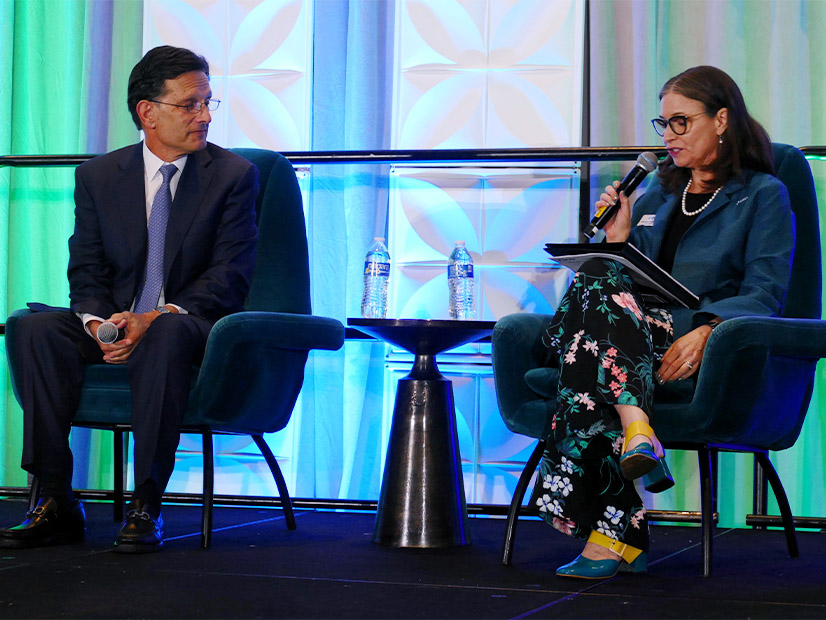
HOUSTON — Former U.S. Rep. Eric Cantor (R), one-time House majority leader and Young Gun, spent 27 years in the political arena before what he calls a “very unscheduled departure from politics.”
However, he got his start interning at his local utility, Dominion, in its government relations office. Who else then, do you invite to your power conference to speak about the political weaponization of the grid?
“Most people don’t think about the grid until something goes wrong,” Cantor said while “fireside” chatting with Barbara Clemenhagen, the Gulf Coast Power Association’s executive director, during GCPA’s 39th annual Spring Conference and Exhibition on April 6-8.
He referenced several major grid outages, including ERCOT’s dayslong blackouts during the 2021 winter storm, that were “certainly attention-grabbing events.”
“I think people really, at least in the beginning, thought that they were isolated,” Cantor said.
Of course, that has changed with the tsunami of interconnection requests from large loads that will require billions of dollars in infrastructure costs, all of which eventually will land on ratepayers’ bills. Communities in Virginia, Texas and elsewhere also are complaining about data centers’ massive electricity consumption and water use, noise pollution, strain on local infrastructure and limited job opportunities.
According to a 2025 Data Center Watch report, $64 billion in U.S. data center projects have been blocked or delayed by local opposition. The report says the pushback is bipartisan, with Republicans concerned about tax incentives and energy grid strain and Democrats focused on environmental impacts and resource consumption.
“The NIMBY factor has also played a role in making the grid political because if the utility wanted to lay a line through your neighborhood, you better darn sure bet that that’s a political issue,” Cantor told Clemenhagen. “I think where we are today is when you have electricity prices going up in the context at a time in which inflation has taken hold, where people are already sensitive to higher gas prices … and you combine that with this almost ferocious negativity around data centers, that’s when I think we have arrived at the point where this thing is really political and the grid has become political.”
Look no further than democratic socialist Sen. Bernie Sanders and right-wing Florida Gov. Ron DeSantis. Despite being on opposite ends of the political spectrum, both have come out against the growth of artificial intelligence data centers. Sanders (I-Vt.) has called for a national moratorium on data center construction. DeSantis has unveiled an AI bill of rights that would allow local communities to block their builds.
“It’s kind of crazy, and I think a little bit scary, the fact that they have decided to come full circle and meet in the middle by calling for a moratorium on data centers,” Cantor said of his former colleagues. “We’ve got a lot of work to do to get around this growing perception … that is influenced by inaccurate cost-benefit analysis. Let’s just dial it back.”
One of the GOP’s so-called Young Guns along with Paul Ryan and Kevin McCarthy — and like Cantor, both now out of office — he was first elected in 2000 riding George W. Bush’s coattails. He worked his way into the GOP leadership and was the party’s House majority leader from 2011 to 2014.
When Cantor was upset in his primary that year by political newbie Dave Brat, an economics professor, he resigned his position and then his seat. He quickly accepted an opportunity with global investment bank Moelis & Co., where he is vice chairman and managing director.
“At Moelis, we are doing a lot in terms of infrastructure and digital-infrastructure financing,” he said. “As we see with these forthcoming [initial public offerings] — just trillion-dollar AI companies — there is a lot in place on the future here.
“Even the politicians that are pro-AI and believe and support this tremendous capex that’s going into digital infrastructure, they’re just as soon saying, ‘Hey, we’d rather have it in another community. Certainly, people would not mind,’” he added. “Right now, what that causes is, frankly, no political downside for a politician just like DeSantis and Sanders taking this kind of position.”
Cantor offered some hope for data center proponents. He said the administration’s 2025 reconciliation bill, also called the One Big Beautiful Bill Act, stopped short of squashing the renewable industry because enough Republicans came out in support.
“It will mean something to the development of data centers and the advancement of AI and America’s leadership,” he said. “I think that is our best route back to trying to settle this down, so it doesn’t become even more weaponized. … I know it’s hard because you’re sitting there in a position to want to commit capital in vast sums to try and beat the challenge, and yet you don’t really know where the pendulum is going to swing in Washington [D.C.].”
Data Centers Respond to Pushback
The public pushback has led some data center developers to alter the way they interact with local communities.
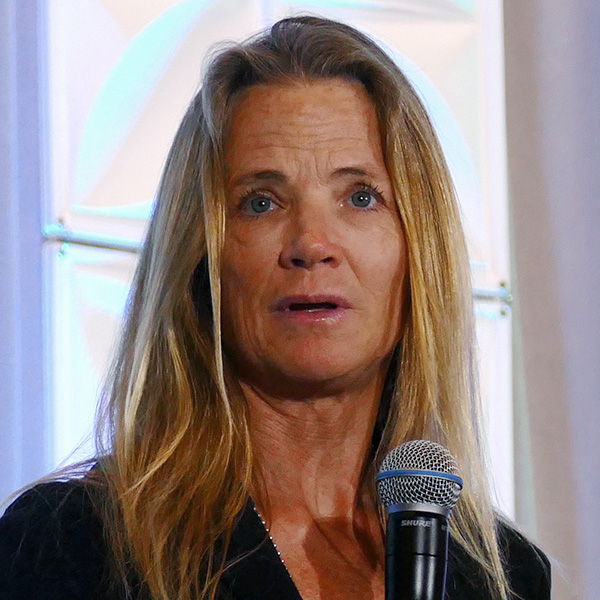
Ali Fenn, Lancium’s president, said the company focuses on its role as participants in the community, as opposed to just being players. The energy technology and infrastructure company is developing a massive 1.2-GW Stargate 1 AI data center campus in Abilene, Texas, designed for high-performance computing using renewable energy.
“We care deeply about all the local stakeholders, and we care deeply about our, ideally, leave-no-trace kind of a motto,” she said during a keynote presentation.
Stargate 1 will feature a closed-loop, direct-to-chip liquid cooling as an alternative to the evaporative cooling Fenn said many data centers use.
“It’s the cheapest thing to do. … That’s great from an overall cost perspective, but it uses a ton of water,” she said. “We use something like less than 1% of Abilene’s water. Currently, we’re not even in the top 100 users. I think the [amount] we use is the equivalent to five Starbucks. It’s super important. We have to be a net benefit to these communities, and we have to be proactive about that because we cannot win AI at the expense of everybody else.”
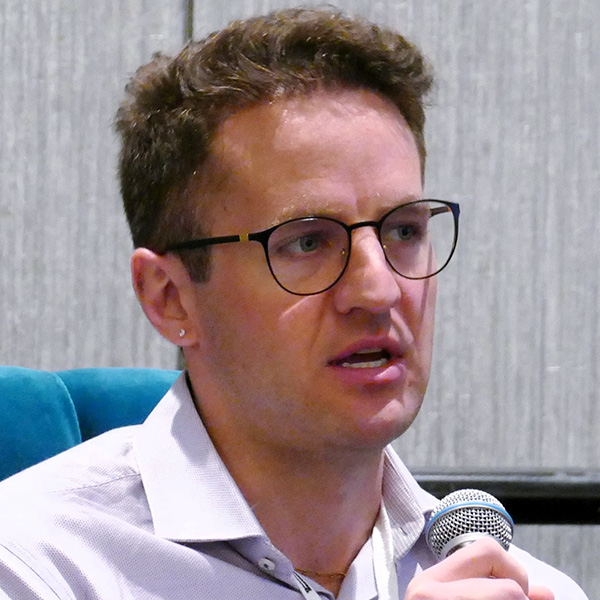
“It’s all about communication,” said Chris Matos, Google’s energy market development strategic negotiator, noting the company once tried to slip into communities under the radar. “We go in first and explain we actually have a water-sustainability policy that looks at the water trend rates in the local community and says, ‘Can we use water insight relative to electricity?’ Water has become increasingly the biggest risk to project that comes from the energy side.”
Satoshi Energy COO Brock Petersen said community engagement is critical, especially in the rural areas of Texas that have become targets for large load construction.
“The community can definitely make your life difficult. You don’t want to be a bad community member,” he said, stressing the need to create solutions. “We’ve kind of seen with other states that kind of blow back on some of the data center build out. We’re operating in these rural communities … so making sure from a water perspective that you’re being a good steward of that. No one wants all the traffic and everything else, especially when you live in a pretty rural place. That can be pretty jarring.”
Gresham Gets Pat Wood Award
The conference began by honoring Kevin Gresham with its 2026 Pat Wood Power Star Award for his significant contributions to the industry.
Gresham has been heavily involved in the ERCOT market for more than 20 years and was credited for being a steady, collaborative force in shaping its competitive landscape. He chaired the ISO’s Protocol Revision Subcommittee for nearly a decade, where he helped draft the market rules for the transition to competition, and represented the generator segment on the grid operator’s board until 2021.
“This organization means a lot to me … over the years, and it continues to expand the ability to bring stakeholders together and to hear and discuss issues,” Gresham said in accepting the award.
He retired from German firm RWE Renewables Americas in 2025, where he directed U.S. legislative and regulatory activities. He also led regulatory affairs for Reliant Energy. Gresham has chaired the American Council on Renewable Energy, the North American Generator Forum, and the Advanced Power Alliance’s board. He was appointed to and served on the U.S. Department of Commerce’s Renewable Energy & Energy Efficiency Advisory Committee (2014-2016).
The award is named for former FERC and Texas PUC chair Pat Wood, its first honoree in 2006. It celebrates those who have “pushed boundaries and fostered positive change.”
Wood was unable to attend but participated in a congratulatory video reel for Gresham. He said he and his wife were in the Himalayas, “So we will be saluting you from on high, very high, and wishing you all the very best.”
“You were shepherding our wonderful stakeholder group [in drafting the competitive market’s rules], helping us with the regulations at the commission, getting it all right,” Wood said. “From the beginning, you’ve been there and had a wonderful career across our industry, ever since. You’ve been a constant presence and a real inspiration to a lot of us that care a lot about Texas.”