Maryland legislators passed the Utility RELIEF Act, which responds to rising power prices by trimming surcharges for a state efficiency program, eliminating the RTO adder for its utilities and requiring the Public Service Commission to review supplemental transmission projects.
The House of Delegates version (HB 1532) and the Senate version (SB 841) went into the weekend with different amendments, but leadership from the two houses and Gov. Wes Moore (D) announced a deal April 13 to get the legislation through on the last day of the session.
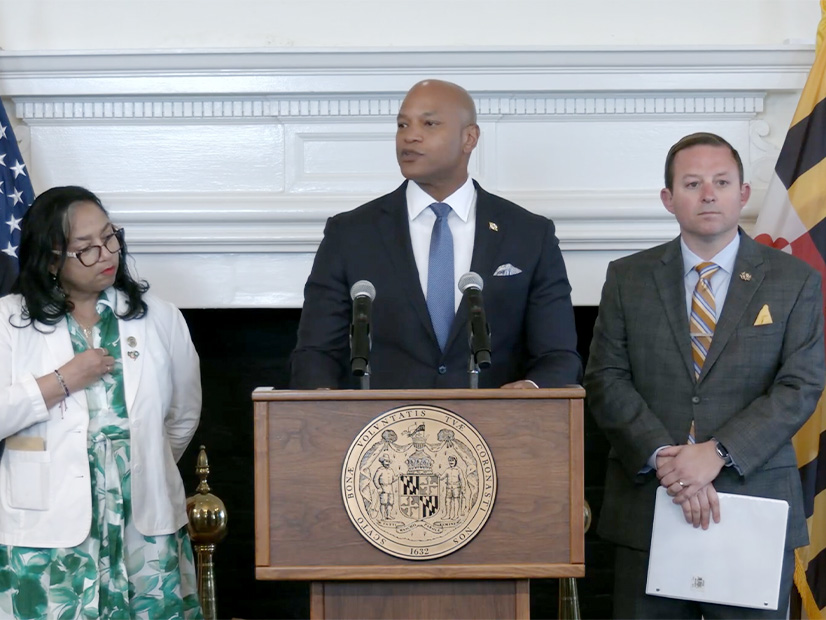
“Over the past year, energy prices have soared and people are getting crushed,” Moore said at a press conference. “Since just last year when this new federal administration came on board, energy prices are up 13% in the state of Maryland.”
An “all-of-the-above” approach to energy works because the state should be supporting what is fastest and cheapest to help address a looming capacity shortfall in PJM, he said. The fastest resources that can come online are renewables like solar, which have run into problems with the federal government.
Moore was among the bipartisan group of governors who attended a White House event in January where they called for a backstop capacity auction and an extension of a cap on prices in the main auction, which are being implemented. (See White House and PJM Governors Call for Backstop Capacity Auction.)
The cap on capacity prices is expected to save the average PJM customer $400. Moore said the state law would save hundreds of dollars more.
The bill addresses the backstop auction being developed by PJM to ensure the costs of it are allocated to data centers, Senate President Bill Ferguson (D) said at the press conference. (See PJM to Present Initial Reliability Backstop Proposal.) It also sets up a registry at the PSC to deal with “phantom load” from speculative data center projects, he added.
“Under this law, data centers will pay for the grid upgrades they need and not the people of the state of Maryland,” Moore said. “Under this law, utility companies can’t come back after the fact and stick you with extra charges. Utility companies can no longer pass their unlimited salaries onto ratepayers.”
The bill requires utility participation in PJM and would make it so they are not eligible for the adder to transmission rates, with Moore saying the bill “ends that loophole.”
The legislation also requires the PSC to review most new transmission lines above 69 kV, with some exceptions for projects that are just rebuilding old lines on existing rights-of-way with minimal changes. Any proceedings for a certificate of public convenience and necessity will require that utilities analyze whether advanced transmission technologies could be used, the bill said.
While the bill was popular with Democrats, in the end Republicans generally voted against the bill, which passed the Senate by 35 to 11 and the House by a vote of 105 to 27. Democrats enjoy substantial majorities in both chambers.
In remarks before the final vote, Senate Minority Leader Steve Hershey (R) called the legislation “a bill about talking points” that saves just a little bit of money.
“Leadership and the governor can come to the people of Maryland and say, ‘hey, we did something for you,’” Hershey said. “And what we’ve said all along is you might have done something — you’ve done the absolute bare minimum.”