ALBANY, N.Y. — New York likely will be splitting atoms and burning methane to power its grid for decades to come, and likely in greater quantity than it is today.
Most people who spoke about the state’s electricity generation mix at the New York Energy Summit on April 16 presented this as a fact, which is a remarkable turnabout in a state that has worked so hard over the past decade-plus trying to boost its renewable energy portfolio.
Policymakers are not giving up on solar or wind, and many activists and legislators remain staunchly opposed to new gas or nuclear plants. But renewable energy so far has not expanded enough to bolster the state’s aged generation fleet for looming load growth or replace fossil-fired plants.
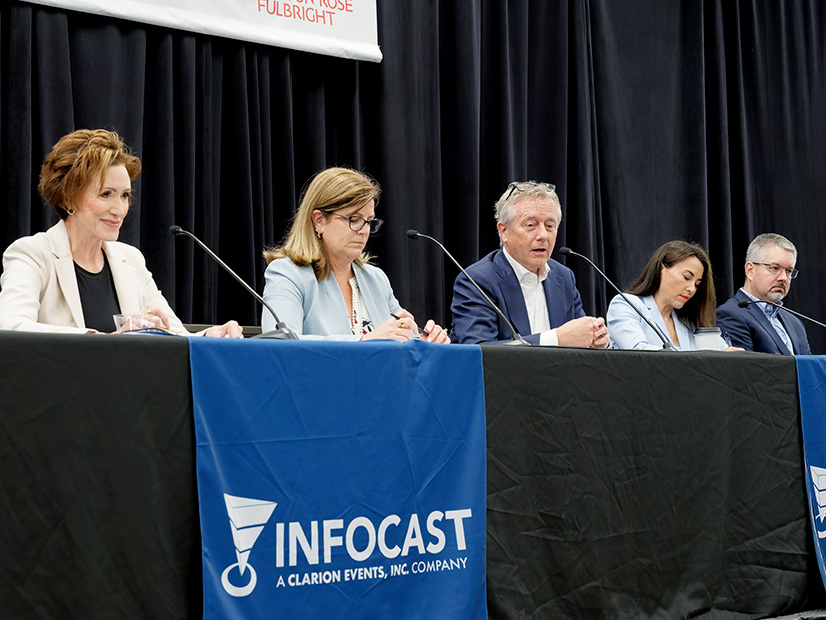
Chris Stolicky, chief of gas system planning and reliability at the state Department of Public Service, clarified that the plan never was to abruptly turn off the gas, but to find alternatives gradually.
“Natural gas never left the conversation. It’s still here,” he said. “At the same time, we’re not going gangbusters expanding the gas system. It’s part of a measured need, it’s reliability.”
The details are evolving. Gov. Kathy Hochul (D) has been hedging on the timeline of the state’s landmark 2019 climate law, wanting to push back certain milestones as she emphasizes consumer affordability.
Factor in the ongoing wrangling over the overdue package of spending and policy decisions for the state’s current fiscal year, as well as her re-election bid, plus the normally slow pace of rulemaking, and one understands why there are not more specifics offered about whether the state will allow or encourage more natural gas generation.
“There’s a balance,” Stolicky said. “We’ve all been talking about the climate act for the last three days [at the Infocast summit]. We also know that the governor has come out and talked about the all-the-above approach. She gave an indication about what she was thinking, but we’re all kind of in a holding pattern.”
Hochul has been much more specific about nuclear. In June 2025 she directed the New York Power Authority to develop at least 1 GW of advanced nuclear, and in January she raised the target to 5 GW of new nuclear generation.
As he moderated a different panel discussion, Isuru Seneviratne of the advocacy group Nuclear New York pointed out that nuclear power in the global West has a track record of late, over-budget projects. He asked how New York might avoid the same result.
Richard Barlette, Constellation Energy’s director of state government affairs in New York, said the preparation would be no different from any other nascent clean energy technology — setting up a supply chain, manufacturing infrastructure and workforce development. Career training efforts already are underway in New York, he noted.
Judi Greenwald, CEO of the Nuclear Innovation Alliance, said the small modular reactors in development eventually could be built more quickly with modular production and installed with less site work on a small footprint.
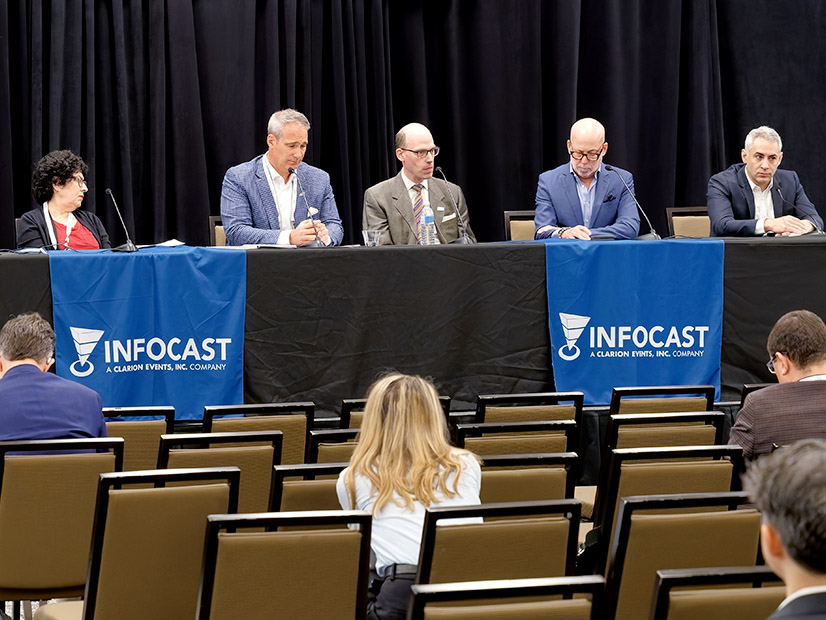
Seneviratne added his own thoughts: “One of the things that New York has done is that with the 5-GW plan, it has the opportunity to avoid the pitfalls that we have had when you try to build a plant once every 30 years — you don’t have the people, you don’t have the workforce, you don’t have the supply chains.”
The Nuclear Company’s head of public affairs, Douglas Smith, pointed out that New York’s nuclear aspirations are not a one-off, but part of a national trend with bipartisan support at multiple levels of government. “I think if we were looking at a state-by-state basis, we’d be in trouble,” he said. “But we’re looking at a national approach, and I think that’s what’s going to make it viable.”
In 2024, natural gas accounted for 50.5% of the fuel mix in New York and nuclear provided 21%. Hydro — primarily from large state-owned projects — accounted for 16.8%. Solar and wind were far behind at 4.5% and 2.3%.
All of these technologies have advantages and disadvantages, supporters and detractors.
But the existing generation portfolio is aging, with some facilities now in their sixth decade of service.
No generation technology — other than perhaps distributed solar — will be quick, easy, widely popular or inexpensive to build, but just keeping the status quo is not a viable long-term alternative. It is not even a short-term option, if the state hopes to comply with reliability standards, continue electrifying structures and vehicles, and attract new industrial development.
‘Real Need’
A panel discussion on economic development and the large power loads that accompany it had a recurring theme: Action is needed now.
Moderator Shannon McGriff, executive director of The Energy Professionals Association, led off with an important point: “There’s been a lot of attention around the nearly 12 GW of large load in the queue. How much of this projected load growth do you think is likely to materialize?”
“There is huge risk in underbuilding,” Grid Strategies Vice President Seth Kaplan replied. “It’s a tough state to build stuff in, and the last thing we need are more impediments. And underbuilding energy resources would be an additional impediment.”
But overbuilding would be just as bad for a different reason — the cost borne by New Yorkers, he said.
“Getting this right is going to be absolutely essential,” he said, acknowledging that he had evaded the question and offering a partial solution: grid optimization and load flexibility.
“If we really focus on squeezing everything we can out of the current system, we can build in a buffer,” Kaplan said. “We can meet rising demand, both from manufacturing and from electric vehicles and electric heat pumps, and not overbuild it.”
Mike Kramer, vice president of data economy strategy at Constellation Energy, said tallying up queues is not a straightforward task.
“You have a bit of a chicken and the egg, where you have to put in your load request before you have financing of the facility, before you have maybe a data center builder or you have an end use customer for the compute,” he said.
Utilities do their best to weed out duplicate requests, Kramer said, but that is hard, and some percentage of the interconnection requests will never come to fruition.
Randy Wolken, president of the Manufacturers Association of Central New York, pushed back from the other direction.
“I get that we don’t want to overbuild because ratepayers pay for it, but there’s a real need,” he said.
“I think it’s really important that we don’t prevent projects, large manufacturing projects, because we can’t figure out the load profile that makes it affordable.”
Three of the five panelists uttered the now-ubiquitous phrase “all of the above.”
New York, they said, should embrace all forms of energy, including new nuclear and new gas.