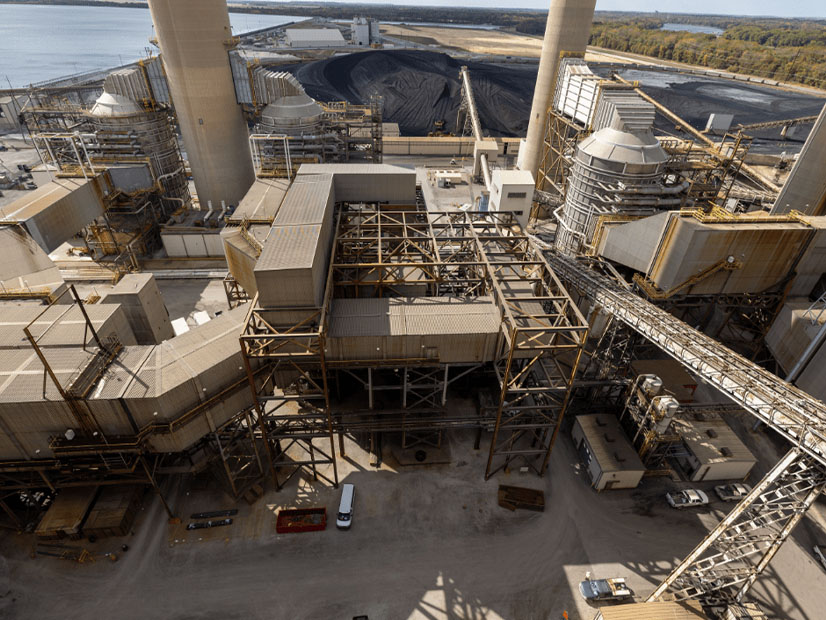
Prior to the U.S. Department of Energy’s March extension of emergency orders for the F.B. Culley Generating Station, owner CenterPoint Energy asked the department not to re-up the stay-open mandate.
According to a letter obtained by Indiana’s consumer advocate Citizens Action Coalition, CenterPoint warned that necessary expensive upgrades and the lengthy outages they would require to keep the coal plant running are “neither practical nor financially responsible.”
The Feb. 17 letter from CenterPoint Indiana Operations President Mike Roeder to Energy Secretary Chris Wright explained that maintaining Culley’s Unit 2 “will require substantial investment to support an inefficient and increasingly unreliable asset, rather than advancing affordable and reliable service for customers in southwestern Indiana.”
Roeder requested DOE allow its original Dec. 23, 2025, emergency order under Section 202(c) of the Federal Power Act to expire and abstain from issuing future emergency edicts.
According to CenterPoint’s data for the 48 days between Dec. 23, 2025, and Feb. 8, 2026, Culley Unit 2 was:
-
- On outage due to equipment issues for 26 days.
- On reserve shut down (available but not economically dispatched by MISO) for five days.
- Available but limited to between 45 MW and 78 MW net output “due to maintenance issues” for the remaining 17 days.
Roeder said unavailability and underperformance dogged a struggling Unit 2 during MISO’s maximum generation emergency on Jan. 24 and continued through the dayslong winter storm.
“Unit 2’s performance during the recent MISO cold weather event underscores a pattern of unreliability of that unit. Although the unit was dispatched on Jan. 24 and Jan. 25, 2026, Unit 2 was limited to 45 MW (net) due to a significant derate. One day later, on Jan. 26, systemic equipment failures forced another outage, further demonstrating the unit’s ongoing inability to provide dependable service,” Roeder wrote.
CenterPoint estimated that for Unit 2 to become operational, it could require more than $20 million of repairs and replacements, including between $1.9 million and $2.5 million for acid cleaning of the boiler and new boiler tubes alongside an “unavoidable” $14 million to $18 million turbine overhaul.
Roeder said Unit 2’s turbine-generator is “operating beyond the original equipment manufacturer’s overhaul specifications, significantly increasing the risk of catastrophic mechanical failure.” He estimated the plant would require a 10-week outage for the work.
Roeder said CenterPoint may encounter “additional operational factors” that could drive repair costs even higher.
“These factors make clear that extending the life of Unit 2 is neither practical nor financially responsible, underscoring the need for a more prudent and economically sound path forward,” he said.
Roeder included Indiana Gov. Mike Braun (R) in the correspondence.
DOE did not honor CenterPoint’s request and cited emergency conditions and “year-round resource adequacy concerns” within MISO when it ordered Culley in late March to remain online for another 90 days through at least June 21, 2026.
But Roeder called DOE’s narrative into question. He said MISO and the Organization of MISO States’ 2025 Resource Adequacy Survey showed that members expect to meet their capacity needs through 2031. He also invoked NERC’s 2025 Long-Term Reliability Assessment, which expects the RTO to have a surplus ranging from 3.4 GW to 5.8 GW on hand for summer 2026.
“We have adequate generation capacity — without Unit 2 — to meet MISO’s planning reserve margin requirement through the 2027/2028 planning year, reflecting our commitment to continued system reliability,” Roeder wrote.
Roeder pointed out that Unit 2 accounts for less than 1% of the total installed capacity in MISO Midwest and said CenterPoint’s integrated resource plans since 2016 have shown that Culley’s retirement is the best way to dodge the “costly investments to maintain operational reliability and environmental compliance” that keeping the unit online would demand.
CenterPoint planned to retire Culley at the end of 2025.
Citizens Action Coalition (CAC) Program Director Ben Inskeep said CenterPoint’s letter demonstrates there’s no grid emergency as DOE purports and “that coal plants are too unreliable, expensive and polluting to continue operating.”
“The federal government’s unlawful orders directing utilities to keep dilapidated and unreliable coal plants open at a massive and growing cost to consumers is an outrageous abuse of power that will cause Americans’ energy bills to continue to increase,” Inskeep said in an April 16 press release accompanying the letter’s reveal.
The CAC called Culley’s level of outages and derates through the coldest portion of winter “shocking.”
The CAC is one of multiple public interest organizations challenging DOE emergency orders at the D.C. Circuit Court of Appeals. (See Groups Contest Indiana Coal Plants’ Emergency Extensions at D.C. Circuit.)
MISO contains multiple coal units DOE blocked from retiring. In addition to Culley Unit 2, DOE also forced Northern Indiana Public Service Co.’s R.M. Schahfer Plant and Consumer Energy’s J.H. Campbell Plant in Michigan to stay open.
At an April 16 MISO Market Subcommittee meeting, Independent Market Monitor Carrie Milton reported that coal use in winter 2025/26 fell across MISO year-over-year despite DOE’s efforts to keep multiple coal plants online.
CenterPoint, along with Indiana’s other four investor-owned utilities, is facing an affordability inquiry before the Utility Regulatory Commission for growing customer bills. (See Indiana Commission Opens Affordability Inquiry into Utilities.)
“We have a real short-term crisis here,” URC Chair Andy Zay said at the commission’s March 24 hearing. “I think we’re creeping up into what we call the lower-middle class with this affordability crisis. The reality is, on Main Street, there are people that simply can’t afford to pay these bills.”
The commission is conducting a series of 10 listening sessions across the state throughout April. Zay said the commission would review residents’ narratives and decide whether to take formal or informal action.