By Ted Caddell
Quarterly earnings calls aren’t only about the numbers. They are often platforms companies use to highlight other news.
Calpine last week announced plans for a new 760-MW plant in PJM, while PPL said it had proposed a 725-mile transmission line through New York, New Jersey, Pennsylvania and Maryland at a cost of $4 billion to $6 billion.
Exelon, which announced its acquisition of Pepco in its first-quarter earnings call in April, used its second-quarter earnings call to continue its push for state support for its Illinois nuclear plants.
EXELON
 Exelon reported net income of $522 million, or 60 cents per share, for the second quarter this year, compared to $490 million, or 57 cents a share, for the same period last year. The 6.5% increase was due in large part to increased capacity prices in PJM, the company said.
The company — which has previously said that some of its Illinois nuclear plants are unprofitable and at risk of closing down — hopes to win state incentives for the plants’ contribution to the economy and their role in helping the state comply with the Environmental Protection Agency’s proposed carbon emissions rule.
“State agencies are drafting a number of reports that will look at the economic value of the units to the local communities, jobs, the value of the energy produced, the value of the low carbon resources,” said Joseph Dominguez, Exelon’s senior vice president of government and regulatory affairs. He said he expected to see the reports in November or December.
“It’s pretty clear that if you lose nuclear plants, your ability to comply with any carbon regime going forward is going to be jeopardized,” CEO Chris Crane said.
PPL
 PPL reported earnings of $229 million, or 34 cents per share, compared to $405 million, or 63 cents per share, last year. That included a special charge of $128 million, or 19 cents per share, related primarily to the anticipated spinoff of PPL Energy Supply.
“Strong performance at each of our regulated utilities with stronger margins from our competitive Energy Supply business led to very solid results through the first half of the year,” CEO William H. Spence said.
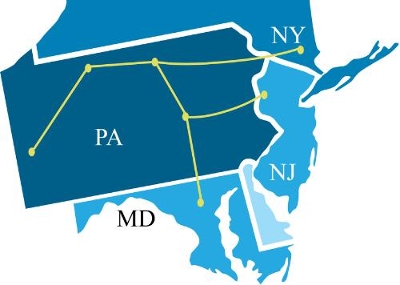
Spence announced that PPL has submitted to PJM a proposal to build a 725-mile, 500-kV transmission line that would run from Western Pennsylvania into New York and New Jersey, with another spur running south into Maryland. Spence estimated the cost for the project at between $4 billion and $6 billion. He said if construction begins by 2017, the project would be completed by 2023 to 2025.
The project was submitted to PJM as part of the Regional Transmission Expansion Plan “window” that opened June 27. (See RTEP Proposal Window About a Month from Opening.)
PPL said the line would address both reliability and congestion as well as move power expected to be produced by new generators fueled by shale gas in northern Pennsylvania. Spokesman Paul Wirth said it would address reliability problems on three 230-kV lines: Lackawanna-North Meshoppen, Montour-Sunbury and Siegfried-Frackville.
CALPINE
 Calpine reported a profit of $139 million, or 33 cents per share. During the same period last year, it showed a loss of $70 million, or 16 cents per share. Operating revenues drove most of the improvement, as they climbed from $1.57 billion to $1.94 billion, an increase of about 23%.
Calpine signaled its confidence in the PJM market by announcing a new 760-MW generator at its York Energy Center near Delta, Pa. It is to be built on the site of its existing 565-MW combined-cycle plant. Using existing infrastructure will result in construction savings, and its location will allow it to take advantage of shale gas from Pennsylvania fields, according to CEO Thad Hill.
PEPCO
 Pepco Holdings Inc. reported adjusted net income of $71 million, or 28 cents a share, compared to $53 million, or 21 cents per share, last year. The company credited higher electric distribution and transmission revenue and lower operation and maintenance expense for the uptick.
Pepco reported that applications for approval of its acquisition by Exelon have been filed with the Federal Energy Regulatory Commission, the Virginia State Corporation Commission, the Delaware Public Service Commission, the D.C. Public Service Commission and the New Jersey Board of Public Utilities.
Filings with the Maryland Public Service Commission are expected in the coming quarter.
DOMINION
 Dominion Resources reported earnings of $159 million, or 27 cents per share, compared to $202 million, or 35 cents per share, last year, a decline of 21%. The company attributed the dip to milder weather, and a one-time charge resulting from Virginia legislation that permitted the company to recover 70% of the costs previously deferred or capitalized relating to the development of a third nuclear unit at North Anna and offshore wind facilities. Revenue declined to $2.81 billion from $2.98 billion, or 5.6%.
Thomas F. Farrell II, Dominion’s chairman, president and CEO, noted on a conference call that the company recently received an environment assessment approval from FERC for its Cove Point LNG facility in Maryland. Farrell also noted the company’s acquisition of two solar projects in Tennessee and an agreement to acquire its seventh in California, bringing its total solar projects in operation or development to 232 MW.
AEP
 American Electric Power reported earnings of $390 million, or 80 cents per share, compared to $338 million, or 69 cents per share, last year, an increase of about 15%.
CEO Nicholas K. Akins said the company’s regulated transmission business brought in 10 cents per share for the quarter, up from 4 cents for the same period last year. It is a part of the business AEP is counting on.
“The additional $300 million that we’ve allocated to our transmission business in 2014 brings our total transmission capital investment to approximately $1.9 billion, which will support future earnings growth,” Akins said.
PSEG
 Public Service Electric Enterprise Group reported a profit of $212 million, or 42 cents a share, compared to $333 million, or 66 cents a share, for the second quarter, a drop of 36%.
An extended outage of its Salem nuclear station’s Unit 2 was the cause of some of the decline. PSEG Power, the company’s generation arm, showed a 74% drop in net income, from $210 million in the second quarter of last year to $54 million for the same period this year.
The company’s regulated utility business reported a 25% rise in profit — $151 million on revenue of $1.435 billion this year, from $121 million on $1.423 billion last year.
“The primary driver of growth — increased investment in transmission in our utility PSE&G — remained strong in the second quarter, offsetting the impact from mixed operating conditions,” PSEG Chief Executive Ralph Izzo said.