MISO stakeholders are skeptical of the RTO’s proposed new approach to divvying up reliability obligations among load-serving entities based on evolving system risk.
The RTO revealed early in 2025 that it intended to rearrange the reserve margin obligations it parcels out among its LSEs to align with historical load during the most perilous hours on its system. (See MISO Ponders Redistributing LSEs’ MW Obligations Based on Demand During Risky Periods.)
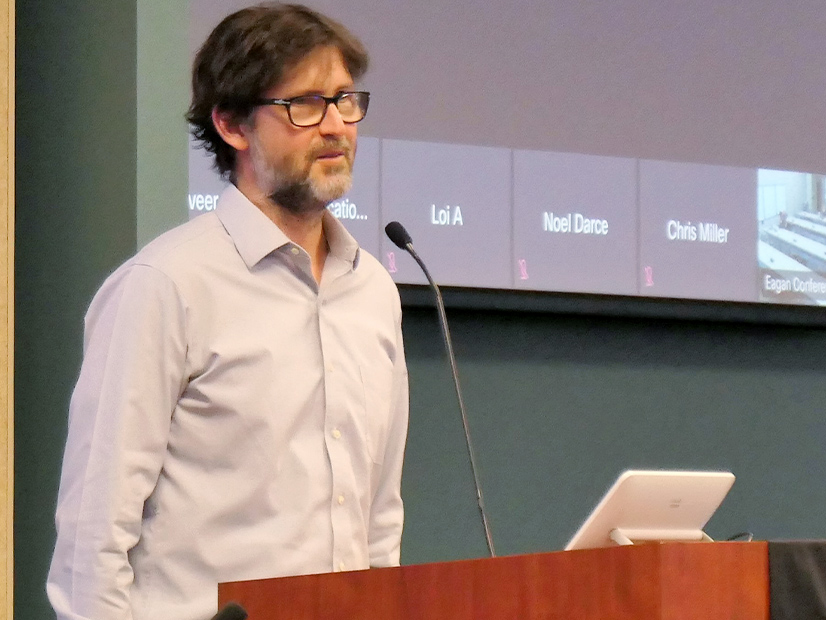
At a July 9 Resource Adequacy Subcommittee meeting, MISO said it would make a few changes from when it announced its plan about six months ago. Now, it plans to use different demand hours that determine the allocation and keep those hours in place for three years at a time in a bid for the allocation to be more stable for LSEs’ resource planning.
MISO assigns its LSEs a portion of its overall planning reserve margin requirement (PRMR). Today, the grid operator divvies up the PRMR based on LSEs’ 50/50 load forecast for MISO’s coincident peak. MISO said because of shifting and growing risks to the system, its reliability requirement should be reallocated among LSEs based on periods that contain the highest reliability risks. MISO previously said there’s a mismatch between LSEs’ obligations and the load LSEs are consuming at the times of greatest need on the system.
MISO Market Design Economist Bill Peters said though MISO needs to change the responsibility of each of the LSEs because risk is shifting, it also needs to respect that LSEs “need stability and a way to plan” with a somewhat stable PRMR allocation year over year.
MISO is reassessing its PRMR allocation partly because it moved to an availability-based capacity accreditation based around risky hours, not peak load. Peters called reallocating the PRMR the “opposite side of the coin” to accreditation.
But MISO no longer proposes to use the same set of annual risky hours that it uses for its capacity accreditation, when resource availability is expected to be less than 25% of operating margin. Instead, it plans to devise what it calls “seasonal expected resource adequacy risk hours” that will be fixed for three years at a time. Peters said those hours still would ensure that LSEs furnish output during the times of greatest need.
MISO staff stressed that the seasonal expected risky hours would be different than MISO’s existing “resource adequacy hours,” or the anticipated risk periods that MISO deems critical for its availability-based resource accreditation.
The seasonal expected risky hours would be derived from an analysis of the past three years of historical resource adequacy hours. Peters said the analysis would examine how the hours are “trending and when are we seeing risk.”
Peters said MISO may consider updating the hours if “substantial changes” occur sooner than the three-year cycle. He said MISO would have to set criteria for what magnitude of change could trigger an update outside of the regular three-year cadence.
Peters said a MISO analysis of five years of data has shown that resource adequacy hours “slowly shift but remain relatively stable” year-over-year, making the three-year option viable.
Stakeholders asked if MISO expects the seasonal resource adequacy hours to change dramatically from one three-year set to the next.
“I expect some different hours in the next three-year iteration,” Peters said, but didn’t venture a guess as to what degree.
Peters said MISO no longer can portion out the PRMR based on a single annual peak demand period, as is done now.
“We have a lot of capacity availability while the sun is shining now,” Peters said. “The model is showing us we have problems when the sun goes down. That’s different than what we’re used to.”
MISO has about 14.5 GW of solar capacity and counting.
“Should your obligation be based on a peak period where the sun is shining and system risk is low? We think not,” Peters said.
Peters said the shared PRMR obligations are emblematic of the interconnected nature of the system and how “your actions affect everyone else.” He said the PRMR allocation exemplifies the Hawaiian word “kākou,” which expresses collective responsibility, or “we’re all in this together.”
Peters said MISO still needs to add historical meter data on demand reductions and behind the meter generation from LSEs to get the full picture of net settled load to provide allocation examples. He said without that information, MISO cannot allocate the PRMR properly.
Some stakeholders said MISO needed to collect that LSE-level data before proposing the new design.
Attorney Jim Dauphinais, representing multiple industrial end-use customers, said he had “serious concerns with the proposal” because it relied on too many hours —upwards of 500 in the summer based on MISO’s illustrative example — and didn’t appear to account for actions LSEs might take in emergencies or near emergency situations to cut back load.
“It seems like almost an overcompensation for the stability issue and dilutes the price signal of trying to keep load off of true loss of load risk hours,” Dauphinais said. He said he feared the proposal would eliminate the incentive to reduce load and warned that load that hasn’t shown up before on the system in certain hours could begin cropping up.
WPPI Energy’s Steve Leovy said MISO didn’t provide enough data to show that the PRMR allocation would give LSEs the steadiness they need to plan. He said he saw “nothing” in MISO’s proposal that would prevent an LSE’s obligation from jumping “four or five percentage points” from one year to the next.
“We’re getting way too ahead of ourselves without knowing what the results of this process would look like,” he said.
MISO’s Davey Lopez said MISO’s proposal is far from final. MISO said it hopes to file a new PRMR allocation for FERC approval sometime in early spring.
Dauphinais said MISO would be better off using an allocation based on demand during a few hours of net peak throughout the year rather than trying to tie the proposal loosely to RA hours.
Minnesota Power’s Tom Butz said MISO should ask itself whether it’s seeking to truly quantify risk or develop a “mechanism of math.”
“The chances of this being stable are really, really low,” Butz said.
MISO is collecting stakeholder opinions on its PRMR allocation blueprint; staff will return to the Resource Adequacy Subcommittee in August for more discussion.
At the April Resource Adequacy Subcommittee meeting, Public Utility Commission of Texas economist Werner Roth said the proposal might introduce “a ton” of complexity for little payoff.