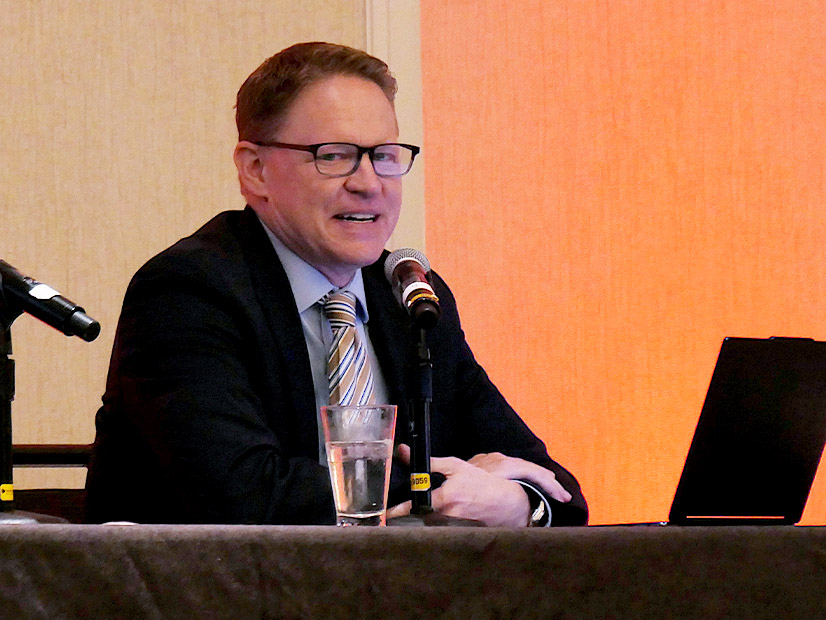
ROSEMONT, Ill. — MISO Independent Market Monitor David Patton addressed the recent controversy surrounding his longstanding criticism of MISO’s latest, $22 billion long-range transmission portfolio at the Organization of MISO States’ Resource Adequacy Summit.
Patton began a May 13 unscripted talk to regulators by joking that the “ominous” red light background on stage wasn’t doing him any favors. He told regulators that he was on their side despite some states being disappointed that he condemned many of the underpinnings of MISO’s second, $21.8 billion long-range transmission plan (LRTP) portfolio.
Patton said he was only trying to “weaponize the markets” to spur the most reliable and economic dispatch decisions while respecting states’ policies.
“By the way, I love transmission,” he joked. At another point, Patton teased that he “wasn’t allowed” to speak out on transmission planning, referring to MISO leadership asking FERC whether it’s appropriate for the IMM to analyze the value of proposed transmission portfolios in addition to markets. (See MISO Intent on Answers as to IMM Role in Tx Planning.)
Patton’s comments come about a week after MISO petitioned for the declaratory order with FERC (EL25-80). The RTO’s stakeholders are split on whether the IMM should independently assess the value of transmission projects. Patton continues to take issue with several of MISO’s estimates of the second LRTP portfolio, including its underlying capacity expansion modeling and the value of resolved reliability benefits, the amount of new generation that can be avoided and environmental benefits through the new transmission.
MISO anticipates a benefit-to-cost ratio of between 1.8:1 and 3.5:1 over the first 20 years of the LTRP projects’ lives through reliability improvements, production cost savings, capacity that won’t have to be built and environmental benefits. The IMM has pinned the value of LRTP II closer to a 0.3:1 benefit-to-cost ratio and has advocated for a condensed portfolio.
Patton said transmission planning and functioning markets are intrinsically linked and should be evaluated interdependently.
“We have to understand that when we make bad planning decisions, we undermine the market,” Patton told attendees. He again said the 20-year future MISO relied on to recommend the portfolio of mostly 765-kV lines is impractical and doesn’t represent the resource mix that will be built.
Patton said MISO is overbuilding the transmission system at the cost of the market incentivizing the construction of battery storage and developing other dispatchable technologies. It’s “very important” that MISO be realistic about the generation mix that’s on the horizon, Patton said, pointing out that many utilities remain committed to building new gas generation despite MISO allowing for very little in the future it used to plan the second LRTP.
“If we plan for a fictional system … we’re going to either pay higher costs or have an unreliable system,” Patton said.
In its filing, MISO asked FERC to “confirm” that the IMM’s “unsolicited transmission planning and monitoring activities are outside the scope” of its engagement rules with the IMM under its tariff and that it “has no obligation to reimburse Potomac [Economics] for such unsolicited transmission planning and monitoring activities at the expense of tariff customers.”
MISO’s Board of Directors in mid-February directed RTO leadership to freeze all payments to the IMM for work related to transmission planning.
MISO said its request did not preclude it from relying on an independent transmission monitor in the future. It also said it wasn’t seeking to “limit the activities of Potomac, such as participating in stakeholder processes, separate and apart from its role as the hired IMM for MISO.” Essentially, MISO said the IMM should size up transmission, pro bono and on the side as an interested stakeholder.
MISO said it needed to “remove uncertainty” around the IMM’s authority and figure out which services its customers should be paying the IMM for.
The grid operator ended by saying it plans to hire an independent, third party to assess the benefit estimates of future LRTP portfolios and the 20-year scenarios it devises to justify them.