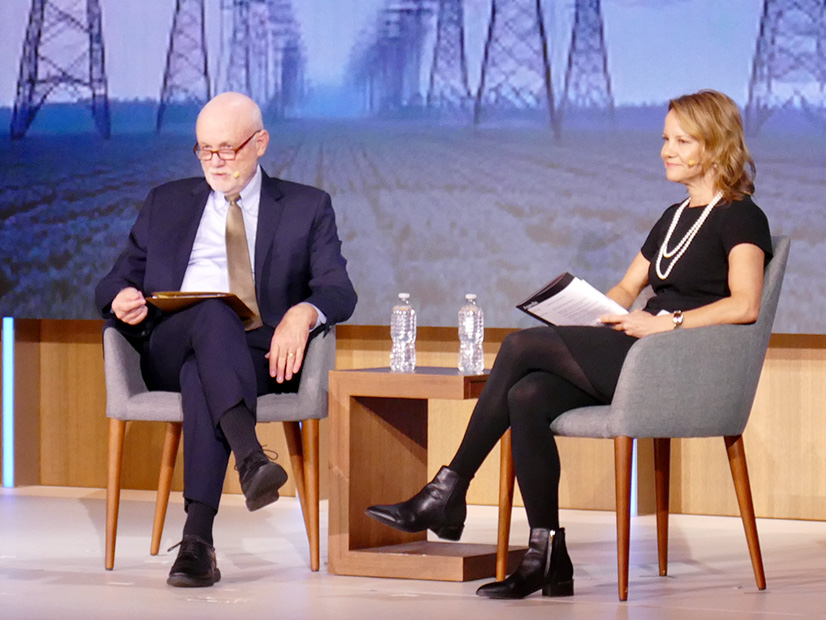
WASHINGTON — President Donald Trump’s policies and the growth in demand from data centers and other new customers have changed the trajectory of the power system, speakers said May 19 at the Energy Future Forum.
“Demand is going up, but we’re losing exactly the dispatchable resources that we need,” FERC Chair Mark Christie said. “Particularly we’re losing coal resources, and we’re losing some gas, and over the last 20 years, we’ve lost nuclear.”
The “reality that is tracking us down” is demand rising from data centers, manufacturers and other sources, while too many resources are retiring.
“And they’re not being replaced with sufficient dispatchable capacity,” Christie said. “So, it’s just arithmetic. You don’t need to be a Ph.D. in math to see the numbers are not adding up.”
FERC’s main role in dealing with that situation is regulating wholesale markets, which cover about three-fourths of the customers in the country, he said. It has a larger role in restructured states that have left their generation investment decisions largely up to those markets. “A lot of states effectively delegated their ability to determine their generation mix to these FERC-regulated markets.”
A key role for FERC as a regulator is to be a truth teller about the reliability issues facing those markets, he continued. The commission is holding a two-day technical conference on June 4 and 5 to detail the status of resource adequacy across those markets.
“One of the things that I really worry about is that we kind of continue to march down the path of removing diversity from the grid,” NERC CEO Jim Robb said.
While plenty of forensics remain to be done to determine the causes of the massive blackout in Portugal and Spain on April 28, Robb said a major factor in its size was the lack of traditional generation operating on their grid at the time, with 74% being inverter-based resources (primarily solar and wind).
The rest was hydro and natural gas, which provided some inertia that can help cushion the grid against frequency disturbances, but ultimately it was the “wall of inertia” from the French nuclear fleet that stopped the blackout’s growth, Robb said. Generators from across the Strait of Gibraltar in Morocco provided black start to bring back Iberia’s grid within a day.
While traditional generation helped bail out that blackout, Robb said some new inverters are capable of grid forming, and other technologies like flywheels and synchronous condensers can provide vital ancillary services too.
“Batteries can also kind of help on frequency response,” Robb said. “We’re seeing that in Texas right now. And the solar-battery combination is really a killer summer generating resource.”
Solar and batteries are a great pairing in regions with a lot of sunshine, with the best in the U.S. being Texas and the Desert Southwest. But the combination is not nearly as effective in the winter, only helping balance the grid a little.
“It’s kind of a horses-for-courses thing: Any one resource can be good for one thing, but not everything,” Robb said. “And that’s true of gas; it’s true of coal; it’s true of nuclear.”
Batteries also can help address the main issue of growing demand by helping balance the transmission system and adding flexibility to data centers without the emissions associated with more standard diesel backup generation, Eolian CEO Aaron Zubaty said. He brought up a Duke University study that has been making waves since its release this winter. (See US Grid Has Flexible ‘Headroom’ for Data Center Demand Growth.)
“We’re building a 2-GWh site right now in Texas, next to a retiring coal power plant,” Zubaty said. “We’re finishing multiple 1-GWh sites right now in Portland, Ore. These are designed to be locations so that you don’t need to rebuild transmission, and so that the grid runs more efficiently.”
Batteries can help all kinds of large, inflexible loads connect more easily to the grid by running during peak times, avoiding the need to expand the grid in order to keep them running. On top of data centers, Eolian also is working on projects with large industrial sites like aluminum smelters to accomplish the same thing, Zubaty said.
Eolian is focused on lithium-ion batteries because they have become commoditized, and their affordability is making longer-duration batteries more economic.
“When you can do eight and 10 hours — where, by the way, we can turn it on in 250 milliseconds — that is a very unique asset on the energy grid for all the reasons we heard earlier about reliability,” Zubaty said. “The combination of many, many hours of reliability plus instant response has pretty much never existed in the history of the grid at this scale.”
While renewables and storage continue to grow, the flow of capital in North America has shifted to natural gas and other traditional resources, 1PointSix CEO Terrence Keeley said. And it’s not just the U.S.
“It will be very interesting to watch the metamorphosis of Mark Carney as [Canadian] prime minister from central banker. We’re going to find that he’s much more interested in developing Canadian tar sands than perhaps he had been as a banker,” Keeley said.
Even with the Wall Street money flowing increasingly to other resources, renewables continue to grow. Keeley criticized language in this year’s budget bill on clean energy tax credits. (See House Committees Mark up Budget Bill that Guts Energy Tax Credits.)
“One of the big problems we’re having amongst Republicans is how quickly these incentives are going to be removed for renewables,” Keeley said. “Turns out they fought against the [Inflation Reduction Act] when it was going into law, but they’re now fighting to not take it off too quickly. St. Augustine needs to be called out, in light of our new pope: ‘God, grant me chastity, but not yet.’”
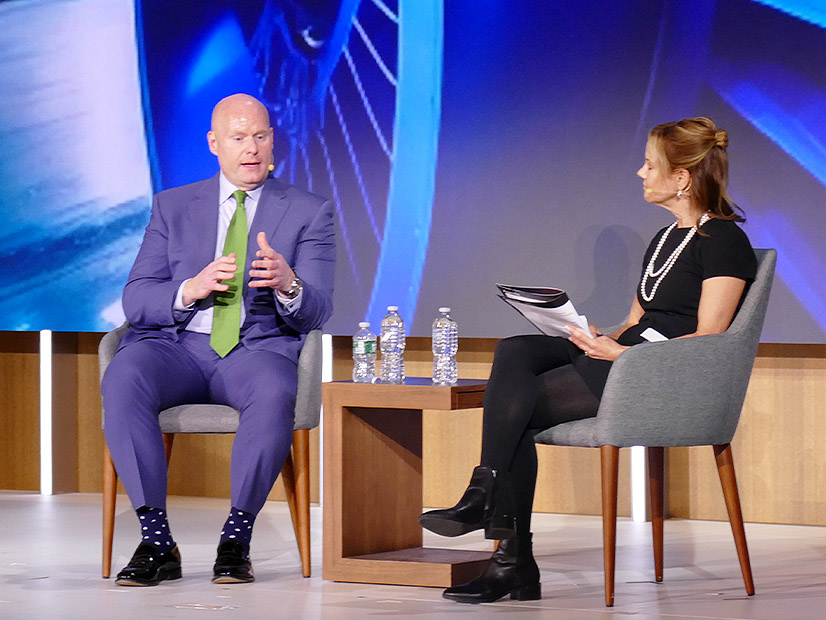
GE Vernova Gas Power CEO Eric Gray has seen firsthand the rise in demand for the turbines it manufactures as industrialization, data centers and electrification are growing its orders.
“Given the fact that gas turbines can be installed in a relatively short period of time versus some of the other technologies out there, gas is a good solution to what we need today,” Gray said.
As recently as late 2023, GE Vernova could have fulfilled an order for a turbine in 12 to 18 months. If one is ordered today, it will not be delivered until 2028. The company is responding to the uptick in demand with $600 million overall invested this year, including $300 million in gas.
Part of that money is going is going to its manufacturing plant in Greenville, S.C., where it is installing 500 new pieces of equipment in a bid to make the facility efficient and capable of producing more turbines. The investments are expected to grow the firm’s production capacity by 35%, Gray said.
Domestic demand has been constant for about 12 months. Before that, the firm was seeing more orders from Southeast Asia, Taiwan and Saudi Arabia, he said. Another wrinkle is Trump’s tariffs, but Gray said they’re not having much of an impact on business.
“If you fast forward to tariffs, as we said publicly, around 5% of our spend comes from China, Mexico and Canada,” he added. “It’s definitely not immaterial, but it’s something that we’re working our way through. The conversations we’re having with our customers today — obviously, having an increase in price changes the economics that they thought they were underwriting, but the fact of the matter is that the demand is still there. We need the electrons, so they’re being somewhat accepting of the tariffs and the price increases that they’re seeing as a result.”
The forum was sponsored by the National Center for Energy Analytics, RealClearEnergy and the U.S. Chamber of Commerce.