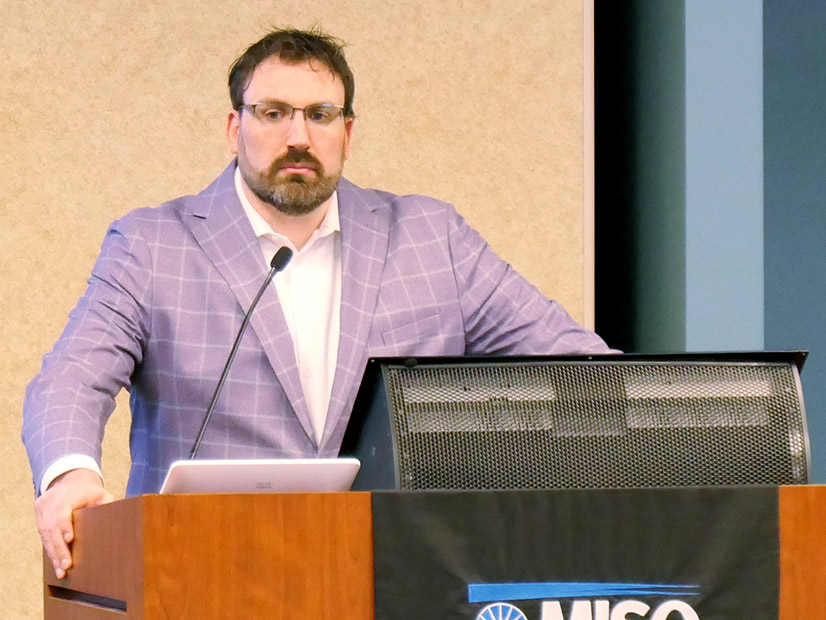
MISO said starting with the 2026/27 planning year, it will require its demand response resources to demonstrate actual demand reductions through tests to weed out imposters in the capacity market.
“We need to see everyone perform a real power test,” Joshua Schabla said during a May 21 Resource Adequacy Subcommittee meeting.
MISO said requiring real power tests with actual load cuts decreases the likelihood that resources fraudulently register in capacity auctions. MISO currently allows its demand response fleet to submit mock tests or opt out of testing. Under the new regime, real power tests would be required annually for at least one hour. Exceptions would be limited to trusted performers with a history of responsiveness and overrides because of state regulations.
Schabla said the last time load-modifying resources were deployed was Dec. 22, 2023, long enough to need renewed proof that the resources can discount load levels.
MISO said it would file the changes with FERC at the end of May for a June 1 go-live date. The grid operator said the “rapid” deadline would ensure all demand resources have the summer to perform a test in preparation for the 2026/27 planning year.
MISO would permit waivers of testing requirements only in two limited circumstances: when a test is precluded by regulatory restrictions, or when a resource requesting a waiver hasn’t amassed any penalties in the past three planning years, hasn’t changed its registered value in the past three years and — also in the last three years— has made at least an 80% reduction of the maximum accredited value it has requested for the upcoming planning year.
Schabla said testing waivers should be reserved for resources that have shown to be “solid” through scheduling instructions or MISO-initiated tests.
MISO also plans to stop letting aggregated demand response drop to a firm service level for testing. The RTO’s pending demand response accreditation filing before FERC similarly cuts the firm service level-reduction option for aggregations. Schabla said “gaming opportunities are substantial” when aggregated resources can specify a firm service level baseline.
MISO recognizes two types of demand response: those that make megawatt reductions and those that drop to a predetermined firm service level.
The stricter testing is part of MISO’s larger reining in of demand response following a handful of FERC investigations and findings that companies have manipulated the capacity market. MISO in March proposed an overhaul of its capacity accreditation methods for demand response that would be based on whether they can help during system risk. (See Stakeholders Ask FERC to Soften MISO’s Proposed DR Accreditation.)
A few months before its April capacity auction, MISO said it would hold its demand response to heightened testing requirements. (See Following DR Exploitation, MISO Announces Stiffer Requirements Before Capacity Auction.) The new tariff filing would solidify the change going forward.
MISO’s Independent Market Monitor recently predicted more enforcement actions from FERC on the horizon for bad actors among MISO’s demand response fleet. During the Organization of MISO States’ Resource Adequacy Summit in May, Patton said a planned data center has been collecting demand response payments even though its construction location remains an empty field. (See “IMM: Problem Remains with ‘Not Real’ DR,” MISO CEO: Slim Reserves Not Necessarily Bad.)
Schabla read from lines from recent FERC orders levying penalties on companies that have offered phantom demand response to prove the point that MISO needs stricter testing requirements.
“I hope you can agree with us that we need to put in controls today” that demand response resources can prove they can reduce demand, Schabla said. He said it’s “clear we need to act, and we need to act fast.”
MISO said the “lack of a real power test was specifically cited in several recent FERC orders and stipulations as helping to perpetuate the fraud.”
For the 2025/26 planning year beginning June 1, MISO said it cleared about 3.7 GW of demand resources that waived the requirement to perform a real power test.
Under the upcoming summer clearing price of $666.50/MW-day, the grid operator said a 10-MW demand resource can expect to be compensated $613,180 over the season.
MISO said, in total, auction revenue this year for demand response resources that have waived a real power test is about $282 million.
“There’s a great deal of money to be made in our capacity market,” Schabla said. He added that it’s appropriate for demand resources to flock to MISO’s market to offer their capabilities but, “if we’re going to pay that much money, it has to be real.”
Schabla said MISO is looking for “reasonable requirements, reasonable barriers” when attracting demand response, although he admitted nothing would be a “panacea” that would completely defeat fraud.