FERC is resolute in its support of MISO’s annual megawatt cap in its generator interconnection queue.
FERC is resolute in its support of MISO’s annual megawatt cap in its generator interconnection queue.
The commission rejected rehearing requests that framed the queue cap as discriminatory, preferential and riding roughshod over state authority (ER25-507).
FERC in late January gave MISO the go-ahead to impose an annual megawatt cap on the generation applications it accepts in its interconnection queue. The cap limits megawatt values of queue cycles to 50% of MISO’s non-coincident peak among its five study regions. (See FERC Approves Annual Megawatt Cap for MISO Interconnection Queue.)
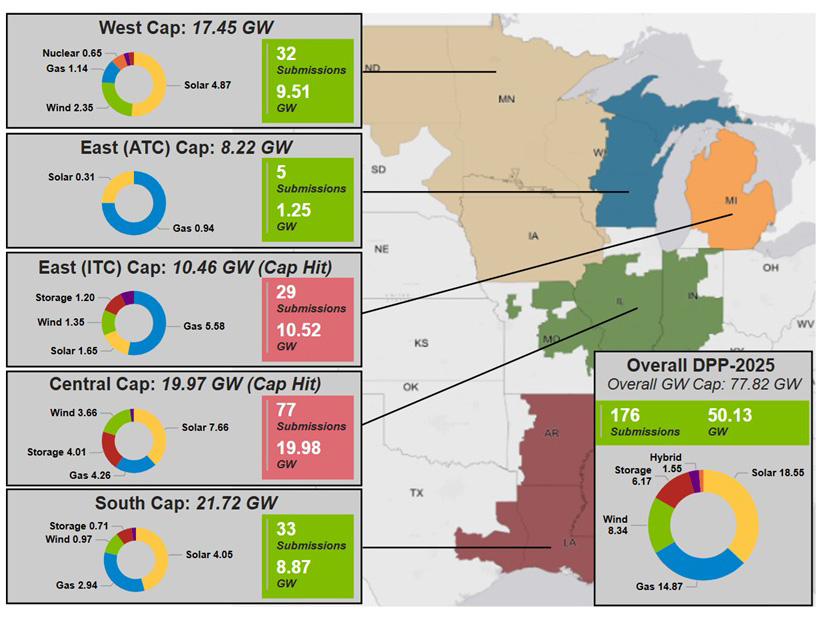
Two study regions — East and Central — already have exceeded their megawatt caps for the 2025 cycle. Across all regions, MISO has a 77.82-GW cap for the 2025 cycle. As of mid-May, it has fielded 50.13 GW across 176 submissions.
MISO South regulators in early March asked FERC to reconsider its approval of MISO’s queue cap. Led by the Mississippi Public Service Commission, regulators argued the cap needs an exemption for state-designated necessary resources. They asked FERC to backtrack and either reject MISO’s plan or condition it on MISO including an exemption for the states, saying the MISO plan tested the very limits of cooperative federalism.
In its May 27 order, FERC decided it didn’t transcend its statutory authority and infringe on state jurisdiction by allowing the queue cap, even though the cap will have “incidental effects” on state jurisdiction. It said the Supreme Court already decided those inadvertent encroachments are of no legal consequence. FERC also said that despite Southern regulators’ prerogatives, the commission is allowed to consider “resource adequacy concerns in exercising its jurisdiction.”
FERC also said it judged the queue cap plan as fair and reasonable without the state exception and would not order MISO to include one.
Clean energy groups also argued against FERC’s acceptance of the cap. They said FERC should reconsider because MISO didn’t have a strong rationale for the cap and said the cap itself will introduce undue discrimination and preference among developers vying for a spot on the MISO grid.
FERC disagreed with the groups, who said that in accepting the cap, the commission abandoned standardized generator interconnection processes established under FERC Order 2003. FERC said the clean energy groups should have raised the argument sooner in proceedings but said “in any event,” the queue cap followed Order 2003’s “recognition of independent entity variations for RTOs/ISOs.”
FERC also said it found nothing amiss with MISO’s first-come, first served aspect of the cap to determine cutoff points. The commission disagreed with the groups that argued prioritization could create an unfair environment by incentivizing projects to line up for exploratory or speculative positions. Instead, MISO ultimately would study submitted interconnection requests as part of a cluster. FERC said projects that entered too late to beat the cap simply would be subjected to a later cluster of projects.