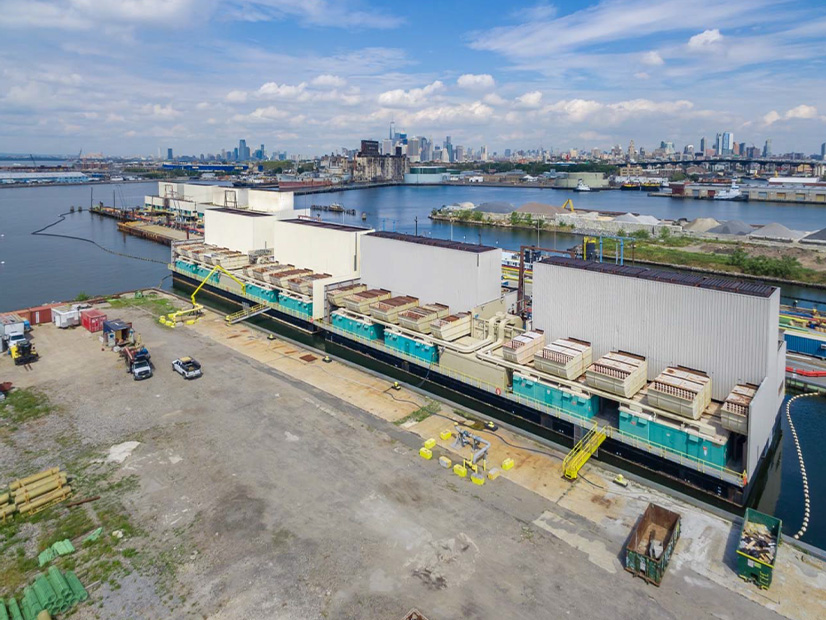
Amid increasing demand and dwindling supply, repowering aging fossil plants would help maintain reliability while still lowering emissions in line with New York’s climate change policy goals, NYISO argues in its annual “Power Trends” report.
Amid increasing demand and dwindling supply, repowering aging fossil plants would help maintain reliability while still lowering emissions in line with New York’s climate change policy goals, NYISO argues in its annual “Power Trends” report, released June 2.
Repowering, or retrofitting, older units “can offer a bridge between old and new, the past and the future,” the ISO says. “Upgrading our existing fleet not only can help with a stepped approach to carbon reductions by replacing older, dirtier turbines with new, cleaner cutting-edge technology, it also holds the potential for helping avoid future generator breakdowns, therefore bolstering grid reliability.”
Much of the report repeats the same concerns as in the past few years: not enough renewables coming online to replace retiring fossil-fired plants, with large new loads being added to the grid at an accelerating pace.
“The grid is undergoing rapid and instrumental change,” NYISO CEO Rich Dewey said in a press release announcing the report. “We continue to observe declining reliability margins while forecasting a dramatic increase in load. It’s imperative during this period of transition that we maintain adequate supply to meet growing consumer demand for electricity.”
The ISO lists examples of repowering for different fuel types; for example, for wind resources, “replacing turbines with greater capacity or upgrading older blades with more efficient technology can improve energy yield.”
But it also notes elsewhere in the report that about 25% of New York’s total capacity consists of fossil fuel plants that have been operating for more than 50 years.
“As these fossil fuel generators age, they are experiencing more frequent and longer outages,” NYISO says. “Greater difficulties in maintaining older equipment, combined with the impact of policies to restrict or eliminate emissions, may drive aging generators to deactivate, which would exacerbate declining reliability margins.”
It goes on to say that “only New York’s existing fossil resources and certain hydro generators deliver the full array of services needed to balance a dynamic grid. Despite the need to reduce fossil fuel use to meet the state’s emissions-reduction targets, some level of fossil-fired generation will be needed for reliable power system operations until the capabilities they offer can be provided by other resources.”
But the NYISO Market Monitoring Unit noted in its State of the Market report for 2024 last month — and as New York regulators have acknowledged — development of new renewable and storage resources is severely lagging the state’s targets. The Climate Leadership and Community Protection Act (CLCPA) required a 70% clean generation mix by 2030, a target officials have admitted likely already is out of reach. (See N.Y. Moves to Boost Lagging Clean Energy Development.)
“While over 14 GW of Tier 1 awards have been announced under the [Clean Energy Standard], just 9% have entered service, while 61% have been canceled, and most of the remainder have not yet moved forward with construction,” the MMU wrote. Among the reasons listed for the delays and cancellations are weak nonperformance penalties, giving developers increased incentive to submit more aggressive bids. “Consequently, awards are more likely to go to projects that are relatively unlikely to be constructed.”
The report “clearly demonstrates that the time for state action is now,” Gavin Donohue, president of the Independent Power Producers of New York, said in a statement. “Energy consumption will continue to increase as New York strives to achieve its electrification goals, and that will require a diverse energy portfolio, as well as modernized generation units. This report further proves that the aging units and repowering opportunities need to be addressed as they are critical components of New York transitioning to a cleaner energy future in a reliable, affordable and responsible fashion.”