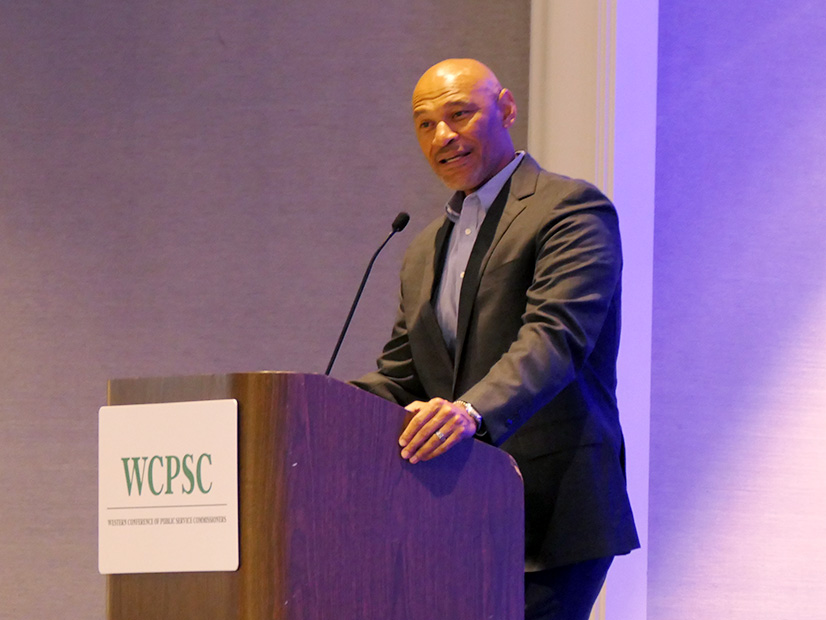
BPA CEO John Hairston’s keynote at the annual meeting of the WCPSC spotlighted a theme that would dominate discussion at the event: the looming prospect of overwhelming growth in electricity demand in the West and across the U.S.
PORTLAND, Ore. — Bonneville Power Administration CEO John Hairston’s keynote at the annual meeting of the Western Conference of Public Service Commissioners spotlighted a theme that would dominate discussion at the event: the looming prospect of overwhelming growth in electricity demand in the West and across the U.S.
Hairston’s core message: Utility planning practices must change to deal with what’s on the horizon.
“Current grid practices were designed for low growth that was more predictable and gradual, but I think you all understand that those days are over today,” he told the audience of Western regulators and power industry stakeholders.
Hairston said transmission providers have been “flooded” with interconnection requests that would require developing new infrastructure to serve “power-hungry” data centers or connect new generators to the grid.
Requests for new service in BPA’s territory exceed the entire Northwest’s current peak load, he said.
“In BPA’s experience, our processes have been overwhelmed by transmission service requests or duplicative and speculative projects,” he said. “The reality is, it is not easy to plan for transmission grid advancement around prospective data centers or generators that may never come to fruition, and the volumes that we’re seeing is just simply too big for our models to handle.”
Hairston said the agency sees the need for a “new planning paradigm” and is “rethinking” its transmission planning processes and working with its utility customers to identify new approaches by the end of the year.
“BPA understands that time is of the essence. We have an ambitious timeline for establishing transmission planning reforms. It’s my expectation that by November, we will have developed a solution that will allow us to move ahead with studying requests in our current transmission service queue. That’s all 65,000 MW of that,” he said.
Hairston also pointed to a key challenge the agency — and the industry in general — faces in addressing interconnection queues: a shortage of staff to do the work.
In BPA’s case, staffing issues were exacerbated by the Trump administration’s actions earlier in 2025 to reduce the size of the federal workforce, which resulted in many agency employees taking “deferred resignation” buyout packages. (See BPA to Restore 89 ‘Probationary’ Staff, Agency Confirms.)
“At Bonneville, our critical functions are being met, and the lights will continue to stay on, but with fewer resources, there will be impacts, and workforce needs could potentially slow our progress toward greater expansion,” Hairston said.
The issue has been compounded by a federal hiring freeze, but Hairston said he’s “hopeful” about the agency’s “prospect of regaining our hiring authorities.”
“The Department of Energy recognizes the vital role that BPA plays in supporting our nation’s grid and is committed to ensuring that we have the staffing that we need to execute on our mission,” he said.
‘Collaboration was Key’
Hairston’s speech notably omitted mention of a subject that’s consumed the attention of many Western stakeholders for the past two years: BPA’s much-awaited decision in May to join SPP’s Markets+ rather than CAISO’s Extended Day-Ahead Market. (See BPA Chooses Markets+ over EDAM.)
Critics of that decision contend it will prevent the Western Interconnection from developing the kind of single electricity market necessary to take full advantage of the region’s resource and load diversity, thereby maximizing the use of non-emitting renewable resources. The “seams” between Markets+ and EDAM will impede the coordination required to do that, they argue. (See Debate Lingers After BPA Day-ahead Market Decision.)
Throughout BPA’s day-ahead decision-making process, BPA staff have expressed confidence in the ability of the agency — and SPP — to manage energy transfers across seams based on its own history of doing so within the Northwest.
Hairston’s speech appeared to pick up on that line of thinking, if obliquely.
“On paper,” he said, the Western Interconnection might look fragmented to many, divided into multiple balancing areas “that operate and plan for the future of the grid independently.”
“But that doesn’t mean that we work in silos,” he said. “We understand that reliability and efficient operations require a lot of coordination. In fact, if you look back over the history of the Western Interconnection, it’s safe to say that collaboration was key to almost every major advancement that we’ve had.”
Hairston also pointed to historical efforts to share resources across the West, including development of what now is known as the Western Power Pool, which in recent years has led development of the Western Resource Adequacy Program (WRAP), which will provide a mandatory RA framework for participants in Markets+.
“Essentially, the program addresses the segmentation in the region where multiple utilities could be counting on the same power during the same time, which may not be available in the market,” he said. “Now, with all members using the same resource planning methods, WRAP provides greater assurance of maintaining region-wide reliability.”
Without naming the market, Hairston’s speech appeared to refer to one of the key challenges facing Markets+: the lack of transmission connecting its non-contiguous footprint, spread across discrete pockets in the Northwest, Desert Southwest and Colorado.
In speaking about BPA’s proposed interregional transmission projects, he called out plans for a possible line that would run from Central Oregon to the Nevada-Oregon border, “opening an opportunity for a southern partner to take it from that point, enabling energy transfers between the Pacific Northwest and the Desert Southwest.”
“And while I’m encouraged and hopeful about our prospects, I’m clear-eyed about the obstacles that we face. Among them is the challenge of making significant infrastructure investments while preserving affordability,” he said.