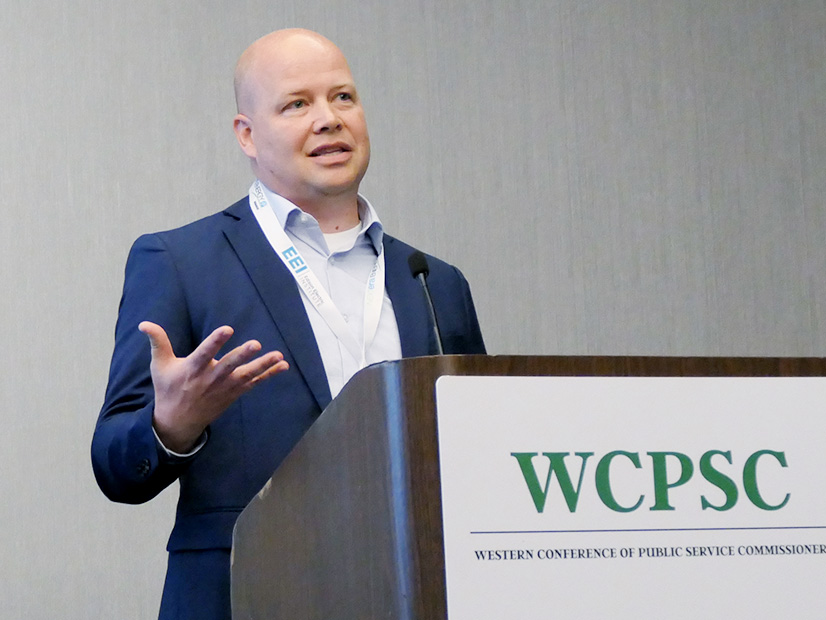
Panelists at the annual meeting of the Western Conference of Public Service Commissioners emphasized the need for innovative regulatory frameworks in order to keep up with new technology seeking interconnection.
PORTLAND, Ore. — Panelists at the annual meeting of the Western Conference of Public Service Commissioners emphasized the need for innovative regulatory frameworks to keep up with new technology.
Jay Griffin, senior adviser at the Regulatory Assistance Project and former chair of the Hawaii Public Utilities Commission, said electric industry participants in the U.S. should look to their counterparts in the United Kingdom.
After having visited the U.K., Griffin said, “one of the striking things there was how much quicker the pace of interconnection is for large loads and generation resources.”
Griffin made the comments at a panel discussion on technology adoption rates and regulatory reform during the WCPSC session June 2.
Griffin noted the U.K. has leveled the playing field of interconnection in part by having an open-source map that updates real-time capacity throughout the entire network and by making the pre-application connection assessment easier through a publicly available web app.
“They’re bringing resources online much faster,” Griffin said. “The tradeoff there is some level of curtailment over time, but that’s in exchange for bringing projects online years faster.”
Another key to the puzzle is that the U.K. uses performance-based regulation (PBR), according to Griffin.
PBR is a way to align utility incentives with the interests of customers and society. Traditional regulation pays utilities for what they build, while PBR focuses on what they achieve, according to a report issued last year by RMI.
PBR still is in the “nascent phases” in the U.S. — and in the Pacific Northwest, said Lauren McCloy, policy director at the Northwest Energy Coalition.
Still, the fact that PBR is being discussed as a way to address public needs and bring new technologies online is encouraging, McCloy said.
To implement PBR in the U.S., regulators should start “with a broad-based conversation about what are the policy goals that we’re trying to achieve,” according to McCloy.
“What are the technologies that are available to try to achieve that? And then, what are the incentive structures within cost of service-based regulation and maybe, you know, other frameworks that we could adopt to make that technology both more accessible, more transparent and deliver more benefits to customers.”
However, Elliott Nethercutt, senior director of state regulatory affairs at the Edison Electric Institute, urged caution.
Nethercutt said the existing regulatory framework is designed for reliability and affordability.
“I think that we got to move faster, but we don’t want to throw out the baby with the bathwater,” Nethercutt said. “We just need to see how we can make things … work and move a little more efficiently.”
Pilot programs, future test years, cost trackers and multiyear plans, among other alternative approaches to regulation, “can really move things faster and really meet the needs of electric companies and their customers in an era of rapid load growth,” according to Nethercutt.
Risks of Inaction
In a separate panel, Michele Beck, executive director of the Utah Office of Consumer Services, similarly stated that the industry must take a cautious approach when implementing new technology and updating planning processes.
“I understand there’s new times, and we need new solutions, but … the solution is not to put risk on customers,” Beck said.
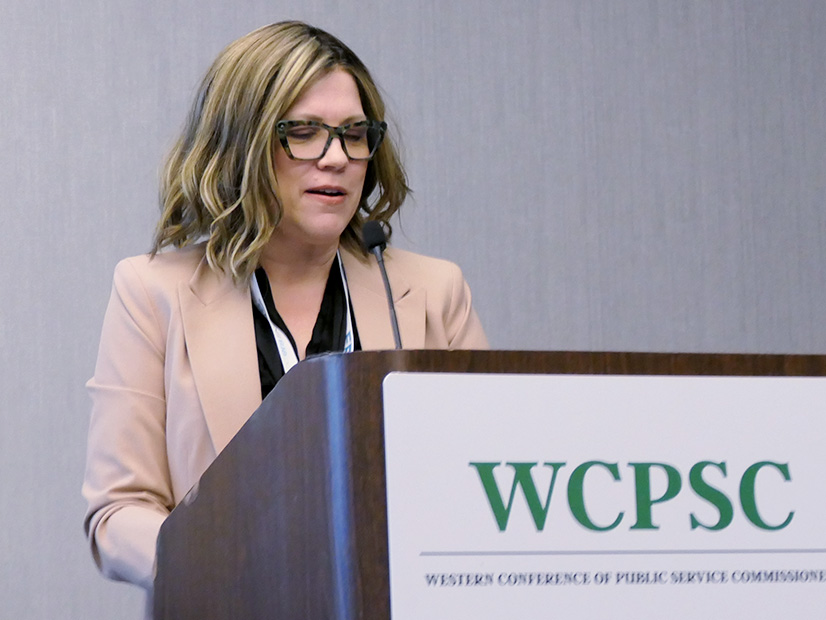
Beck also noted “maybe we need a pilot program” to temporarily step outside the current “least-cost, least-risk paradigm.” This would allow regulators to look at cost allocations and augmentations to planning processes “to make sure that we’re treating all the resource types fair,” Beck added.
Meanwhile, Mark Thompson, a former Oregon utility commissioner who now is Form Energy’s senior director of state affairs, said while it’s a fair question to ask about the risk to ratepayers, regulators also should ask “what are the risk of not doing a new technology?”
“If the future is very different from the past, and we see all these constraints, and we have new challenges, and we have a new need for resources, there’s significant risk for ratepayers of never figuring out the new technology,” Thompson said. “These new technologies need a pull from the market. They need a pull from utilities who are willing to be partners, and they need a pull from regulators saying, ‘we’re willing to try something with you. Let’s figure out what it is.’”