The Edison Electric Institute’s annual conference and thought leadership forum featured numerous discussions on the industry's ability to meet the explosive demand without sacrificing reliability and affordability.
NEW ORLEANS — The 1,300 attendees who gathered in the Big Easy for Edison Electric Institute’s recent annual conference and thought leadership forum had little time for the city’s 24/7 nightlife.
They had a problem to solve: how to meet the biggest surge in demand since the post-World War II boom without raising prices for their customers.
Incoming EEI Chair Calvin Butler, Exelon’s CEO, said during the June 2-4 conference that the industry stands at “an exciting crossroad.”
“New challenges, historic levels of investment and burgeoning technologies like artificial intelligence are redefining America’s energy future,” he told the membership. “I look forward to working with EEI and its member companies to ensure that we continue to meet the evolving needs and expectations of our customers, while at the same time working to keep their bills as low as possible.”
“This is a remarkable time for our industry,” said Butler’s predecessor, Portland General Electric CEO Maria Pope, in opening the conference. “The extraordinary, once-in-a-generation demand for electricity is real, and it is here now.”
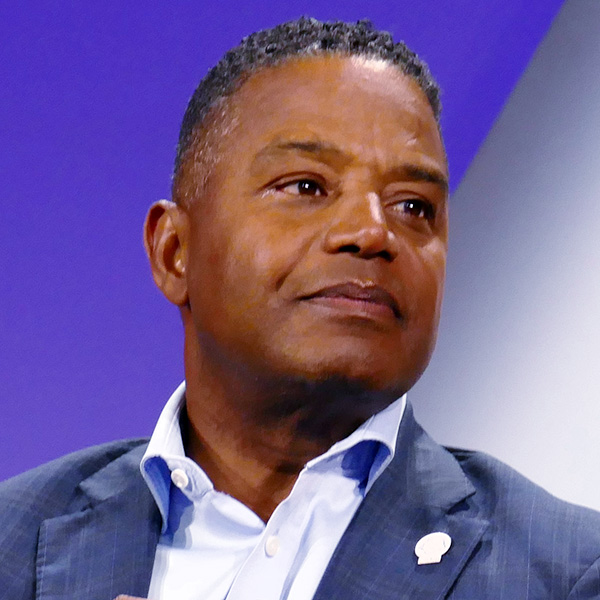
“It is remarkable the amount that we have invested in new technologies and resource adequacy,” she added. “We have seen our grid change at a pace and level that we have never seen before. We need to figure out how to get more out of the system while thinking differently.”
The U.S. Energy Information Administration said in January that the nation’s electricity consumption grew by 2% in 2024 and will continue to grow at that rate in 2025 and 2026. It will be the first three years of consecutive growth since 2005-2007, with much of the demand coming from battery manufacturing operations and data center consumption.
One of the key questions, of course, is how much of that demand will actually show up — that and whether there will be enough resources added to the grid in time to meet the demand. (See related story, FERC Dives into Thorny Resource Adequacy Issues at Tech Conference.)
“This is the question I was waiting for,” Amazon Web Services’ Vibhu Kaushik said during a panel discussion on increasing capital deployment to meet new demands from data centers, advanced manufacturing, electrification and large resilience programs.
“We’re all here together, and we are excited because this demand growth is real,” he said. “So why is the demand increasing? It’s increasing because customers today are using more technology than ever before. So yes, demand growth is going to go up.”
Asked the same question, Allen Otto, managing director of power, energy and renewables for Guggenheim Securities, said, “Nobody really knows, right?”
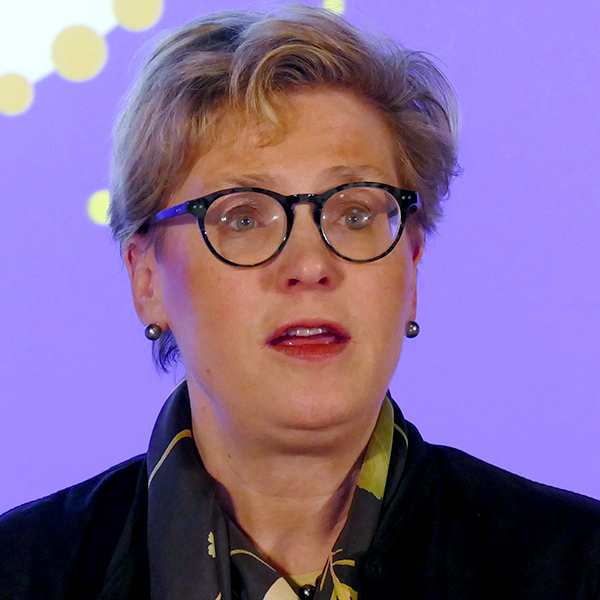
“Where we get concerned is not actually developing the assets to where we can unlock the economic potential that we have a number of industry areas,” he said. “There are a number of projections that are out there, and at the high end, they are 4% year-over-year power demand growth for all those reasons that we’re now familiar with. Even if it’s half that, it’s massive. It’s massive, and part of the issue is if we don’t move now, we’re going to have challenges even getting there. We don’t know exactly what the demand is going to be, but we do know that if we don’t act now, we’re going to fall behind our global adversaries and our allies, right?”
Congested generator interconnection queues don’t help. A recent Enverus study found that in 2024, new projects had spent anywhere from 9.2 years (CAISO) to 3.8 years (ISO-NE) in the queue, an average of 6.2 years per grid operator.
“Why do we have 2.6 TW of generation, a lot of carbon-free energy waiting to be connected to the grid?” Kaushik said. “Carbon-free energy that can be built in 18 months is waiting for five to seven years to be connected to the grid. Demand that could be connected faster to serve customers for essential services is waiting to be connected. The grid should eventually be a plug-and-play platform for all customers and all generators.”
Jeff Bladen, energy leader for Verrus, called for building out the grid, noting “there is no future” in which the industry benefits without “actually building stuff.”
“I’m a sellout for building as much transmission as we can get approved. We’re going to have to build more generation, right? At some point, you have to make electrons,” he said. “What I like to tell folks is that it’s important for us to get the most out of the grid we have while we’re building the grid we need, right? If we’re building large loads that are actually assets rather than liabilities, those will be assets for a very, very long time.”
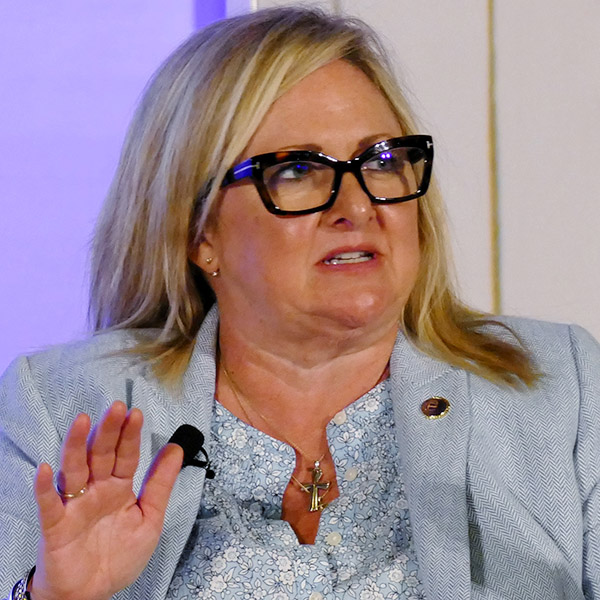
Tricia Pridemore, a member of the Georgia Public Service Commission, said meeting the demand is the topic of conversation among state regulators “morning, noon and night.”
She said her commission was first exposed to the concept of data center demand in 2023 — just as Georgia Power was bringing the Vogtle nuclear plant’s third and fourth units to the grid at an estimated cost of $30 billion, more than double initial projections.
“[They] said, ‘But wait. We need more energy.’ You can imagine the five elected regulators just laughing them out of the office,” Pridemore said.
But after getting into the integrated resource plan’s process and meeting customers, the commission approved an IRP with 7.1 GW of new capacity in six months. Pridemore said it was the first IRP docket specifically developed for data centers and onshore manufacturing.
“We have before us right now another 1,500 MW of new capacity,” she said. “We’ve developed a construct that gets these customers involved, that gives them a seat at the table, but most importantly, they’re paying for it. We’re constantly trying to build out this required and necessary infrastructure. … We’ve got to be able to rise to this occasion, but we can’t do it off the backs of our residential rate payers. All 50 states have seen rates increase over the last several years, so now’s the time for us to be creative as regulators.”
Pridemore found a friendly voice in Louisiana Gov. Jeff Landry. He called for a “recalculation” of the regulatory environment, given the potential billions of dollars in new generation for his state.
“That’s the problem that we have to solve: How do we meet the demand without laying it on the backs of the consumer?” Landry said.
Southern CEO Chris Womack said utility work has to change in a future where technology and AI are likely to play such a huge role. He said lessons learned will be important because “we’re doing some things we never had to do before.”
The industry will have to navigate its way through construction, permitting reform, “the chaos in D.C. … all kinds of the tariffs and trade and just so many external factors that are coming into play,” Womack said.
“We will do this, but I think it’s so important for us to really understand the reality of what we face, and the reality that’s in front of us is going to be incredibly different,” he said. “The technology is going to keep moving so incredibly fast, it’s going to make us incredibly uncomfortable. We’ve got to … be comfortable doing incredibly uncomfortable things. … We’re going to have to keep pressing forward to meet this moment, to meet the challenge that’s in front of us. And we will, but I think it’s going to be so incredibly important that we find a way to do this together, to do this collectively.”
Industry Faces Tariff Uncertainty
The administration’s global tariff war is complicating the electric industry’s efforts to meet historic levels of increasing demand. During the final day of the conference, the government doubled tariffs on steel and aluminum from 25% to 50%. For an industry that relies on steel and other metals to build its generating plants and infrastructure, the result is obvious.
“A lot of other things we can sort of mitigate, but we use a lot of steel,” Occidental Petroleum CEO Vicki Hollub said. “And so when we have a lot of steel tariffs, it can really impact our industry and our cost structure.”
Hollub said her governmental and regulatory staff have been unable to provide clear answers on what to expect out of D.C.

“For the first time in my tenure as a CEO, I’ve heard our government guy come to our board meeting and say, ‘I don’t know’ to more questions than [having] thoughts,” she said. “We just can’t forecast right now. We’re trying to come up with lots of scenarios and evaluate the possibilities that, clearly, the largest impact on us would come if the steel tariff were to stay high.”
“The elephant in the room is what’s going on with the tariff policy,” said incoming EEI CEO Drew Maloney. “Everybody you know wants to understand how that’s going to impact their businesses here and how that impacts our traditional trade partners … how that’s going to impact business and sort of watching to see what happens.
“As we develop this more of an America First policy, what does that mean for Europe? Is Europe going to do more manufacturing going forward? Are they going to sort of reshore their supply chain?” Maloney added, calling for global collaboration with global trading partners “because that obviously is going to impact our energy growth that we’re going to have here.”
Maloney was appointed EEI’s CEO in April, replacing interim CEO Pat Vincent-Collawn, effective July 1. Vincent-Collawn, CEO of TXNM Energy and its two subsidiaries in Texas and New Mexico, replaced Dan Brouillette when he stepped away from the organization in 2024.
Maloney brings with him decades of legislative expertise from working on Capitol Hill and maintaining relationships with key lawmakers for various organizations. He served in the Treasury Department during the first Trump administration and as chief of staff for the House of Representatives GOP leadership.
Growing up on a farm in the Shenandoah Valley also prepared Maloney for work in D.C.
“I had to get up really early in the morning to make sure that all the animals were fed,” he said. “I had to clean out the stalls — great preparation for working in Washington, because there’s a lot of stall-cleaning in Washington.”
The Benefits of AI
While the growing reliance on AI could result in data centers consuming up to 12% of the nation’s power demands by 2028, speakers from the high-tech sector stressed the benefits of working with the technology.
Victor Peng, the recently retired president of AI developer AMD, said he was impressed with his audience’s willingness and desire to “meet this special moment in time.”
“I’ve heard from everyone here how collaborative this industry is, and that’s critical,” he said. “It’s encouraging to see people committed to understanding how to support AI. Really, it’s more than AI. This industry touches everyone’s lives on a daily basis and in every facet. The positive thing about AI is that it will affect everything.
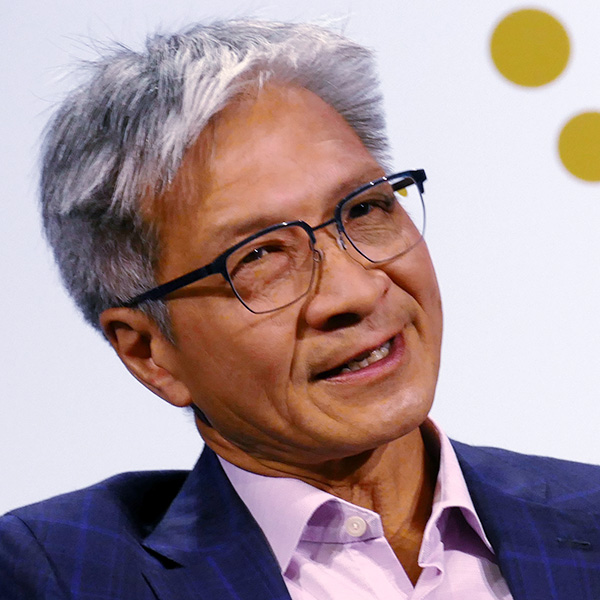
“You should feel comfortable that this is not a bubble. The demand is real, and it will last for a really long time. And the pace that it is expanding at is daunting.”
“I think anyone who reads history understands that adaptability and harnessing new technologies is really the difference between success and failure,” Oracle CEO Safra Catz said. “It is without a doubt the difference between success and failure for companies, and it truly is the difference for countries and entire civilizations. There is no question that harnessing AI is widely recognized as a technical matter and a national security matter.
“This is the moment we’ve all been waiting for, using data to get better information to really help you all run your business. So, this moment is very, very important, and it’s going to be a challenge for a lot of folks to make the bold decisions of how do they move their technology to the 21st century. We’re already 25 years into it.”
Pausing for effect, Catz said, “The time is now.”
New Leadership for EEI
EEI’s Board of Directors elected Butler as chair for the 2025/26 cycle. The board also elected Womack and Evergy CEO David Campbell vice chairs. All three selections are effective July 1.
Butler most recently served the institute as a vice chair. The EEI’s chair rotates annually.
The three chairs appeared on stage together before the membership June 3 to share their thoughts on the coming year. Campbell, a lifelong Dallas Cowboys fan now leading a utility headquartered on the Kansas-Missouri border, wore a No. 3 Philadelphia Eagles jersey with Butler’s name of it, much to the delight of Butler and Campbell.
“Many of you were coming up to me saying, ‘Hey, what’s up with David wearing an Eagles jersey?’” Butler said. “I said, ‘I don’t know. That’s just David being David, and I’m flattered.’”
It became obvious who was the loser of a 2025 Super Bowl bet. As a reminder, Butler’s Eagles had no trouble with Campbell’s adopted Kansas City Chiefs, 40-22.
“Why number three?” Campbell said he asked Butler. “He said, ‘Because that’s my favorite number.’”
“But what do Eagles do? You know what you have to do,” Womack said, flapping his arms and encouraging Campbell to sing the Eagles’ fight song, “Fly, Eagles Fly.”
Campbell declined. However, he did complete his losing wager with a robust and quick “E-A-G-L-E-S, Eagles!”, half-heartedly punching the air with his right fist.
“This is a devastating day for me,” he said.
Louisiana Gov. Ribs Entergy
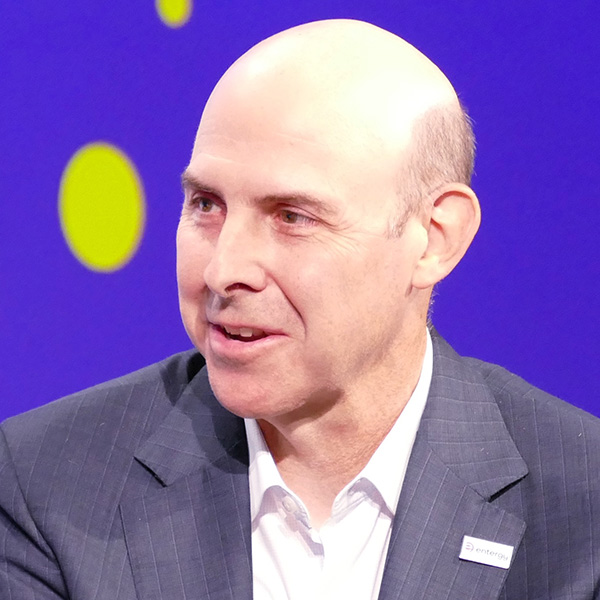
As the EEI’s host member, Entergy was given the honor of conducting the conference’s opening discussion, a conversation between its CEO, Drew Marsh, and Gov. Landry.
Entergy is seeking regulatory approval to build 2.4 GW of gas-fired power plants to service Meta’s massive data center in Northeast Louisiana. It’s about a $10 billion ask that also includes 100 miles of 500-kV transmission and eight 230-kV lines.
Marsh asked Landry whether the state can continue to attract large investments in the future. Given the opening, Landry responded without directly mentioning May’s load shed that knocked 100,000 Entergy customers offline. (See related story, NOLA City Council Puts Entergy, MISO in Hot Seat over Outages.)
“I mean, the question is, can y’all keep the lights on?” Landry said, drawing chuckles from the audience and a wan smile from Marsh.
Faces in the Crowd
Among the industry CEOs and regulators at the conference were former Louisiana Sen. Mary Landrieu, now a lobbyist but still exhibiting a master politician’s touch with reporters; former EEI CEO Tom Kuhn, now board chair for wireless communications company Anterix; PGE’s Pope chatting on the sidelines with Grid United’s Michael Skelly; industry consultant and Texas regulator Bob Gee, now a board member with the United States Energy Association; and Archie Manning, former quarterback for the New Orleans Saints and patriarch of the family’s quarterback dynasty, and his son Cooper, whose own football career was ended by a spinal condition.
The Mannings regaled their audience with their tales of Archie’s life in New Orleans and raising three boys who have quarterbacked four Super Bowl winners. Cooper’s son, Arch, is expected to be the NFL’s top draft pick should he leave the University of Texas early next year. By all accounts, Arch is just as grounded as his father and his more celebrated uncles.
“Clearly, I had an unbelievable mentor at home,” Cooper said, referring to his father. “I can’t tell you the number of times I’ve had to ask, ‘What would Dad do?’”
Archie, who was sacked 337 times during his 11-year career with the Saints (nine of which were losing seasons), told the story about being honored as one of the club’s 50 greatest players. During a banquet honoring the players, Manning, recovering from knee-replacement surgery, limped to the podium to say a few words. One of his “old” offensive linemen — “who, I assure you, was not one of the 50,” Manning said — offered to carry him up to the podium.
“I couldn’t help it. I said, ‘No, I don’t want to be carried, but if you and your buddies had blocked anybody out, I wouldn’t be like this,’” Manning said to laughter.
Edison International, Fortis Win Awards
Edison International and its Southern California Edison subsidiary won the 97th Edison Award for domestic companies and Canadian utility Fortis won the international Edison Award, presented annually during the conference.
Edison and SCE were recognized for the utility’s Advanced Waveform Anomaly Recognition system, which supplements advanced sensors and other applications already in service with state-of-the-art physics-based AI models and machine-learning technologies. The technology can help to identify and locate problematic equipment on SCE’s circuits before a failure occurs, mitigating outages.
Canadian electric holding company Fortis was honored for its Wataynikaneyap Power Transmission System project, the country’s largest Indigenous-led electric initiative. Fortis partnered with Wataynikaneyap Power and 24 First Nations communities to construct an 1,118-mile transmission line connected to 22 substations. The system connects 17 rural and remote First Nations communities to the Ontario provincial energy grid.
The Edison awards are chosen by a panel of former energy industry executives.