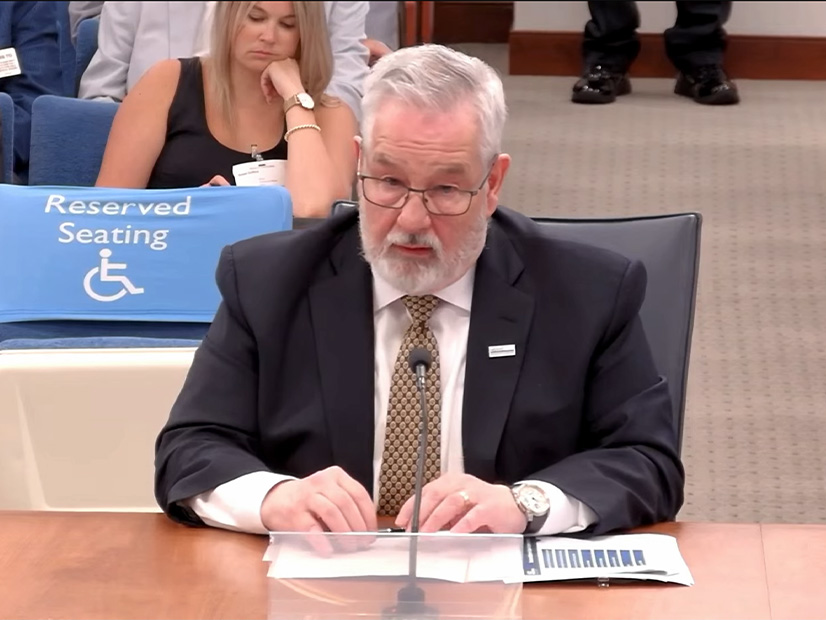
NERC Chief Engineer Mark Lauby told FERC commissioners that two recent reports on the Iberian Peninsula outages of April suggest the U.S. is “on the right track” regarding necessary steps to protect the grid from similar incidents.
Speaking at FERC’s monthly open meeting, Lauby reviewed the reports released June 17 by the Spanish government and June 18 by grid operator Red Electrica on the blackout that left the entire population of Spain and Portugal — as well as parts of France — without power for up to 18 hours. The reports concluded that traditional synchronous generation could not adequately control high voltage resulting from frequency oscillations on the grid. (See related story, Expert Says Spain Blackout Unlikely in U.S.)
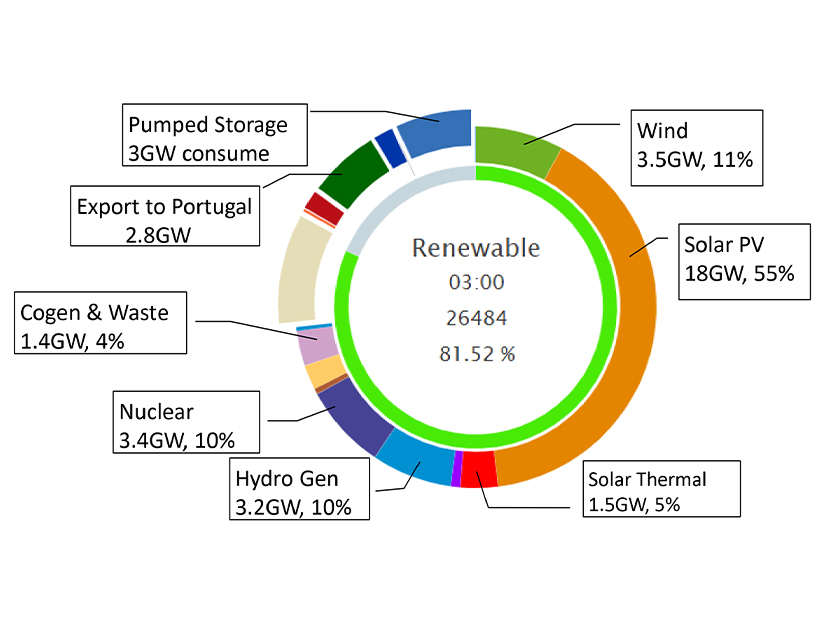
“Initial thoughts were that this event was maybe driven by reduced inertia or frequency ride-through,” Lauby said, referring to speculation in the days after the blackout that the high proportion of solar, wind and battery resources on the Spanish grid made it difficult for Red Electrica to manage the oscillations. “But it’s become clear — from the Spanish reports, anyway — that the challenge was the ability to manage the grid’s static and dynamic voltage.”
Reviewing the sequence of events, Lauby said the frequency oscillations began around noon April 28, first with local oscillations between the Spanish and Portuguese systems and then an inter-area oscillation that “raced … all across the continent.” Red Electrica activated its mitigation measures in response to the oscillations, after which voltage began to rise.
According to the government report, 11 thermal generation plants and an unspecified amount of hydraulic generation were available for voltage control at the time of the blackout. Spain’s electricity regulations do not allow renewable energy resources and battery energy storage systems to be used for voltage control. Red Electrica attempted to combat the voltage fluctuations with static reactive devices, which reduced system voltage but left the operator with less flexibility because of the stepwise “all-or-nothing” nature of the devices.
At 12:32:57, about 10 minutes after the voltage began to rise, 355 MW of generation of unknown type left the grid after a collector substation tripped offline due to overvoltage. Within the next 20 seconds, an additional 1.5 GW including four wind farms and four solar installations was lost. After another two seconds, as the Iberian grid began to lose synchronization with the rest of the European system, the AC lines between France and Spain were disconnected, and the Spanish and Portuguese systems collapsed at 12:33:24, less than 30 seconds after the initial generation loss.
Reviewing the recommendations in the Red Electrica and government reports, Lauby noted that several of them are measures that U.S. grid operators already are required to follow.
“Some of the standards we have in place, for example our voltage and reactive standards, along with FERC Order 827, ensure sufficient dynamic reactive support is planned and operated,” Lauby said. He noted that Red Electrica’s recommendation of a review of overvoltage protection settings is similar to efforts already underway in the form of a Level 3 alert approved by NERC’s Board of Trustees in May setting out essential actions regarding inverter-based resource performance and modeling. (See NERC Warns Summer Shortfalls Possible in Multiple Regions.)
Lauby also pointed out that unlike Spain’s regulator, FERC and NERC already require that all generation units capable of voltage regulation, including IBRs, provide such service. In addition, the reports mention tools like synchronous condensers, static VAR compensators and static synchronous compensators that already are present in the U.S. grid.
Asked by FERC Commissioner David Rosner whether the reports suggested any “gaps in [NERC’s] reliability standards” that could lead to similar incidents, Lauby said he didn’t see any “glaring gaps” but emphasized the importance of continuing to work with experts and equipment manufacturers to identify vulnerabilities.
Lauby also told attendees that the European Network of Transmission System Operators for Electricity, an association of 40 transmission system operators spanning 36 European countries, is preparing its own analysis of the Iberian blackout, to be released in September. He said NERC “will wait for that report to gain any [further] insights” into the incident.