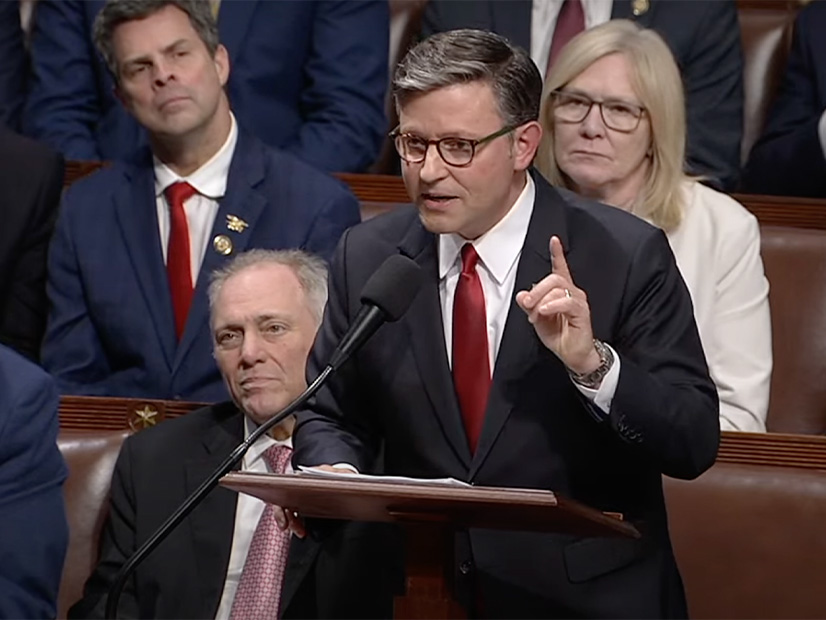
After it took Republican leadership most of the previous day cajoling its members, the House of Representatives on July 3 voted 218-214 to pass the Senate version of its budget reconciliation package, the One Big Beautiful Bill Act, just in time for President Donald Trump to sign it into law by his imposed deadline.
“The House has passed generational legislation that permanently lowers taxes for families and job creators, secures the border, unleashes American energy dominance, restores peace through strength, reduces spending more than any other bill has, and makes government more efficient and effective for all Americans,” Speaker Mike Johnson (R-La.) and other Republican leaders said in a joint statement.
The bill makes permanent tax cuts enacted during Trump’s first term and slashes federal funding, including on tax credits for renewable energy and other programs Democrats passed in the Inflation Reduction Act of 2022. (See related story, Senate Passes Trump’s Big Bill that Slashes Clean Energy Tax Credits.)
Republicans kept the voting open for hours to secure passage, which was delayed by a record-long speech on the floor by Minority Leader Hakeem Jeffries (D-N.Y.). The entire Democratic caucus voted against the bill, as well as two Republicans.
“Our House Republican colleagues, Mr. Speaker, have one last opportunity to join us … to stand up and protect the health care of the American people; stand up and protect the nutritional assistance of the American people; stand up and protect our farmers; stand up and protect our veterans; stand up and protect the clean energy economy; stand up to protect our public schools,” Jeffries said.
The clean energy provisions were highly criticized by trade groups representing developers and environmentalists, but the investor-owned utility trade group Edison Electric Institute said the bill had some benefits for its members, including lower corporate tax rates and interest deductibility, and supported some energy tax provisions.
“Our top priority is delivering affordable, reliable energy to hundreds of millions of Americans. We support the many provisions in the bill that help us achieve this goal and grow our economy,” EEI President Drew Maloney said in a statement. “We will continue to work with the administration and lawmakers to implement and develop policies to support energy infrastructure investment and keep customer bills as low as possible.”
Clean energy supporters said that with rising demand, the bill’s changes and cuts to tax credits for renewable resources will only raise prices for consumers.
“While the new policies are a step backward, the combination of surging demand for electric power and economic benefits of renewable energy technologies ensure that clean power will continue to play a significant and growing role in our nation’s energy mix,” American Clean Power Association CEO Jason Grumet said in a statement. “America’s electricity demand is projected to surge by as much as 50% by 2040. That growth requires every available source of reliable power, including the clean energy technologies that are the only shovel-ready sources of additional power and the low-cost option across much of the nation.”
While the two parties have now used reconciliation in recent years to enact major swings in clean energy funding, one area they have so far failed to move on is permitting reform, despite both sides of the aisle having support for the concept.
“Permitting reform can and should be a bipartisan focus for members in the coming weeks and months that remain in this Congress,” Americans for a Clean Energy Grid Executive Director Christina Hayes said in a statement. “America’s transmission grid is at a crossroads. No matter your politics, the reality is clear: Demand for electricity is rising. Whether that power comes from natural gas, coal, nuclear, wind or solar, none of it will reach homes, businesses or data centers without a modern, reliable and expanded transmission network. As technology advances, we must ensure our grid can keep up — or risk losing America’s dominance in the global competition for advanced manufacturing and artificial intelligence.”
The Clean Energy Buyers Association represents many of the big tech firms behind the surge in data centers and other large energy users whose total demand is bigger than any U.S. state. CEO Rich Powell saw mixed results in the bill and seconded the call for “fundamental reforms to our national permitting system.”
“We regret that the tax credits for solar and wind are being sunset at a difficult time when we need all energy options to support unprecedented electricity growth in America,” Powell said. “We do acknowledge and appreciate the work of President Trump and Congress in expanding the critical policies needed for clean firm energy, such as nuclear, batteries and geothermal, to support the next generation of carbon emissions-free energy resources. America’s energy dominance depends on our ability to lead in the technologies of the future and to continue to invest in all forms of clean energy.”
The Business Council for Sustainable Energy said the bill will hold the U.S. energy industry back, though renewables and efficiency should continue to grow in spite of it.
“Compared to earlier proposals, the final legislation provides a more workable transition for some energy businesses currently utilizing federal energy tax credits,” BCSE President Lisa Jacobson said in a statement. “However, it imposes many rapid changes to various energy credits that will cause uncertainty and increase energy costs. These provisions include consumer credits for energy efficiency and clean energy that help lower energy costs for families and businesses, make the grid more resilient, protect good American jobs and provide certainty for vital investments in the energy sector.”