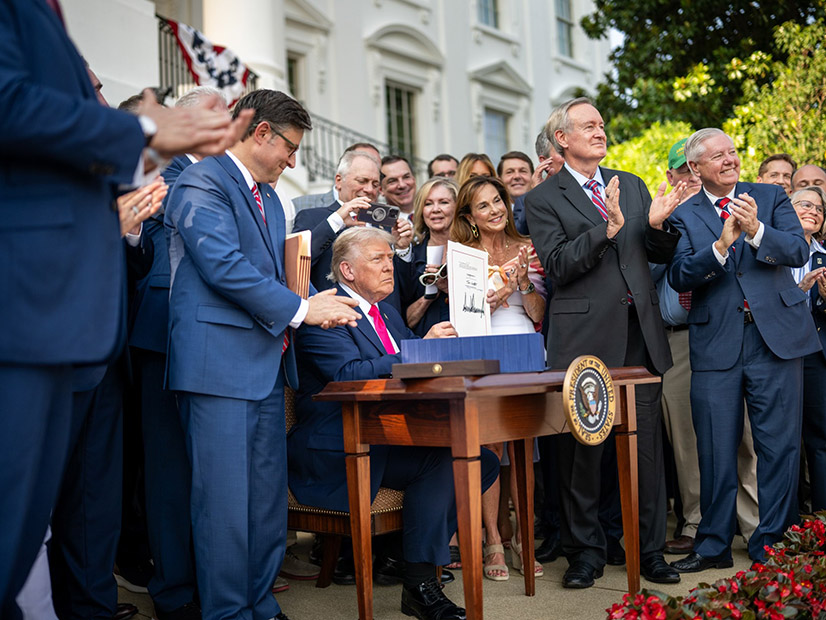
The winners and losers in the energy sector are delineated clearly by the One Big Beautiful Bill Act engineered by President Donald Trump.
But it remains to be seen how big the losses will be for wind and solar power, and how many caveats accompany the wins scored by fossil fuels.
On July 7, three days after he signed OBBBA into law, Trump issued an executive order with strict-sounding directions for carrying out the bill’s provisions targeting wind and solar energy, with critical details to be determined in weeks and months to come.
His on-again-off-again tariff threats — not least the 50% levy on copper imports he announced July 8 — could impose significant costs on the fossil fuel industry, which OBBBA clearly was intended to benefit.
What is clear now is that development of wind and solar power — which provided 14% of utility-scale generation in the United States in 2023 and accounted for 78% of capacity additions in 2024 — will become significantly more expensive.
New projects will need to begin construction by July 5, 2026, or be placed in service by Dec. 31, 2027, to qualify for the generous investment and production tax credits of the 2022 Inflation Reduction Act — a much earlier sunset than specified by the IRA but not as fast a termination as was sought by the strongest critics.
Wind and solar developers also will need to follow complex rules pertaining to fire-walling their projects’ finances from FEOCs — foreign entities of concern, particularly in China. (Norton Rose Fulbright needed more than 3,200 words for a FEOC explainer it published July 8. The Bipartisan Policy Center needed nearly 3,000.)
Peter Fox-Penner, an energy policy and strategy expert and a principal at The Brattle Group, told RTO Insider that the energy provisions of the 800-page OBBBA are a clear and significant threat to wind and solar power development, both of which are frequent verbal targets for Trump.
“I’m struck by what a direct assault this is, in particular on wind and solar, talking about the supply side of electricity,” Fox-Penner said. Combined with measures targeting residential energy efficiency and electric vehicles, OBBBA is a major change for many aspects of the energy sector, he added, as well as for the economy, domestic manufacturing, electricity ratepayers and the environment.
Not everyone is unhappy with OBBA.
Some other emissions-free technologies — geothermal, hydropower, storage — do not face the same rapid and drastic tax credit cutbacks as wind and solar.
And the fossil fuel sector — oil, natural gas, coal — has much to smile about.
“This is the most important energy bill in a generation,” American Petroleum Institute CEO Mike Sommers said in a news release. “President Trump has delivered on his promise to unleash American energy by unlocking opportunities for investment, supporting global competitiveness and opening lease sales onshore and offshore from the Gulf of America to Alaska.”
But many entities in the renewable energy and environmental advocacy sectors are not smiling at all:
-
- “A vote that will live in infamy.” — Greenpeace
- “This stands to be the biggest job-killing bill in the history of this country.” — North America’s Building Trades Unions
- “This bill will be a major step backwards on energy security, prices and jobs in communities across the country.” — Clean Energy Business Network
- “Ceding the race to build the clean energy economy of tomorrow to China.” — Sierra Club
- “The clean energy provisions in the legislation President Trump championed will prove devastating.” — Environmental Defense Fund
- “Congress has turned its back on the very industries that are adding the majority of the new electricity generating capacity to the grid.” — Solar Energy Industries Association
- “Whatever promises the White House may have made when twisting the arms of some House Republicans, the Treasury Department has a duty to administer the law fairly, in a way that provides certainty to the businesses relying on these tax credits.” — National Resources Defense Council
The NRDC comment pertains to Trump’s July 7 executive order, in which he orders the strictest possible enforcement of OBBBA’s provisions on construction start dates, safe harboring and FEOCs.
And it alludes to Trump’s reported promise to the House Freedom Caucus — which was unhappy with even the limited leeway being given to wind and solar — that his administration would use its executive powers to the maximum extent in limiting wind and solar subsidies.
On July 3, U.S. Rep. Ralph Norman (R-S.C.), a founding member of the caucus, explained this in a CNBC interview.
A day after Trump’s executive order, Norman posted on Facebook: “This order dismantles the green energy giveaways pushed under the Biden administration — programs that propped up costly, inconsistent sources like wind and solar while leaving taxpayers on the hook and our grid exposed to instability.”
So what will Trump do now?
His executive order was strongly worded. But he often speaks in strong terms, and he changes his stance often.
Trump has long followed what is sometimes called the Trump Uncertainty Principle, keeping everyone guessing about his strategy so they cannot counter it.
He is hardly the first president with such an approach — President Richard Nixon had the Madman Theory — but Trump has embraced it more openly than most.
For the offshore wind industry, struggling to build momentum in the United States, the uncertainty presented merely by Trump’s re-election was enough that multiple developers paused their U.S. projects.
For the established solar and onshore wind industries, OBBBA presents a more nuanced challenge, particularly with projects that are not ready to break ground and might not qualify for subsidies under terms that may be revised or re-interpreted.
Some projects will be delayed or canceled because the financial calculations on which they are based will change for the worse.
Some of the domestic manufacturing facilities that were to be a legacy of the IRA will not be built. E2 counts $15.5 billion worth of cancellations from January through May, and that is just the publicly announced cancellations.
This in turn means continued reliance on foreign manufacturing that is potentially subject to Trump’s tariffs and OBBBA’s FEOC rules.
And there’s that word again — “potentially.” The beauty of creating uncertainty through vague wording and implied threat is that general trepidation cannot be challenged in court the way a stop-work order or funding clawback could be. The profit-driven private sector is left to ponder the odds as it weighs investment decisions.
“I do think we see some of that, in the sense that the developers and the financial community that finances the developers [are] aware of the uncertainties and the unpredictability of the federal policies now,” Fox-Penner said. “And I do think that has an incremental effect on them. I can’t quantify it, but I think it is there.”
He added: “It is, I think, part of a conscious policy to try and slow [wind, solar and EV adoption] down.”
Princeton University’s ZERO Lab projects $500 billion in lost capital investments through 2035 because of OBBBA and calculates Americans’ annual energy expenditures will be $52 billion higher in 2035. It projects that clean energy production will continue to increase but will be 820 TWh lower in 2035 because of OBBBA than it would have been in mid-range projections under Biden-era policies.
Fox-Penner agrees: Solar and wind generation will continue to be built. Not as much as there would have been, he said, and not enough to meet the growing U.S. demand for power, but dozens of new gigawatts still will come online, despite OBBBA.
Wind and solar are so much faster and cheaper to build than other types of generation that they will carry on, albeit at a slower pace, he explained.
“We have done some analysis at Brattle Group and others have done some analysis that shows that wind and solar construction will be adversely affected substantially by this bill. But at the same time, it will continue at a significant pace in parts of the country even without these subsidies, because it remains the cheapest form of raw kilowatt hours,” Fox-Penner said.
In regions where electricity is expensive, wind and solar still could be economical without federal subsidies, he added.
The problem in some of those expensive electricity markets is that the cost of energy development also is expensive, and there is no quick replacement at the state or regional level for the disappearing federal tax credits.
New York is such a place — it has grand ambitions for renewable energy and is placing much of the cost of decarbonizing the grid on ratepayers who already have some of the most expensive electricity in the nation. Further subsidies would be a hard decision to make.
The New York State Energy Research and Development Authority, which helps manage the state’s clean energy transition, told RTO Insider it has not fully analyzed the impacts of OBBBA but implied that they would be considerable.
A spokesperson said: “The new law puts thousands of jobs at risk and could cut billions in funding and impact overall market momentum. This bill undermines New York state’s demonstrated leadership in advancing clean energy technologies as a part of an all-of-the-above energy strategy including investments in wind, solar, hydroelectric and nuclear power to create a clean, affordable and reliable energy grid.”
Fox-Penner said there is no quick way to refill the pipeline and meet rising demand with other technologies if solar and wind projects are cancelled.
The backlog on large gas turbine orders is several years long, and construction of new nuclear generation may not scale up before the mid-2030s. Few observers expect anything beyond delayed retirements for coal, either.
“We do not see evidence of any significant expansion in coal to date, nor do we think it makes economic or environmental sense,” Fox-Penner said.