IESO planners are using “adaptive pathways” to account for uncertainty over future load growth, the ISO told stakeholders.
“It’s not let’s wait and see what happens and then … react to that, and … if there’s a data center that pops up here, let’s completely build the system around that,” IESO planner Nikola Dimiskovski said in a July 16 webinar on planning for Greater Toronto Area (GTA) East.
“Adaptive planning is identifying in this region, what is the next logical step for expansion? What do we want the system to look like overall? … [We] develop a couple of different pathways for that, and then through iterative processes … every year, we can kind of revisit the plan in terms of where are we on this timeline.”
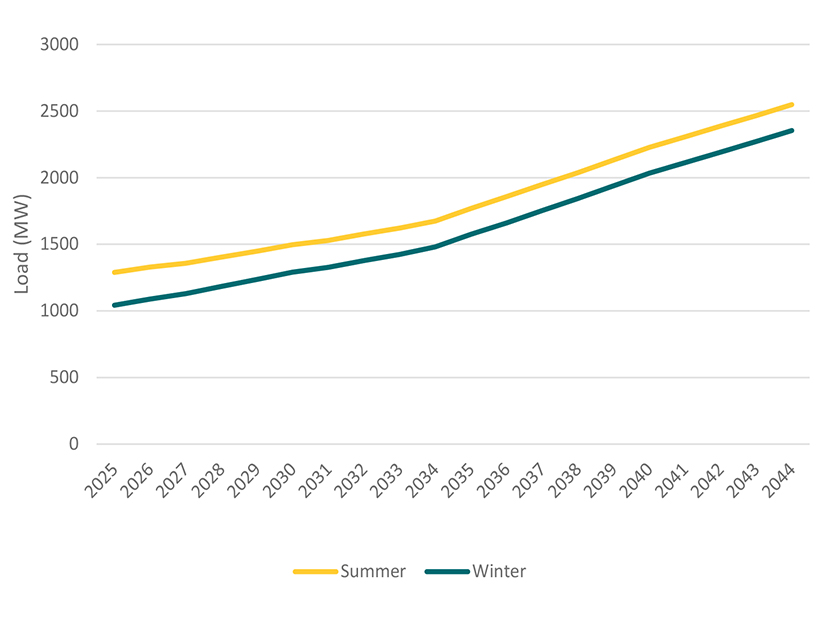
The ISO predicts electric demand in GTA East will increase by 98% in summer and 126% in winter by 2044 from electrification and growth in residential, commercial and industrial loads. That’s above the projection for all of Ontario, which is expected to see a 75% increase in demand by 2050.
The GTA East Integrated Regional Resource Plan (IRRP) is one of 11 regional plans IESO is developing, along with its Central and South Bulk Study, to deliver the increased power through wires and non-wires solutions. The infrastructure needed to address local electric system needs is planned by local distribution companies, which are the main sources for the province’s demand forecasts.
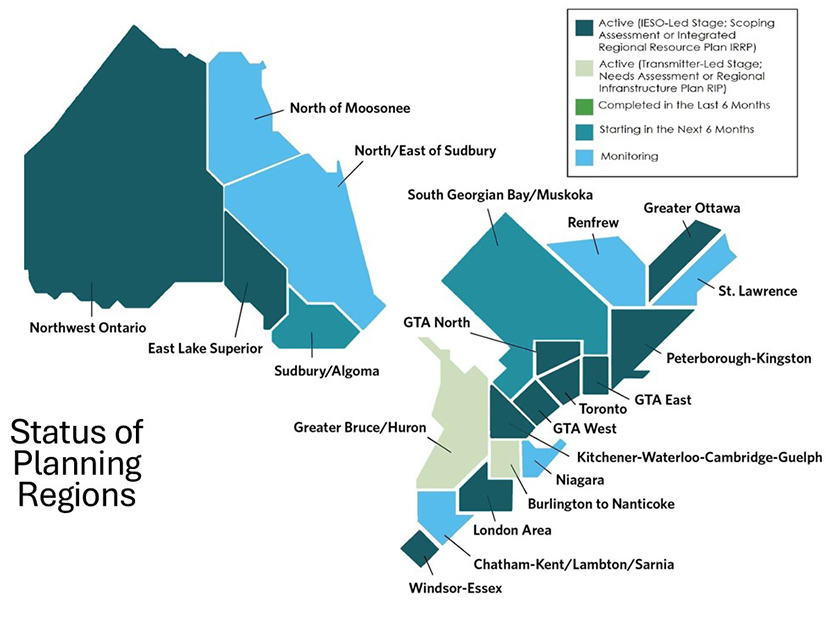
IESO is considering several options for new transmission in GTA East, including an underwater cable, two overland options using existing corridors, and an underground line crossing the city, said Bev Nollert, director of transmission planning.
Three Scenarios
The GTA East plan will consider three scenarios, including a reference case based on current trends and policies in electrification of transportation, space heating, industry and other areas, along with high- and low-demand scenarios bracketing the reference case.
IESO’s recommendations will be driven mostly by the reference demand forecast, with the low and high forecasts used to “test the robustness of the plan, identify signposts to monitor forecast changes and contemplate additional actions required if lower or higher demand growth materializes,” the ISO said.

Under adaptive pathways, planners calculate how much increased load would trigger the need for a new transmission line, Dimiskovski said. “Or instead of a new line … what would be the equivalent to a new line? That might be something like a 300-hectare wind farm with battery storage. So those are your two pathways. You can either build the solar panels and the wind and all those things, or you can build the lines. And then, of course, you can do kind of a hybrid of those two.”
The result will be a “subway-style” map listing “no regret” investments, he said.
“You might think 2034 is really, really far away. But if this current system cannot meet that load [in] 2034, that means we have to start building a transmission line about seven to eight years before that,” he said. “Two years from now, we have to start building something if we think the load is going to come.”
Uncertainty
Unlike other parts of Ontario, which are starting to shift to winter-peaking regions due to electric heating, GTA is projected to remain summer peaking, Dimiskovski said, adding, “I don’t think we’ve 100% captured a full electrification of electric heating.”
Dimiskovski mentioned uncertainty over load growth increases in the second half of IESO’s 20-year projections. “In the first five to 10 years, we have a pretty good amount of certainty for what’s going to come onto the system. So that’s things like customer connections, large projects that you can see, community development plans, things like that. But then beyond the 10 years, governments change, new technologies come up, electrification is going to intensify.”
Demand growth is predicted to become increasingly steep beyond the first 10 years. “Electrification is going to really start to manifest there,” Dimiskovski said. “Whether it’s 2044 or 2034 or 2064 or whatever it might be, eventually, it seems like the trend is that the lowest-hanging fruit of what can be electrified will be electrified.”
Dimiskovski said he is more confident in projections for GTA than for Ottawa, where “we’re seeing tripling or quadrupling of the load — so 3,000 additional megawatts.”
What’s Next
Written feedback on the GTA webinar should be emailed to engagement@ieso.ca by Aug. 6.
The ISO will share needs and “screened-in options” in the fourth quarter, with an analysis of the options in Q2 2026 and completion of the IRRP set for Q4 2026.
Incumbent transmission companies will lead development of wired solutions. “For non-wire solutions, implementation mechanisms for new resources and energy efficiency programs will be determined following plan publication,” the ISO said.