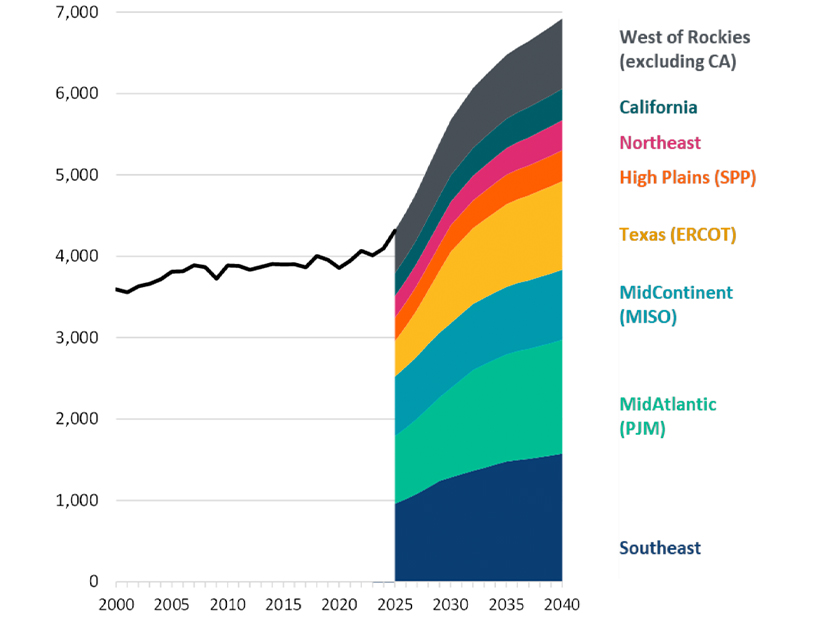
The power industry can meet growing demand in a timely and cost-effective way by deploying commercially available new technologies to increase the use of the existing grid and proactively planning for new infrastructure, a new report from the Clean Air Task Force said.
The “Optimizing Grid Infrastructure and Proactive Planning to Support Load Growth and Public Policy Goals” report, prepared for CATF by The Brattle Group, highlights how to deal with demand growth from data centers, reshoring manufacturing and electrification.
“By mobilizing demand-side flexibility, increasing the utilization of the existing grid and recognizing uncertain future needs through proactive planning, utilities and other grid operators can serve new loads while mitigating cost increases, thereby avoiding large bill increases for existing retail customers and protecting them from future risks,” the report said.
“Combining more efficient capital utilization with more proactive planning thus offers a win-win proposition that protects customers, serves new loads more quickly, benefits utilities and grid operators, and supports a wide range of public policy goals for clean energy and economic development,” it said.
Demand growth has come back at a time of stressed supply chains, compounded by long interconnection queues and other factors contributing to a slowdown in the speed and scale of deploying new resources, CATF Electricity Director Kasparas Spokas said in an interview.
“We hope this report serves as a little bit of a menu of options of underutilized, but effectively no-regrets solutions that policymakers can evaluate and assess and hopefully adopt to both grow load while minimizing emissions and cost as much as possible,” Spokas added. “And so, the goal really here was to highlight … some of the near-term, no-regrets solutions that even if demand, which is highly uncertain, were not to materialize, would still be beneficial for ratepayers.”
The paper offers actionable recommendations for grid planners, but it does not cover the full scope of potential reforms that could be needed under the new demand paradigm, such as changes to wholesale power markets or technology innovations that might become commercially viable.
The pressure from demand is most acute with large loads such as hyperscale data centers and advanced manufacturing facilities because they often require access to vast amounts of reliable electricity and can start operating in a few years, while installing new infrastructure can take decades.
Some of the quicker ways to help manage that rapid demand growth include use of demand-side resources, grid-enhancing technologies and advanced transmission technologies, as well as taking advantage of upsizing opportunities when power lines are refurbished and facilitating interregional trade, the report said.
“Regulators and advocates just have to be very disciplined about requiring planners to effectively evaluate some of these [virtual power plant] demand-side solutions and advanced transmission solutions before committing to new buildout,” Spokas said.
‘Political Feasibility’
Policymakers also should establish and expand efficiency and bill assistance programs for low-income customers and extend demand-side management to those customer classes. Another option is to establish rules that ensure customers with large loads don’t end up imposing stranded costs and financial risks on other customers, the report said.
“I think that there’s a lot of very acute and near-term political pressure that policymakers and legislators and others are feeling with regard to increases in customer prices for electricity, increases in utility bills,” Nicole Pavia, CATF’s director for clean energy infrastructure, said in an interview.
“We think that the political feasibility of implementing a broad suite of solutions kind of depends on gaining and maintaining political will for the energy transition,” Pavia said. “A lot of that has to do with how consumers feel about rates and if affordability is top of mind. And, so, we think some of the measures around affordability can help reduce the political pressure in terms of the increasing rates and utility bills.”
Transmitting energy more efficiently, speeding up queues and addressing affordability concerns will help, but the power system eventually will need new generation and transmission. Those investments can be assisted by facilitating customer-sponsored generation investments and procurements, and collocating generation and load in “energy parks.”
Planning and procurement process should pick the flexible, least-regrets solutions and, where needed, attract new investments in a timely manner. Load forecasts can be improved, clean energy development can be sped up by picking zones that can be connected proactively with transmission and deliberately planning the distribution system to more cost-effectively manage load growth.
The return of demand growth also has increased interest in developing new natural gas-fired power plants around the country.
“There are a lot of low-cost, no-regrets solutions that need to be considered before you get to the point of building a new gas plant,” Spokas said. “Once you get to that point as well, you need to consider the life of that asset.”
Spokas thinks there’s “a lot of talk” about future gas-fired plants being built as “hydrogen-ready” without much consideration about the investments needed to make them so.
“Where will the hydrogen come from? What will be the cost? So, I just think we all need to be very disciplined about what it takes to get to the point of saying, yes, a new gas plant is the solution,” he said.