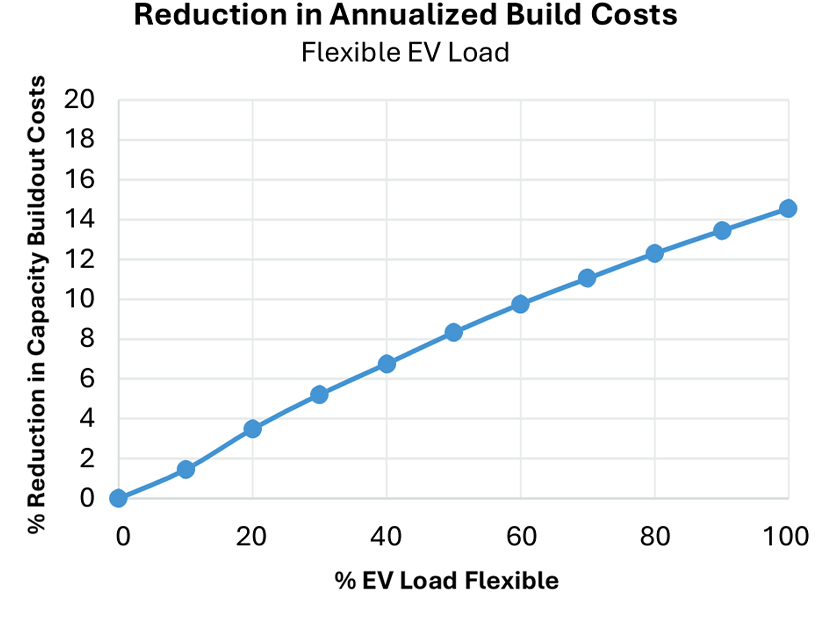
Increased demand flexibility could significantly reduce production costs, capital costs and transmission costs in New England by better aligning load with generation and reducing peak loads, ISO-NE said at the Planning Advisory Committee’s meeting July 23.
Presenting additional results from its 2024 Economic Study, ISO-NE said demand flexibility could reduce production costs by 10 to 15% in 2050. The RTO found that capital cost savings would “increase linearly with increasing demand-side flexibility” by reducing reliance on “expensive resources that are only needed for short durations.”
Demand flexibility would also provide emissions benefits by reducing load during the most carbon-intensive peak periods and would reduce the need for energy storage by limiting the imbalances between energy production and demand, ISO-NE found.
As a caveat to its findings, the RTO noted that the demand flexibility modeling assumes “perfect foresight and total control over flexible load” and therefore may inflate savings projections.
The study is intended to quantify the economic and environmental effects of state and federal energy policies and “evaluate competitive solutions to alleviate identified system efficiency needs.” (See “2024 Economic Study,” ISO-NE Details Evaluation Models for Transmission Solicitation; “Additional Economic Study Results,” ISO-NE Planning Advisory Committee Briefs: March 19, 2025; and ISO-NE Finds Advanced PV Panels Could Reduce Decarbonization Costs.)
ISO-NE has previously forecast significant transmission savings associated with demand flexibility; it estimated in 2023 that the region could save up to $9 billion in transmission costs by reducing its forecast 57-GW peak load for 2050 to 51 GW. (See ISO-NE Prices Transmission Upgrades Needed by 2050: up to $26B.)
Also at the PAC meeting, ISO-NE discussed a sensitivity analysis from the Economic Study reducing the capital cost assumptions for small modular nuclear reactors (SMRs). The RTO’s baseline assumptions for the study relied on conservative SMR cost projections from the National Renewable Energy Laboratory.
“The lower cost assumptions for SMRs shifted [their] buildout from 2039 to the mid-2030s and reduced the buildout of other non-emitting resources,” said Kim Quach of ISO-NE. She noted that lower SMR costs also lowered reliance on peaker generation and largely eliminated the need for 100-hour battery storage.
The RTO also discussed a model sensitivity reducing the emission-reduction requirements. It found that requiring only 75% decarbonization by 2050 would cut total costs by about 50% relative to the base case. The lower costs stemmed from decreased reliance on the most expensive clean resources needed to achieve deep decarbonization, including SMRs.
While scaling back the long-term decarbonization of the power sector could significantly reduce electricity costs, it would make it extremely difficult for states to meet their climate targets and reach net-zero emissions by 2050. Rhode Island has set a goal of meeting 100% of its power demand with clean energy by 2030, while Massachusetts has estimated it will need to cut power sector emissions by 93% by 2050 relative to 1990 levels to reach its net-zero goal.
The Intergovernmental Panel on Climate Change (IPCC) estimates that global emissions must decline significantly in the coming years and reach net zero by 2050 to limit warming to 1.5 degrees Celsius. Passing this warming threshold will intensify extreme weather events and have widespread negative impacts on human health, food and water supplies, and economic growth, according to the IPCC.
Resource Outlook Study
ISO-NE anticipates minimal shortfall risks over the next decade, with the loss-of-load expectation falling below the one-in-10 reliability criteria for each year, ISO-NE’s Donald Poulin said in presenting the RTO’s 10-year resource outlook study.
He noted that forecasted shortfall risks increase as the decade progresses because of growing load and the assumption of a stagnant resource mix.
Asset-condition Projects
Chris Soderman of Eversource Energy presented a $24 million asset-condition project to replace 48 wood structures with steel structures on a 115-kV line in southern New Hampshire.
The company has identified damage and deterioration on 25 structures and will replace additional “Category B” structures facing flooding, uplift issues or are in “close proximity” with more deteriorated structures, Soderman said.
Under the transmission owners’ standardized PAC presentation guidelines, Category B refers to structures with moderate deterioration that may be replaced “in conjunction with other structure replacements.”
Soderman also presented a $6 million project in New Hampshire to replace 15 wood structures on a separate 115-kV line. He said six of the structures have deteriorated to the point of needing replacement, while nine structures are categorized as Category B proximity structures.
Connecticut Needs Study
ISO-NE also discussed a revision to its Connecticut 2034 Needs Assessment.
Following an update to correct errors in the load distribution in Rhode Island, ISO-NE has reduced the extent of thermal overloads it forecasts for Connecticut in 2028 and 2034, along with the number of buses with low-voltage violations it forecasts for 2028.
The revisions did not affect the number of high-voltage violations identified by the RTO, which are associated with minimum loads.
The RTO plans to publish the draft assessment “in the near future” and aims to release the final version in August. It intends to begin work on the Connecticut 2034 Solutions Study in the third quarter of this year, focusing on short-term needs.