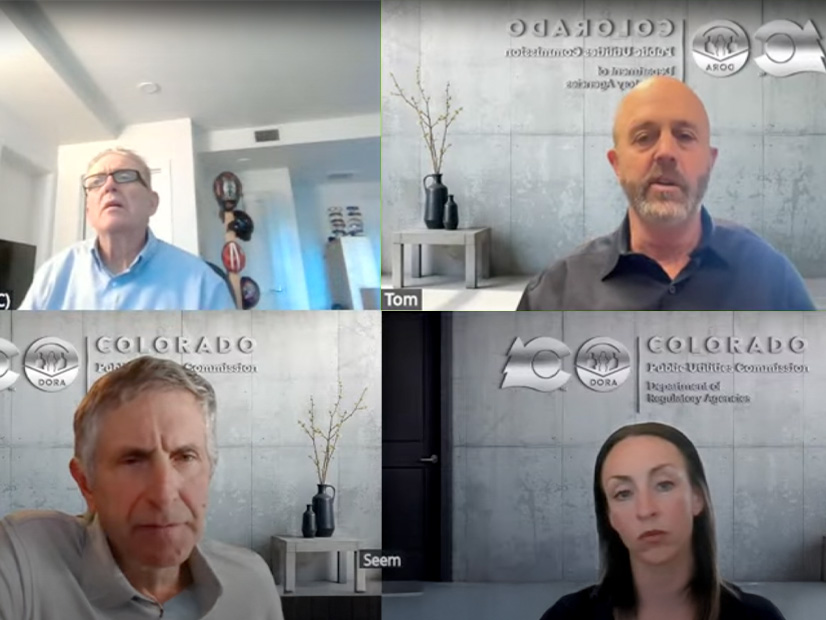
The Colorado Public Utilities Commission will soon decide whether to allow Public Service Company of Colorado (PSCo) to join SPP’s Markets+, but commissioners on July 23 had differing views on whether the move would be in the public interest.
A decision is now expected during the commission’s July 30 meeting. In addition to seeking CPUC approval to join Markets+, the utility is also asking to recover costs associated with joining Markets+ through the electric commodity adjustment tariff.
Markets+ has been in a heated battle for participants with CAISO’s Extended Day-Ahead Market (EDAM).
During the July 23 meeting, commission Chair Eric Blank said he’d vote to approve PSCo’s application. He sees the company’s participation in Markets+ as a way to integrate Colorado’s two balancing authorities, run by PSCo and the Western Area Power Administration (WAPA). WAPA’s Rocky Mountain Region intends to join SPP’s RTO West. (See WAPA, Basin Electric Commit to SPP’s RTO West.)
Blank also sees value in joining Markets+ related to resource adequacy, greenhouse gas accounting and wholesale market price transparency. Those benefits don’t necessarily show up in production cost modeling used to assess the day-ahead market, he said.
“I can’t support denying the application and doing nothing,” Blank said. “In my view, we just need to keep the funding in place and to keep pushing the two Colorado balancing authorities together on the operational side as best we can.”
Commissioner Megan Gilman said she was concerned that the benefits of joining Markets+ wouldn’t outweigh the costs. Cumulative net costs are expected to be around $30 million by 2031, she said.
Blank argued that the amount was small relative to the utility’s overall spending in areas such as wildfire mitigation, distribution system upgrades and capital expenditures.
“Why are you relying on a couple million dollars here versus there given the bigger issues at stake here?” he said.
But Gilman didn’t seem convinced.
“This decision should stand on its own,” she said. “If we’re entering a market, it should be because it provides net benefits to Colorado consumers. And I’m just not seeing that represented appropriately in the evidentiary record.”
In terms of resource adequacy, Markets+ will require participants to join Western Power Pool’s Western Resource Adequacy Program (WRAP). Gilman said PSCo could choose to join WRAP without joining Markets+.
“In evaluating the resource adequacy concerns, I’m not sure where that leads to Markets+ being the only solution and it certainly is an expensive solution,” she said.
RTO Implications
Looming over the discussion was Senate Bill 72 of 2021, which requires electric utilities that own and control transmission facilities to join an organized wholesale market by 2030. The bill defines an organized wholesale market as an RTO or ISO.
Commissioner Tom Plant said projections show that through 2042, the expected benefits of joining Markets+ would exceed costs by about $17 million. But from now until 2030, when utilities are required to join an RTO, “that doesn’t come out positive,” Plant said.
There are expenses that must be paid whether or not PSCo stays in Markets+, he said, along with around $13 million for software that might not be transferable to a different market.
“Direct cost benefits between now and when we are supposed to join an organized wholesale market seem to be clearly under water,” he said.
Complicating matters is that PSCo could file a petition for a waiver from the RTO requirement as allowed under SB 72 — a move some commissioners are expecting.
“If we — you — deny this petition [to join Markets+], I just think work on integrating the two balancing authorities in Colorado ends,” Blank said to his fellow commissioners.
Governance, GHG Accounting
PSCo, an Xcel Energy subsidiary, filed its request to join Markets+ in February. (See PSCo Seeks to Join SPP’s Markets+.)
PSCo is seeking recovery of about $2 million in Phase 1 costs through the electric commodity adjustment tariff. Cost recovery would also include Phase 2 expenses, consisting of about $14 million in administrative fees during the first five years of market operations and about $13 million to $15 million for technology upgrades.
The CPUC held an evidentiary hearing on the matter on May 27-28.
PSCo said it was drawn to Markets+ because of its independent governance, GHG emissions tracking and accounting system, and benefits “overall and in relation to costs relative to the other markets studied, including EDAM.”
But a study commissioned by the Environmental Defense Fund said PSCo would receive millions of dollars more in annual benefits from participating in EDAM rather than Markets+. (See Study Finds PSCo Would Gain More in EDAM than Markets+.)