Ameren Illinois argued to FERC that it should have dibs on sections of two competitive long-range transmission projects worth almost $2 billion from MISO’s second portfolio, claiming that Illinois’ “first-in-the-field” doctrine is tantamount to a right-of-first-refusal law.
The utility told FERC that MISO is wrong to open the Illinois portions of two long-range transmission projects (the Woodford County–Illinois/Indiana State Line 765-kV line and substation project and the Sub T–Iowa/Illinois State Line–Woodford County 765-kV line project) to competitive bidding (EL25-105).
Ameren said Illinois’ “first-in-the-field” doctrine essentially grants it a right of first refusal to build, own and operate segments of the projects located in its service territory. FERC should instruct MISO to re-classify the projects, reverse its request for proposals and assign responsibility for some of the two lines to Ameren, it said in its petition for a declaratory order.
“Despite Illinois’ ‘first-in-the-field’ doctrine and Ameren Illinois’ rights thereunder, due to uncertainty regarding whether Illinois qualifies as a state granting a right of first refusal, MISO improperly included the projects in its competitive developer selection process,” Ameren explained to FERC.
MISO began soliciting proposals from qualified developers for the $984.6 million Woodford County line July 25. Proposals are due Jan. 6.
MISO plans to begin accepting proposals for evaluation on the $940.1 million Sub T-Iowa/Illinois State Line–Woodford County 765-kV project Aug. 8 with a Jan. 20 deadline. The two lines are part of MISO’s second, nearly $22 billion long-range transmission portfolio.
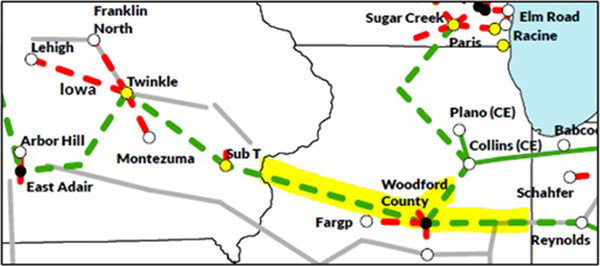
Ameren characterized portions of the pair of projects as “Ameren Illinois segments” that “will interconnect with Ameren Illinois’ existing facilities and provide electric services to, and otherwise significantly affect, Ameren Illinois’ existing wholesale and retail customers.” The company said the projects will lower prices for its customers, reduce overloads, alleviate congestion, allow new generation to interconnect and expand export capability.
Ameren acknowledged that judicial precedent enforces the doctrine and it’s not a codified statute.
The doctrine states that, where “additional or extended service is required in the interest of the public and a utility in the field makes known its willingness and ability to furnish the required service,” there is no justification in “granting a certificate of convenience and necessity to a competing utility until the utility in the field has had an opportunity to demonstrate its ability to give the required service.”
It also says parties must demonstrate that the established utility is providing poor service or is unable to “provide adequate facilities” before one utility is allowed to “take the business of another already in the field.”
The doctrine reasons that the “method of regulating public utilities in Illinois is based upon the theory of regulated monopoly rather than competition.”
Ameren said it “clearly” meets the three-part threshold of the doctrine: It’s an existing public utility, it’s willing to head up the projects, and there’s no reason it’s unable to do so. It said FERC didn’t need to interpret state law to grant its petition.
Six states in MISO (Indiana, Michigan, Minnesota, Mississippi, North Dakota and South Dakota) have enacted explicit ROFR laws that are in effect. MISO does not include Illinois on its list of states with ROFR laws.
Other Long-range Projects in Competitive Stages
In addition to the Illinois segments, MISO has a full dance card in 2025 for overseeing competitive projects included in the second long-range transmission portfolio.
MISO announced July 30 that it selected Republic Transmission to lead construction of the Reid Extra High Voltage Indiana/Kentucky State Line 345-kV project. The project was the first up for bids from the collection.
MISO has two more projects open for bidding: the Wisconsin Southeast 345-kV project and the Bell Center-Columbia-Sugar Creek-Illinois/Wisconsin State Line 765-kV project. The grid operator is staggering its selection processes to make its competitive developer process more manageable.
Through the end of the year, MISO plans to release two more requests for proposals for 765-kV projects from the portfolio: The Marshalltown-Lehigh-Sub T–Montezuma–East Adair project Nov. 25 and the East Adair–Minnesota/Iowa State Line–Arbor Hill–York Avenue project Dec. 11.