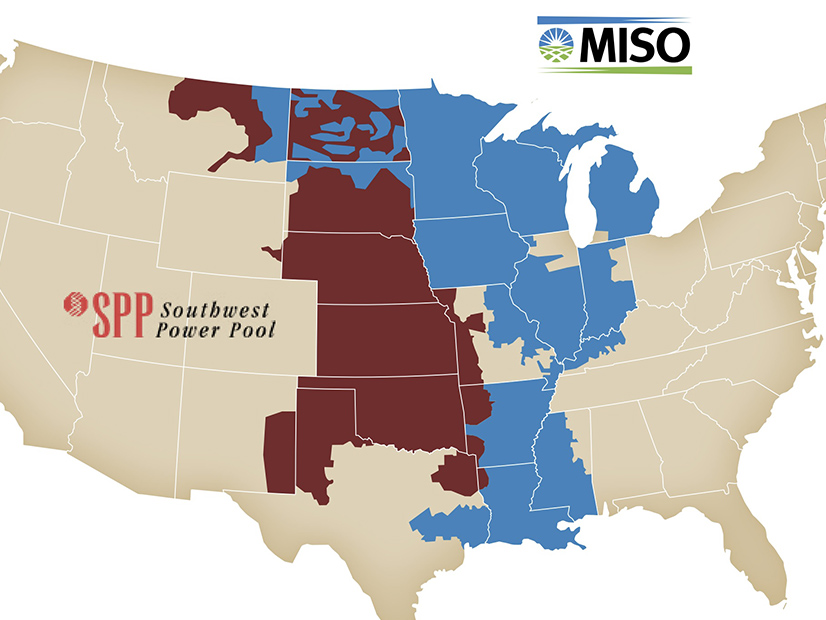
MISO and SPP appear undaunted in their pursuit of a beneficial interregional project after FERC’s rejection of exemptions to their joint study rules.
The grid operators announced they still are in search of projects that improve resilience, reliability and transfer capability under their joint Coordinated System Plan (CSP) study process. They also said they are weighing proposing more benefit metrics to FERC to justify projects.
The RTOs originally set out to perform a different type of CSP this year with more in-depth modeling on a 10-year horizon and a wider variety of benefits they said would have cast a wider net for projects. However, FERC in July denied their requested temporary exemptions. The commission said a limited waiver of requirements was not the best vehicle for changes to the study. (See FERC Denies MISO, SPP Waiver of Joint Study Process.)
Now the RTOs say they are considering submitting a filing to FERC under Federal Power Act Section 205 to include more types of benefits in business cases for joint projects. They said drawing on more and different benefits is in line with FERC Order 1920, which laid out seven categories of transmission benefits.
MISO and SPP’s joint operating agreement currently limits them to using only the value of avoided regional projects to measure the reliability and public policy benefits of interregional projects stemming from the CSP.
The two grid operators have said measuring the reliability value of a project solely on its ability to avoid regional projects constricts their planners from analyzing projects’ usefulness in other areas, like expanded interregional transfer capability or fortification against weather extremes.
During an interregional planning meeting Aug. 6, SPP Manager of Interregional Strategy and Engagement Clint Savoy said the RTOs would have more details on how the two might expand their benefit definitions under the CSP during the next joint meeting Oct. 24.
“It’s something that we’re constantly talking about … how to approach changes we want to make to the process itself,” Savoy told MISO and SPP stakeholders.
The RTOs also said that because FERC rejected the waiver, they will add 15-year-out modeling scenarios to this year’s CSP.
The JOA requires MISO and SPP, when conducting a CSP, to use multiyear modeling, which the RTOs interpret to mean using multiple model years, such as five, 10 or 15 years out. They initially wanted to model several different 2034 scenarios to land on transmission needs instead of studying the system at different points in time.
MISO Interregional Planning Adviser Ashleigh Moore said 15-year models are in progress and would be complete in October or November.
Moore said that if transmission needs prove to be “drastically different” with the addition of the 15-year-out modeling, the RTOs might open a second window for stakeholders to propose transmission solutions. MISO and SPP are accepting transmission project ideas for the CSP through Sept. 5 under their first submission window.
The RTOs still are aiming for a “robust and comprehensive interregional planning process,” she said.
SPP engineer Spencer Magby said the RTOs will model an extreme temperature scenario that will serve as a sensitivity to the study. However, the modeling would extend only to extremely low winter temperatures, not blistering high summer temperatures.
Southern Renewable Energy Association Transmission Director Andy Kowalczyk said MISO and SPP probably should model systems stressed by summertime, especially given the springtime instances of load shedding in Louisiana for both RTOs. (See MISO Says Public Communication Needs Work After NOLA Load Shed.)
MISO and SPP planning engineers said they might consider hot weather modeling additions.
Missouri Public Service Commission Chief Utility Economist Adam McKinnie asked MISO and SPP to share data on their existing transfer limits so stakeholders can have a better idea of how projects could expand transfer capability. Engineers said they would consider the request.
MISO and SPP said they would share draft transmission projects in October and prepare to make project recommendations in December. As for cost allocations of the projects, the RTOs plan to hold discussions on a cost-sharing design late in 2025 and over 2026.
MISO and SPP’s CSP process never has produced a viable interregional project. Their Joint Targeted Interconnection Queue study, on the other hand, has culminated in $1.7 billion in projects to be funded by the interconnecting generation that benefit from the lines.
MISO and SPP also aim to submit a proposal to FERC in 2026 to institute the smaller, congestion-relieving Targeted Market Efficiency Projects, with a similar process to MISO and PJM’s TMEP studies.