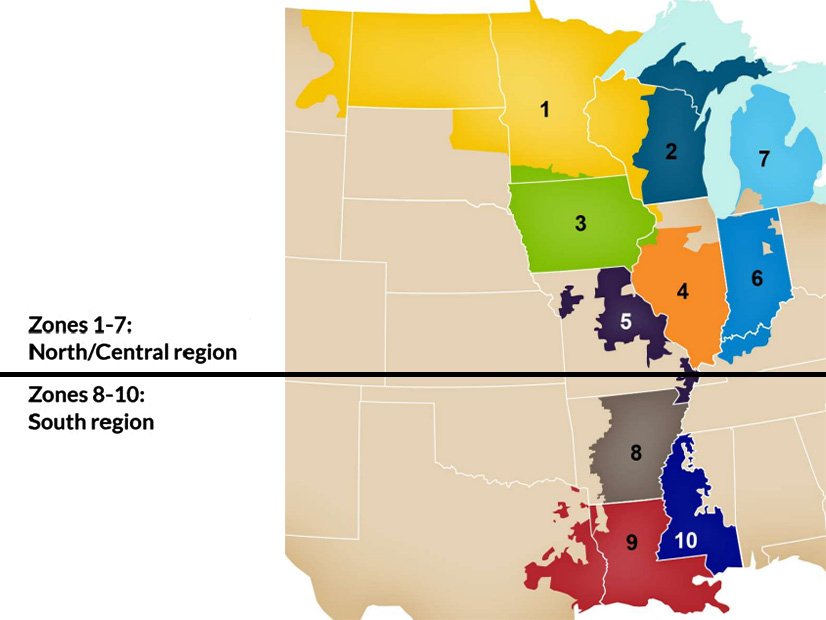
FERC said MISO should spread the costs of keeping a Michigan coal plant running past its retirement date over the RTO’s entire Midwest region.
The commission issued an Aug. 15 decision on the cost allocation of the J.H. Campbell coal-fired power plant, which is slated to run through Aug. 21 on an order from the U.S. Department of Energy. The plant originally was scheduled to wind down operations May 31. (See DOE Orders Michigan Coal Plant to Reverse Retirement.)
FERC said it’s appropriate that MISO split the costs of running the plant on a load ratio share among local resource Zones 1-7, which includes Wisconsin, Minnesota, the Dakotas, a section of Montana, Iowa, parts of Missouri, downstate Illinois, Indiana and a slice of Kentucky in addition to Michigan (EL25-90).
FERC said the allocation design is in line with its cost causation principle, reasoning that the cost split would “allocate costs in accordance with the scope of the emergency as described by the DOE order.”
“We acknowledge that parties have presented different interpretations of how the DOE order defined the geographic scope of the emergency. However, we find that the most reasonable reading of the DOE order’s intended scope is that the emergency necessitating the continued operation of the Campbell Plant is in the MISO North and MISO Central regions, i.e., local resource Zones 1-7,” FERC said.
Plant owner Consumers Energy asked the commission for a Zone 1-7 rate recovery, claiming beneficiaries could be found among all Midwestern zones. However, Great River Energy and various public interest organizations argued that load-serving entities in Zones 1-7 already met their resource adequacy requirements, as evidenced by MISO’s 2025/26 Planning Resource Auction and would not benefit from bonus capacity from the Campbell plant. (See MISO Summer Capacity Prices Shoot to $666.50 in 2025/26 Auction.)
Great River Energy argued the DOE mandate focused on the local impacts of generation retirements, which should mean that costs of the plant fall to Michigan’s Zone 7 alone. It said, “allocating costs of complying with the DOE order beyond Consumers’ own load is not supported by the cost causation principle.”
Michigan Attorney General Dana Nessel contended that the DOE order applied to the whole footprint and FERC should order a cost allocation that includes MISO South.
But FERC said it relied on the DOE citing a MISO presentation of the 2025/26 PRA results, where MISO said that “new capacity additions were insufficient to offset the negative impacts of decreased accreditation, suspension/retirements and external resources” in MISO Midwest. The commission said it seemed resource adequacy concerns in the subregion drove the DOE to issue the order.
FERC directed MISO to draft a compliance filing within a month to enact the new allocation. It also told the RTO to define a load ratio share and how it plans to calculate each load-serving entities’ load ratio share.
According to a recent Securities and Exchange Commission filing from Consumers Energy, J.H. Campbell cost $29 million to run from May 23 to June 30. (See DOE Extension of Michigan Coal Plant Cost $29M in 1st Month.)
The commission declined to grant the Organization of MISO States, the Illinois Attorney General and the Illinois Commerce Commission’s request that it instruct MISO to initiate stakeholder discussions on who should foot the bill for the plant’s extension. FERC said further procedure was unnecessary.
FERC also rejected requests to delay its cost allocation decision until rehearing requests on the DOE’s mandate are resolved.
“We find that arguments against adoption of the proposed tariff provision, such as that imposing the costs of keeping the Campbell Plant in operation violates the tariff and the [Federal Power Act] if the DOE order is deemed unlawful are beyond the limited scope of this proceeding and were not referred to the commission by DOE,” FERC wrote.
FERC similarly refused to address the creation of a provision to refund upgrade costs recovered under the cost allocation should the Campbell plant be subject to another stay-open order beyond Aug. 21. It said any such potential procedure was outside the “limited” nature of the allocation docket.
FERC also appeared to cover its bases should the DOE’s order for the coal plant to keep operating not hold up in court.
“While this order approves the cost allocation methodology in the proposed tariff provision, it does not approve recovery of actual costs,” FERC said.
FERC said Consumers Energy needs to petition it in a separate proceeding “at a later date” for approval to recover costs associated with the DOE’s order “before ratepayers can be charged for such costs.”
“Parties may raise issues related to the scope of costs prudently incurred pursuant to the DOE order in that proceeding,” FERC said. It added that parties to the complaint could “take appropriate steps, such as requesting rehearing in this proceeding, to preserve arguments” that FERC should order refunds should the DOE order be modified, or “otherwise revisit its approach to matters that DOE referred to the commission in connection with the DOE order.”