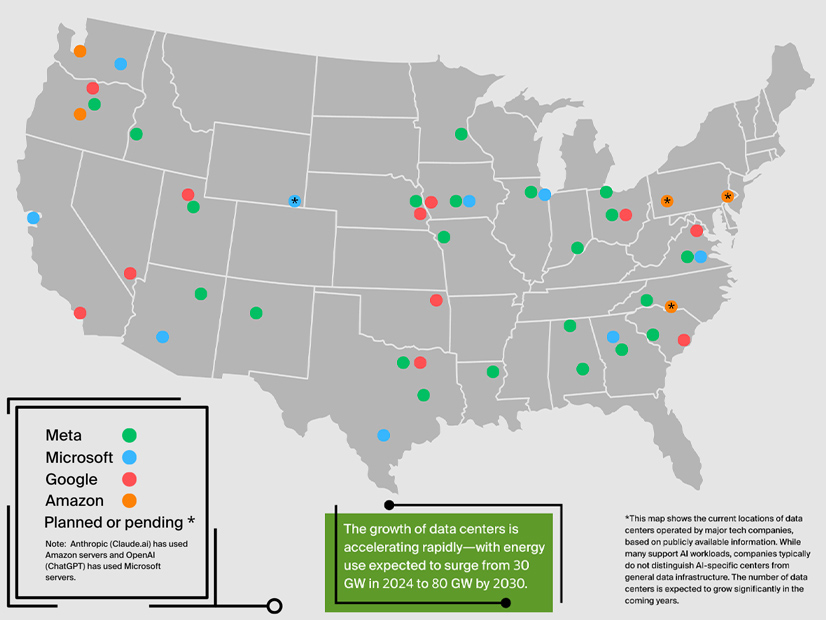
A new campaign from Green America seeks to raise awareness of the impact on the environment from the rush to build data centers for artificial intelligence, calling on tech companies to use 100% renewable energy.
The “Dirty Data: Stop Big AI From Polluting Our Climate & Communities” campaign also will push companies to listen to neighbors near data centers and related power plants about exposure to air pollution and related health conditions. Data centers already use electricity to power the equivalent of 7 million American homes and have contributed to higher power prices.
“There is a lot of excitement about artificial intelligence and its potential to make all our lives better,” Green America’s Director for Climate Campaigns Dan Howells said in a statement. “But for all the benefits, AI comes with a big environmental cost. So, the choices companies like Google, Meta, Amazon and Microsoft make are critical. They could choose a new clean energy future and not return to a dangerous and dirty energy past. In order for the AI revolution to really be intelligent, it must be powered by renewables.”
Demand is predicted to rise to between 165 and 326 TWh per year by 2028, which is enough to power 22% of U.S. households and could generate emissions the equivalent of driving a car 300 billion miles, or 1,600 round trips between the Sun and the Earth.
The biggest tech firms have seen emissions rise this decade, growing on average 150% between 2020 and 2023 with 182% growth at Amazon, 155% for Microsoft, 145% for Meta and 138% for Google. All four tech firms made major climate commitments and pledged to get to net zero, but the growth in data center demand is threatening their ability to meet them.
Amazon denied its emissions had risen that much, saying in a statement that its carbon intensity has declined regularly in recent years. Its absolute emissions have gone up, with its 2024 sustainability report saying direct emissions were up 6% from 2023, and indirect emissions from power purchases were up 1% on the year, in part due to higher electricity usage required to support advanced technologies.
Amazon reported that indirect emissions from other sources (such as work contracted for the firm) was up 6% from 2023 and was the largest share of its emissions at 74% of the total. The increase there was due to data center construction and fuel consumption from third party shippers, the sustainability report said.
Other industries that rely on data centers have seen emissions decline, with telecom seeing a drop to 94% of 2020 levels by 2023.
The rising demand from data centers is driving utilities to keep coal power plants open that were slated to retire. But a go-to source of energy is natural gas, with plans for 20 GW of new facilities in the American South to serve tech companies.
Another option is nuclear power, with Microsoft helping to reopen an old Three Mile Island plant and a deal with Meta to help expand the Clinton plant in Illinois. Google and Amazon also are investing in small modular reactors.
Green America said its campaign is intended to mobilize its members and others to ensure AI becomes a force for climate solutions. That includes siting them responsibly; boosting efficiency in their operations, including with more efficient microchips; and running their operations on clean, renewable energy.
The campaign also calls for more transparency, so that planned use of electricity and water to run new hyperscale data centers is better known. The sector needs to be honest about the scope of their impacts in order to be good neighbors and take responsibility for the pollution produced, Green America said.