
AUSTIN, Texas — The dust has settled in Texas after another biennial legislative session that installed guardrails for data centers and other large loads and avoided stiff penalties on the clean energy sector. At the same time, ERCOT stakeholders still are digesting the massive federal budget reconciliation bill signed into law in July.
Both pieces of legislation weighed heavily on the minds of panelists during Infocast’s annual Texas Clean Energy Summit Aug. 26-28.
The summit’s opening panel took on Texas’ Senate Bill 6, which governs the planning, interconnection and operation of large loads and generation resources in ERCOT. The bill directs the state’s Public Utility Commission to set rules that address cost-sharing and interconnection standards for new large load customers (defined as any load 75 MW or greater). These loads will be required to contribute to utilities’ costs to connect them to the grid.
The legislation also requires electric cooperatives and municipally owned utilities that have not adopted retail choice to pass through reasonable interconnection costs for large loads.
Ned Bonskowski, vice president of Texas regulatory affairs for Vistra, pointed out that SB 6 didn’t occur in a vacuum.
“It wasn’t like on the first day, the Legislature said, ‘Let there be Senate Bill 6,’ and then that was the first energy policy that we had in the state,” he said. “There’s a long continuum of statutory and regulatory policies that it has to fit in, and that goes way back beyond Senate Bill 6. I honestly think that about 75 to 85% of what you see in Senate Bill 6 was already happening or was going to happen anyway, so it’s really codifying in statute, putting some guardrails that the Legislature said they learned how they wanted to be implemented.”
“Load growth, triggered largely by data centers, is creating a lot of anxiety in different markets and we’re seeing different approaches to how to manage that pending issue,” Samantha Robertson, director of global strategy at cryptocurrency miner Bitdeer, said. “In Texas, it’s codified in statute, but we’ve seen it in other jurisdictions where [transmission and distribution providers] are dealing with it differently in their specific service territory or it’s happening at the RTO level. Not only do we have a lot of tools, but we’re in a market where finding innovative approaches and looking at problems in a completely new way is possible based on how the market is designed.”
Caitlin Smith, policy lead for storage developer Jupiter Power, called for load forecasts that are accurate and believable. Load forecasts help transmission planning, she said, but the market also needs to know what is coming in order to serve resource adequacy.
“We’ve had what we all recognize as these kind of very bloated load forecasts. I think we will see that what comes out of this law is hopefully a more accurate load forecast,” Smith said. “Load being the signal that you need more generation, but my understanding what may be different about the data center loads and the AI loads is they’re not price responsive. That creates a tricky situation when you’re thinking about these things, too, right?”
PUC Reviewing 4CP Program
High on the PUC’s priority list is a review of ERCOT’s 4CP program, which assesses transmission charges for the following year based on the grid’s overall — or coincident — peak demand during four 15-minute intervals, one from each summer month. The Texas grid’s increased reliance on solar power has shifted tight conditions from the load peak to the net load peak at the same time as more flexible crypto miners and data centers are connected to the system.
That has caught the attention of lawmakers, who directed the PUC to review 4CP within the context of SB6. The review must be completed by the end of 2026.
“[4CP] has long been a subject of discussion and debate. It certainly will have an impact on incentives for loads and for the market,” Bonskowski said.
Michael Macias, vice president of operations for Electric Transmission Texas, a joint venture between American Electric Power and Berkshire Hathaway Energy subsidiaries, urged his panel’s listeners to engage themselves in the stakeholder process.
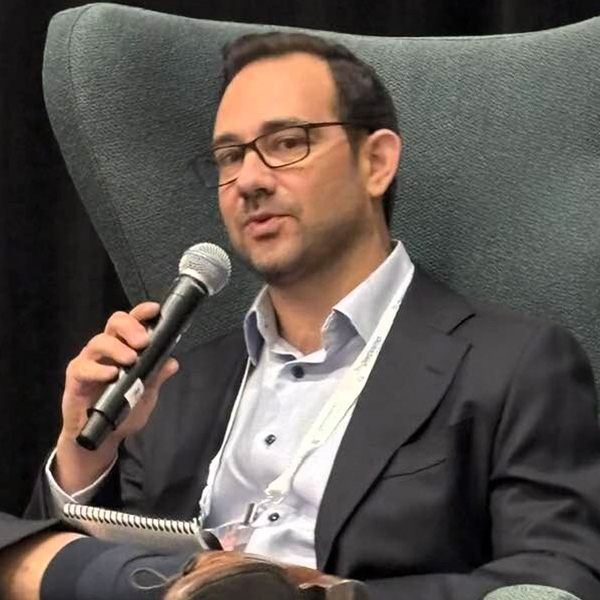
“I think it’s clear that 4CP is on the table for a revision. What’s not clear is how that’s going to be implemented,” Macias said. “What’s also clear is that we know that in order to support the substantial growth that we’re seeing in our time, we’re going to have to spend tens of billions of dollars. If we’re going to build the system up to bring the new load in, then we need to make sure that we’re putting protections in place for everybody, for the folks that are investing in that infrastructure, folks that are using that infrastructure, and then for everybody else that wasn’t planning on having to pay for 760 pipelines around the state.”
Robertson said the conversation needs to include how costs are allocated to large loads.
“I think it’s largely the expectation that AI or high-performance computing data centers wouldn’t necessarily participate in 4CP, so their demand would be whatever their load contribution is during the coincident peaks,” she said. “I think another question that SB6 is asking is how transmission costs are allocated. … That’s something that is going to go back to addressing utility business models. And again, I think it also goes back to the fact that if you want to be interconnected to the grid very quickly and you’re willing to pay for it, maybe you can shoulder 100% of the cost. So, I think that’s a bigger question that isn’t necessarily addressed by 4CP or 8CP or 12CP or whatever it ends up being.”
Managing Large Load Forecasts
Kristi Hobbs, ERCOT’s vice president of system planning and weatherization, keynoted the summit’s second day with a discussion of — what else? — large loads and their effect on the market.
She said ERCOT’s regional transmission planning studies look six years into the future because “we know it takes time to build transmission on the system.”
As part of ERCOT’s latest regional plan, staff asked transmission service providers how much load they were expecting to hook up to their systems. They told staff they expected more than 218 GW of demand.
“Anyone in this room believe that we’re going to hit 218 GW of demand in six years?” Hobbs asked.
A few hands shot up.
“Anybody believe we won’t?” she asked.
More hands were raised.
“Yeah, we were a little bit uncertain about that as well,” she said. “If we would have taken the entire forecast that we received from the transmission service providers, it would have been 85,000 MW of demand from data center loads. That’s more than the entire United States.”
ERCOT is currently tracking about 188 GW of large loads seeking interconnection, compared with 63 GW in December 2024. The grid operator has reviewed and approved planning studies for more than 19 GW of large loads over the past two years. Almost 7 GW have been approved to energize.
A report released in August by Enverus Intelligence Research said load projections from ERCOT and PJM widely differ from the company’s models.
“ERCOT’s and PJM’s estimates imply that each of the next five years, their regions alone would absorb more than 100% of U.S. annual data center capital spending, an assumption we believe is unrealistic,” according to Enverus senior analyst Kevin Kang.
“We know a lot is coming in Texas, but we need to be careful that we’re balancing the cost to consumers with the transmission build for those that will actually be here,” Hobbs said. “They’re very motivated, they’ve got contracts … and they’re wanting to move forward. They come motivated.
“We also have some that come, and I feel like they’re just fishing,” she added. “They put in a request over here, they put a request over there, and they see which utility bites. Whichever one bites first, they’re going to go with that, and then they let the other one just fade off.”
Clean Energy Still Faces Uncertainty
With the federal budget reconciliation bill hamstringing the development of clean energy, the only resource that can quickly and cheaply be brought to market, the sector is grappling with an uncertain future. The bill took away tax credits from wind and solar projects unless they were able to begin construction by July 4, 2026 — or be in service by Dec. 31, 2027, if they did not meet the July 4 deadline.
Clean energy advocacy group E2 said companies have canceled or scaled back more than $22 billion in projects since the start of 2025, including $6.7 billion in investments in June alone.

“It is going to be impactful long-term and in the immediate, too,” said Doug Pietrucha, senior principal with Advanced Energy United. “Realistically, those resources needed to have steel in the ground in the next 10 months to have any ability to take advantage of the remaining tax opportunities that exist for them. So really, the quickest turnaround for those resources is creating a huge decision-point bottleneck for those developers at the moment. There are a lot of projects that are on the bubble.”
Pietrucha noted that batteries are eligible for credits into the 2030s, as long as they maintain Foreign Entity of Concern compliance.
“Certainly, storage has the capacity to do procurement in a way that will permit them to qualify into the future, but the reality of navigating how to do it and actually getting your hands on components that are going to keep you compliant is a whole ballgame in itself,” he said.
“We’re on pause right now, there’s so many moving pieces,” energy storage consultant Katherine Meik said. “It’s not just about the tariffs. Sometimes, it’s about equipment availability. I think a lot needs to be defined. We’ll start seeing some of those answers, but we need to get through the tariff wars first and then we have to figure out who can manufacture and where it’s coming from.”
Asked how ERCOT is dealing with the uncertainty, Hobbs said SB6’s directive to standardize the information required to be included in load forecasts will help. Large load customers must disclose whether they are pursuing similar interconnection requests elsewhere in Texas that could affect the planning and timing of their requests.
“We’re working with the utilities who have the relationships with the customers making the load request to better understand the level of certainty,” she told RTO Insider. “I think we have more certainty on those developments in the shorter term and then it’s getting the best information on the longer-term [loads].”
Developers: Chaos is Good
That uncertainty is not necessarily a problem, agreed a panel discussing the future of the Texas grid, which leads all other states in clean energy installations.
Former ERCOT staffer Nemica Kadel, now with Lightsource BP, advocated for a hybrid solution where everyone contributes to the cost of building out the grid because “we’re all working towards a stable grid.”

“[Cost allocation] has always been a heated topic, especially in Texas, where it’s a socialized cost. There’s questions of who gets to hold the bag right now,” Kadel said. “The way it is, all the ratepayers are paying for it. There’s also a lot of demand, and I know that the policymakers are working on trying to come up with the optimal solution.”
“I’ve always been told that power development is no place for the faint of heart,” moderator Dino Barajas, with the Baker Botts law firm, said. “If you have a weak stomach, you’re probably in the wrong industry, because everything changes on the dime.”
“Every chaos is an opportunity, right?” Kadel responded.
“I love the chaos, just simply because we do have chaos and people have to be talking about it. People talking about it is a good way to get improvements,” said Alex Shattuck, director of grid transformation for Energy Systems Integration Group.
As an example, he used the technical aspects of recent regulatory changes for clean energy being critical facts for eight years.
“We’re just now getting there and putting them into place because people are finally talking,” Shattuck said. “The conversations they’re having give [the regulatory space] momentum to actually get improvements and enhancements to regulatory procedures done.”
“The chaos is 100% a good thing,” OTC Global Holdings’ Campbell Faulkner said. “We finally went from the power industry being rather boring to being interesting again.”