SPP’s Board of Directors has approved a pair of contentious measures that were put aside during its August quarterly meeting: a tariff change to integrate and operate high-impact large loads, and a revised cost estimate for a 765-kV transmission project in New Mexico and Texas.
The latter approval is contingent on cost and schedule control measures that “meet the [board’s] expectations.”
Southwestern Public Service’s 345-mile project, SPP’s first 765-kV line, was approved in February with an estimated cost of $1.69 billion. SPS filed a revised cost estimate of $3.62 billion in June, more than double the earlier projection and easily outside the variance bandwidth of +/-30% that can lead to a re-evaluation. (See SPP Board Sets Aside 765-kV Costs, Large Load Policy.)
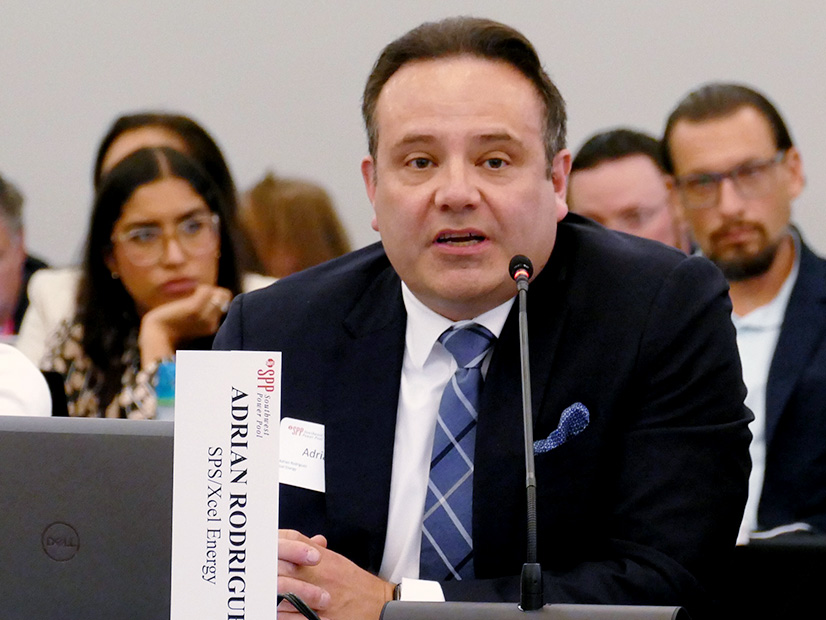
SPS CEO Adrian Rodriguez said during a Sept. 4 special board meeting that the utility has committed to a cost cap and regular reports to the board. He also said it is open to a third-party monitor, as suggested by Texas regulatory staff.
“We’re talking about working with the Southwest Power Pool board, the Southwest Power Pool staff, for this type of transparency and scrutiny and highlight that this is important not just for us, not just for our customers, not just for our regulators in Texas and New Mexico, but for all of you,” Rodriguez told the board, state commissioners and members. “We’re focused on reliability in the Southwest Power Pool and being mindful of the cost impacts to customers across SPP.”
SPP staff said the Potter-Crossroads-Phantom project, which crosses the New Mexico-Texas state line, remains the best technical solution to provide the region with voltage support. It also resolves several needs in the 2025 and 2026 Integrated Transmission Planning assessments and addresses load projections; the RTO’s latest 10-year forecast indicates 105 GW of potential load, almost doubling its current peak of 55 GW.
Casey Cathey, the grid operator’s vice president of engineering, said when the 765-kV project is removed from the 2025 ITP models, staff must add nearly 4 GVARs of temporary reactive power to support the region’s voltage. He said 35 generation projects totaling 10 GW of capacity, some of which are under construction, also are contingent on the SPS line.
“[The SPS project] is required before we can even contemplate moving forward with the 2025 ITP assessments and understanding what that portfolio looks like,” he said. “We did look at alternatives, multiple 345 facilities [and] double-circuit 500-kV facilities. All of those were actually more expensive, [had] wider rights of way and were just less optimal compared to the single 765.”
SPS submitted a cost-cap proposal to the board as part of its commitment to build the project in a “cost-effective manner, with reasonable and measured oversight and customer protections.” It also said it will forgo the return on equity applicable to the cost overruns above the current cost estimate and a 20% variance cap.
The company’s guarantee can be adjusted for exceptions consistent with those provided in competitive bids, such as changes in statutory tax rates, investment costs, import tariffs or secondary impacts on domestic markets, or the schedule resulting from changes in federal, state or local legislation and laws that became effective after Jan. 1. Other exceptions include force majeure (as defined in the SPP tariff) and increases in interest rates.
“I hope we have demonstrated our commitment and transparency to SPP, the staff, board and the commissioners by setting the foundation for 765-kV estimates,” Rodriguez said. “I want to highlight our commitment to being competitive, being transparent and being committed, not just to our customers at SPS but to the entire SPP as we’re evaluating this reliability project.”
He noted the exclusions are primarily based on items that are outside of SPS’ immediate control and those for which it has limited opportunity to mitigate.
The Members Committee approved the revised cost estimate with an 11-1 advisory vote. EDP Renewables opposed the motion, casting doubt on SPS’ cost-containment guarantee, and nine other members — primarily public power entities — abstained.
“We can be a case study on 765,” Rodriguez said. “Our transparency means that we have informed the market, including bidders, of our perspectives on this line, and we can be the case study to make sure that these types of major projects move forward with a clear understanding from the board, from the staff, as to what can be done, what issues arise and where cost mitigations can occur.”
Large Load Integration OK’d
Similar cost concerns were raised by regulators during a Sept. 3 education session on the 765-kV project and SPP’s fast-track study to integrate high-impact large loads (HILLs).
While they favored SPP’s tariff change (RR696) to expedite faster and more predictable interconnection timelines for rapidly developing large loads, they also want to maintain regional reliability, transparency and equitable cost allocation.
Minnesota Public Utilities Commissioner John Tuma spoke for several when he expressed worries about accommodating large loads that might not show up. He drew on the state’s experience in the Iron Range, where he said loads with service agreements don’t always materialize.
“We see a big technology boom. There’s going to be a lot of capital flowing in. It’ll look really sexy,” Tuma said. “Everybody wants to get in the middle of it, but some of them are going to bust, and that’s just a reality that we have to live with. … That’s one of the big concerns as a state that we have because in the end, we pay for our neighbors’ mistakes.
“We want to be quick and nimble. We don’t want to be dumb,” he added. “And so, I’m hoping that we continue to analyze these things carefully. We’re all partners in this together, and if one of our partners screws up, it could cost us and our ratepayers money.”
SPP CEO Lanny Nickell agreed. He said staff will work with the regulators and the Regional State Committee to develop a “fully informed and appropriate” cost-allocation approach for the future.
“The amount of load growth being projected, with much of that driven by data centers, will certainly drive significant transmission upgrade investment,” he said. “We need to make sure that ratepayers aren’t having to bear unfair portions of the cost needed to connect those loads while we have some time to figure out the best cost-sharing approach.”
Staff revised the large load policy to reflect the numerous comments and feedback received from stakeholders, removing conditional high-impact large load service (CHILLS) and the design associated with dispatch, study and charges for the service from its original proposal. It also removed one of three paths for high-impact large load generation assessment (HILLGA).
HILL studies will remain on a 90-day timeline. Changes include a revised HILL definition that clarifies its transmission service study process and its independence from non-conforming load.
SPP members endorsed the tariff change, 18-1, with three abstentions. OGE Energy voted against the measure, citing concerns with delays in the interconnection process and accreditation issues with increases to the planning reserve margin.
Approval is contingent upon SPP modifying the tariff to reinstate a 60-day study under Attachment AQ, which governs upgrades or other changes to delivery point facilities.
Stakeholders approved RR696, as modified, during the Markets and Operations Policy Committee’s own special meeting in August. The measure passed with 95.7% approval after failing during MOPC’s regular quarterly meeting in July at 53.7%. (See SPP MOPC Passes Revised Large Load Policy.)
The tariff change resulted from a directive by then-Chair John Cupparo in May that staff propose by the board’s August meeting a timely, scalable and reliable approach to manage the exponential growth of load demand across the footprint. (See “Cupparo Issues ‘Executive Order,’” SPP Board OKs 1-time Study for LREs’ Gen Needs.)
The CHILLS policy will be taken up during the MOPC, RSC and board meetings in October and November.