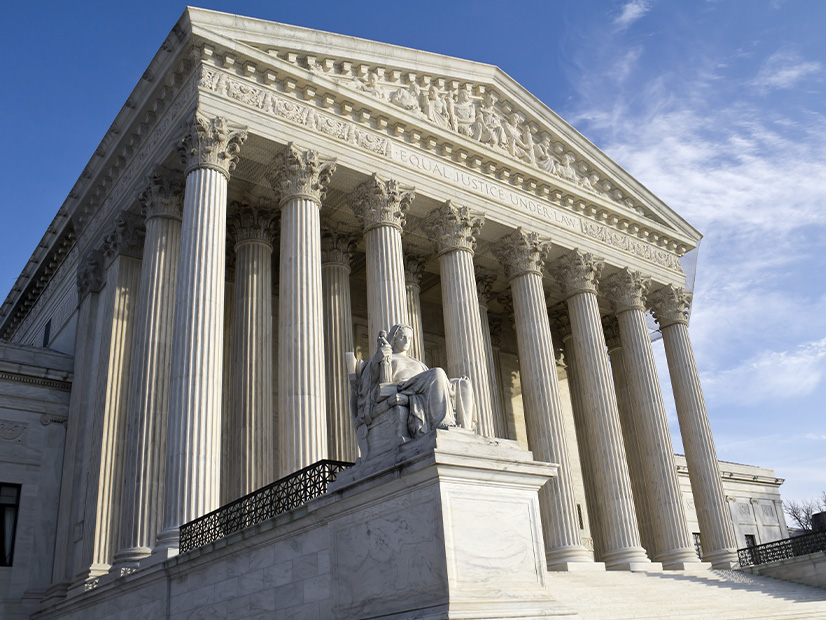
President Donald Trump is poised to have more than one of his own nominees on FERC for the first time in his second term, and, coupled with ongoing cases working their way through the courts, that has raised questions about the future of its independence.
When asked about FERC’s independence during their confirmation hearing in early September, both Laura Swett and David LaCerte gave the standard answer of following the law and FERC’s internal rules and regulations. But depending on the results of several cases, the laws governing the commission and other federal agencies could go through some major, radical changes. (See Senators Focus on FERC’s Independence at Swett, LaCerte Confirmation Hearing.)
The argument against independent agencies comes from subscribers of the “unitary executive theory” which, as Project 2025 said, finds them “constitutionally problematic” because in their view, the opening line of Article II of the Constitution vests executive power solely in the president.
While they exercise executive authority, independent agencies are largely free from White House influence, in part because of laws limiting the president’s ability to fire their members to certain circumstances. These laws were deemed constitutional in 1935 in Humphrey’s Executor v. United States, a case that proponents of the unitary executive have made a target for the Supreme Court revisiting. The precedent is being tested by Trump firing members of several independent agencies and the resulting wrongful termination lawsuits, and many observers see Humphrey’s Executor on the chopping block before the current justices.
“What [Humphrey’s Executor] says is that Congress, when enacting statutes, creating or regulating agencies, can condition or limit the president’s ability to fire certain officials for things like misuse of office,” Yale Law School associate professor Joshua Macey said in an interview. “It’s called ‘for cause removal.’ And, so, the sort of recent trend by the Supreme Court is towards the unitary executive thesis, which says that the president can fire any agency official for any reason whatsoever.”
Beyond the legal issues are “norms-based arguments” about whether a president should be able to control everything an agency does. “The president has shown that he’s willing to basically use all the tools at his disposal to control agencies,” Macey said. “With FERC, he’s been a little bit more reluctant.”
But the Department of Energy’s use of Section 202(c) of the Federal Power Act to keep two old fossil-fired power plants running this summer (and extending both orders this fall) was unprecedented. Macey also cited recent efforts to unseat Federal Reserve Governor Lisa Cook over allegations of mortgage fraud as another example of the White House trying to effectuate the unitary executive theory.
And while naming Democratic FERC Commissioner David Rosner as chair appeared bipartisan on its face, sources told RTO Insider they saw it as Trump exerting control over the agency. Under the precedent of the chair being of the same party as the president, Commissioner Lindsay See, the lone Republican on FERC, would be expected to be chair. (See FERC Independence Likely Coming to an End with Christie’s Exit.)
Ari Peskoe, director of Harvard Law School’s Electricity Law Initiative, pointed to the department’s Notice of Proposed Rulemaking during Trump’s first term as the kind of policy that the administration might try to impose if the unitary executive theory prevails at the Supreme Court. The proposed rule, rejected unanimously by a FERC comprising a majority of Trump’s nominees, would have paid power plants with on-site fuel their full operating costs.
“Congress designed agencies like FERC to operate somewhat independently from the White House,” Peskoe said. “I think part of the reason for that is for the stability of these industries. And particularly for energy industries regulated by FERC, that are making such large investments … unstable policies like we’ve seen at some politically controlled agencies would I think be disastrous for the development of energy infrastructure.”
So far, the Supreme Court has only dealt with the issue by overruling injunctions against firings from lower courts, Peskoe said. In one such decision in May, in a case involving the National Labor Relations Board and the Merit Systems Protection Board, Chief Justice John Roberts wrote that the government was likely to show both agencies “exercise considerable executive power.”
The court said it would benefit from full briefing and argument on the case, which is currently awaiting a final decision from the D.C. Circuit Court of Appeals.
“I’ve been reloading the D.C. Circuit opinion page every day to see whether it will rule on the merits, and that’s the case that I think would be the vehicle for getting this issue on the merits to the Supreme Court,” Peskoe said.
‘Distinct Historical Tradition’
The only case that has brought the Humphrey’s Executor issue as applied to FERC directly before the Supreme Court is an appeal of an enforcement action the agency issued against energy efficiency provider American Efficient, which has challenged the legality of the commission itself. (See FERC Seeks Nearly $1 Billion in Penalties from EE Provider in MISO, PJM.)
“We’ll see what the Supreme Court ultimately says,” Peskoe said. “There’s a lot of ways this could go that maybe would not impact FERC directly. What the Supreme Court has suggested is that somehow the Federal Reserve may be different than other agencies. Maybe there’s a way that FERC could also be different from other agencies.”
In that May decision, Roberts wrote that the Federal Reserve “follows in the distinct historical tradition of the First and Second Banks of the United States.”
Peskoe argued that FERC has its own “distinct historical tradition” in the form of ratemaking commissions, most notably the Interstate Commerce Commission (ICC), a federal railroad regulatory agency created in 1887 that had the same “for cause” removal conditions for commissioners.
“Congress’ goal there was to create deliberative bodies — not political bodies — that were going to handle the sensitive issue of regulating the railroads and setting their rates in terms of service,” he added. “That’s a ratemaking model that persisted as Congress regulated numerous industries under basically the same law over the next 50 or so years, and many of those issues don’t really exist anymore. But FERC is kind of the descendant of the ICC, and when the courts look at these separation-of-powers issues, that history may very well be relevant.”
Ratemaking is a legislative function, not an executive function, and that could help to distinguish FERC, assuming underlying legal precedents change, Peskoe said.
“Congress and state legislatures were completely incapable of doing this, and there were two basic reasons for this,” Macey said. “The first was rate cases. The question of ‘Can Congress review investment and then approve rates that will be passed on to captive ratepayers?’ is an enormously complex and time-consuming endeavor, and no Congress or state legislature had any interest in doing it.
“The second thing is, there’s a time lag. You need to consistently review these things. It’s not really possible to say we’re going to come in once a year, once every two years, and regulate. You need to look at investments in a dynamic fashion over time. That requires expertise, but it also requires a built-out staff whose full-time job is to do this.”
The Federal Reserve is likely to get an exemption from the end of Humphrey’s Executor, Macey said, but it is much less likely that FERC would get one. That leaves two questions, he said: whether there is any value to FERC independence, and whether adjudicatory agencies are exempt.
“FERC does a lot of adjudication,” Macey said. “Utilities file tariffs with FERC, and FERC either approves or rejects those tariffs; that looks less like rulemaking than like adjudication. And typically, we think adjudicator judges need to have some amount of independence because of due process reasons. We have to decide adjudication on the law, not based on political considerations.”
The Supreme Court has not touched that issue, but it will be forced to once the “for cause” protections are removed from FERC and other adjudicatory agencies, Macey said.
Ex Parte Communications
FERC’s ex parte rules already distinguish between its adjudicatory function and its rulemaking function: Commissioners cannot discuss pending rates, but commission chairs have often discussed rulemakings with the White House in past administrations.
Whether the Trump administration would want to intervene in adjudications before the agency in an open question, but the anti-wind policies at other agencies show that the White House cares about certain electricity issues more than others.
“My own view is that probably the primary justification for agency independence is that some matters involve significant expertise, and there is a real benefit to having to not completely immunizing them from political trends but at least limiting the kind of whipsaw reaction that comes in with a policy change every four years,” Macey said.
Presidents will always influence FERC policy, Macey noted, even if that remains solely through the power to nominate commissioners and appoint the chair. While drastic actions like freezing permits for clean energy resources might seem like they favor an administration’s interest, they lead to unintended consequences, he said.
“I think they are pretty bad for capital markets and investment because investors like stability much more than they like a policy that slightly favors their own interests,” Macey said.
FERC would have to change its ex parte rules, or at least how they are interpreted, to start talking about ratemaking cases with the White House, Paul Wight, a partner at DLA Piper and a former FERC staffer, said in an interview.
“There’s a couple of positions where there could be changes in the way it’s currently interpreted,” Wight said. “One position could be it’s not obvious that White House communications with FERC would always be prohibited by these ex parte rules. That’s a legal question.”
FERC ex parte regulations are arguably stronger than what the law requires, he added. But allowing for White House communications “would be a big change.”
“If they wanted to change the regulations, they would have to go through a process, and there would have to be comments from parties on whether or not this is a good policy to allow more direct communication,” Wight said.
The industry wants transparency around the commission’s regulations and, with its need to manage long-term, major investments, it also values certainty.
“You want to know what the process is and [whether] it’s fair,” Wight said. “There’s a lot of strong policy points to be made, [but] if you went to a less independent commission with more direct White House control, it would definitely be a change in the industry. It would be something that folks would have to adapt to. And, you know, I could see pros and cons, perhaps.
“We haven’t lived in that regime, but I think the history of FERC independence [has] been a hallmark of FERC, and I think it served the industry very well.”