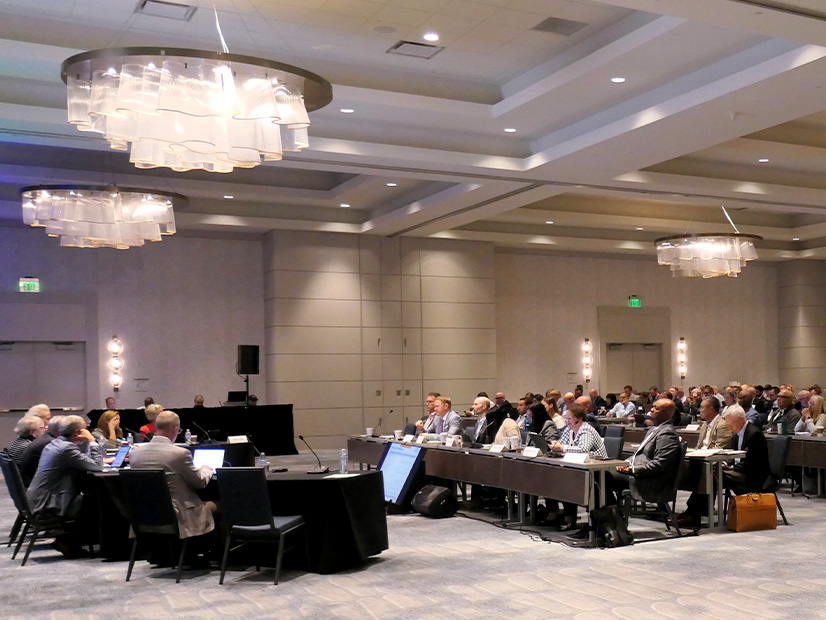
DETROIT — MISO said the summer of 2025 was the most demanding since 2012, though the RTO steered the grid with only a single maximum generation event.
“This summer was one of the most challenging in a decade,” Executive Director of System Operations Jessica Lucas told the Markets Committee of the MISO Board of Directors on Sept. 16.
Lucas said heat and humidity across the footprint were consistently high and that load exceeded 100 GW or higher for more than 750 hours over the summer, a number not seen since 2012 and nearly triple that of 2024.
The summer heat triggered more than 40 Energy Emergency Alerts across the Eastern Interconnection, but in MISO, “we only had one escalation” to an emergency, Lucas said.
MISO experienced a “sharp increase in outages” over the summer, Lucas said. The RTO reported 46 GW in average daily generation outages, compared to summer 2024’s 31-GW average, culminating in a 48% increase year over year. Lucas said members reported “equipment failure” as the leading cause of outages.
“It’s perhaps too early to call this a trend, but it’s an important data point to monitor to see if this extends into the fall,” Lucas said.
At a MISO board meeting Sept. 18, CEO John Bear said summer 2025 was “exceptionally demanding” and “signals a new normal for grid stress.”
The RTO encountered two rough patches in late June and again in late July. Lucas said that from June 21 to 24, the footprint contended with high demand, low wind output and high outages, leading to a maximum generation emergency on June 23. (See MISO Declares Max Gen Emergency in Heat Wave.)
Independent Market Monitor David Patton said he was impressed MISO avoided an emergency declaration on June 24 when virtually every other control area entered emergency procedures.
“What we saw this summer actually bears out what I’ve been saying: that ‘MISO is the most reliable RTO’ — at least among the ones that we monitor,” Patton said and again criticized NERC’s “high-risk” rating for the RTO.
MISO logged its almost 122-GW summer peak in late July. It also issued several capacity advisories for its South region throughout the season. (See MISO on Track to Wrap Summer with 122-GW Peak, Addresses Frequent South Advisories.)
The RTO kept up a near-daily cadence of capacity advisories for MISO South into September. The grid operator repeatedly said either forced outages, limited transfer capability or a combination of both were the culprits.
“You might have noticed we’ve been leveraging our capacity advisories more frequently,” Lucas said.
Stakeholders can construe the repeat advisories as an “indicator” of heightened reliability risks in MISO South, she said, but the RTO wants to communicate “so it doesn’t feel like anyone is caught by surprise” if it needs to institute emergency actions to deal with transmission or capacity issues.
Lucas also said MISO is developing a “set of criteria or methodology to step out of emergency declarations.” She said determining when gird conditions no longer require emergency actions and terminating declarations is a complicated decision that has operating ramifications.
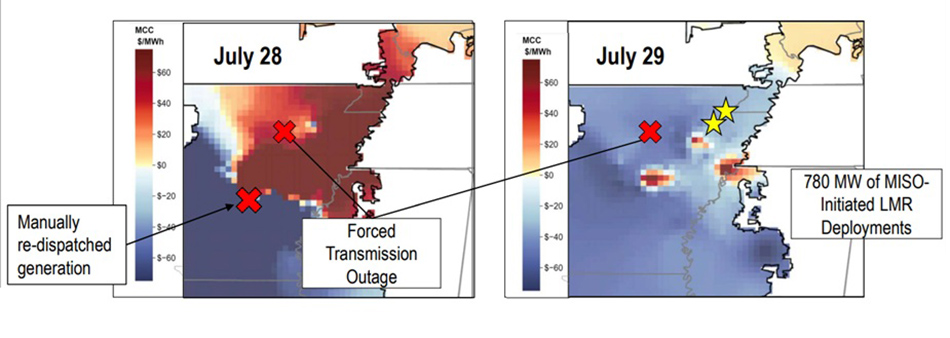
Amid the late July heat wave, MISO reported it unexpectedly lost a 500-kV line in MISO South on July 28-29, leading it to order a local transmission emergency and 780 MW of long-lead load-modifying resources to dial back demand.
Data from Yes Energy show Entergy Arkansas’ 500-kV Keo-West Memphis transmission line from Little Rock, Ark., to Memphis, Tenn., was offline July 28-29.
Lucas said MISO issued six declarations July 29 to manage the situation.
Patton said MISO’s LMR use means it is learning to use demand response to manage transmission emergencies in addition to capacity emergencies. He also said MISO incurred only about $8 million in uplift charges over the summer because of sharper resource commitments and operating decisions.
“That’s like nothing,” Patton said. “My guess is that PJM is going to be in the hundreds of millions. …This pattern is really impressive.”
Finally, MISO set an all-time solar peak of 14.1 GW on Aug. 3. The new record was double the solar output MISO achieved in summer 2024.
Patton said the larger solar fleet has brought ramping challenges that are growing with the solar fleet. He said cumulative evening net load ramp demand “has grown sharply” from about 1 GW in 2023 to nearly 6 GW in 2025 and asked MISO to continue to keep an eye on its increasing requirements. Evening ramping needs also occur later on summer nights, Patton said, with the largest need moving from 4 p.m. ET to 6 p.m. because of solar tapering down.
RTO Insider is a wholly owned subsidiary of Yes Energy.