Stakeholders Endorse Manual Revisions Reflecting Creation of Modeling Users Forum
The Operating Committee endorsed revisions to Manual 3A: Energy Management System Model to reflect the committee’s sunsetting of the Data Management Subcommittee (DMS) to be replaced by the Modeling Users Forum. The forum allows for discussions on the “challenges and opportunities with model information,” how new technology can be employed on the grid and improvements to the energy management system (EMS). Ahead of the February vote to establish the forum, PJM said it would allow for a focus on long-term goals and initiatives. (See “Other Committee Business,” PJM OC Briefs: Feb. 6, 2025.)
The manual revisions replaced references to the DMS, updated links and replaced the subcommittee’s email list.
September Operating Metrics
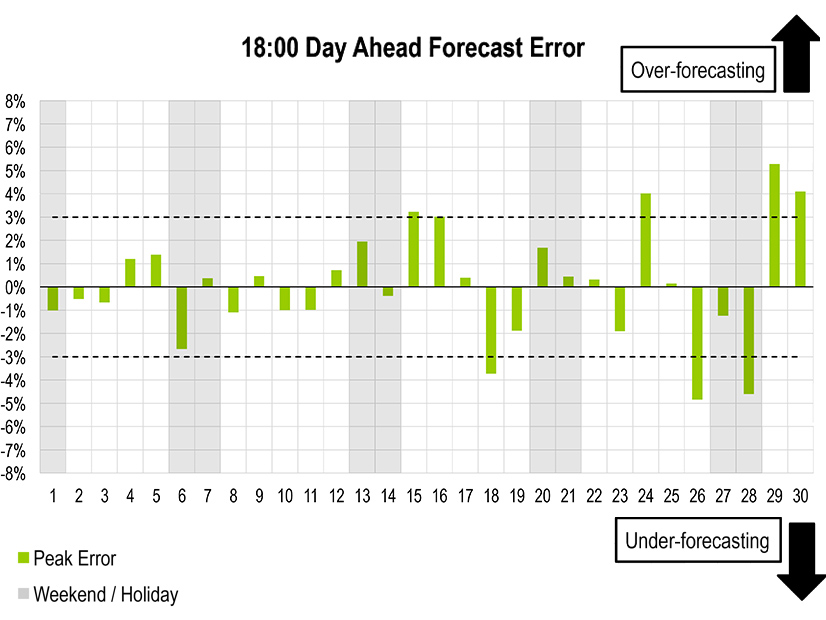
PJM observed an hourly load forecast error rate of 1.18% during September, with the rate for peak hours at 1.84%, according to the monthly operating metrics. There were eight days where the error rate for the forecast peak exceeded the RTO’s 3% benchmark. On Sept. 29, the peak was 5.28% over forecast; the peak on the 30th and 24th came in around 4% lower than expected; and the 15th and 16th were 3.23% and 3.02% over forecast, respectively. Sept. 26 saw the highest under forecast at 4.84%, followed by the 28th at 4.6% and the 18th at 3.73%. The error on each of the days was attributed to temperatures deviating from expectations.
The month saw four spin events, three high system voltage actions, two geomagnetic disturbance warnings and 22 post-contingency local load relief warnings. Six shortage cases were approved: one on Sept. 1 due to a primary reserve shortage while hydro resources were pumping, two on Sept. 4 attributed to a spin event following loss of generation and three on Sept. 25 due to low area control error following a spin event caused by loss of generation.
The Sept. 1 spin event lasted eight minutes, 59 seconds and had 2,421 MW of generation and 542 MW of demand response assigned, with 69% and 89% responding, respectively. Another deployment on Sept. 25 lasted 10 minutes, 29 seconds and had 2,754 MW of generation and 589 MW of DR assigned, of which 75 and 83% responded; a second event that day lasted 7 minutes, 43 seconds and had 2,810 MW of generation and 589 MW of DR assigned, with 60 and 56% responding. The fourth event was on Sept. 29, lasting 6 minutes, 45 seconds and seeing 2,910 MW of generation and 496 MW of DR assigned, of which 49 and 86% responded.
First Read on Manual 14D Revisions
PJM’s Ray Lee presented revisions to Manual 14D: Generation Operational Requirements related to how transmission owners might be required to submit resource proposals under the reliability backstop, PJM’s EMS communications and generator data reporting requirements. Staff plan to seek endorsement of the language during the Nov. 6 OC meeting.
The changes seek to clarify the third step in the black-start, black-stop process, when PJM would open a request for proposals soliciting solutions to reliability needs from transmission and generation owners. The backstop has become an increasing focus over recent months as PJM has shined more detail on the resource adequacy constraints it believes will accompany rising data center load.
Generation owners would be required to report possible start-up issues to the limits they are required to report during a cold weather advisory. Guidelines on the data resource owners must provide PJM were updated to reflect the cold weather advisory drill and cold weather operating limit data requests.
A section that was deleted inadvertently was added back into the manual to describe how communications between control centers will be conducted through the inter-control center communications standard.