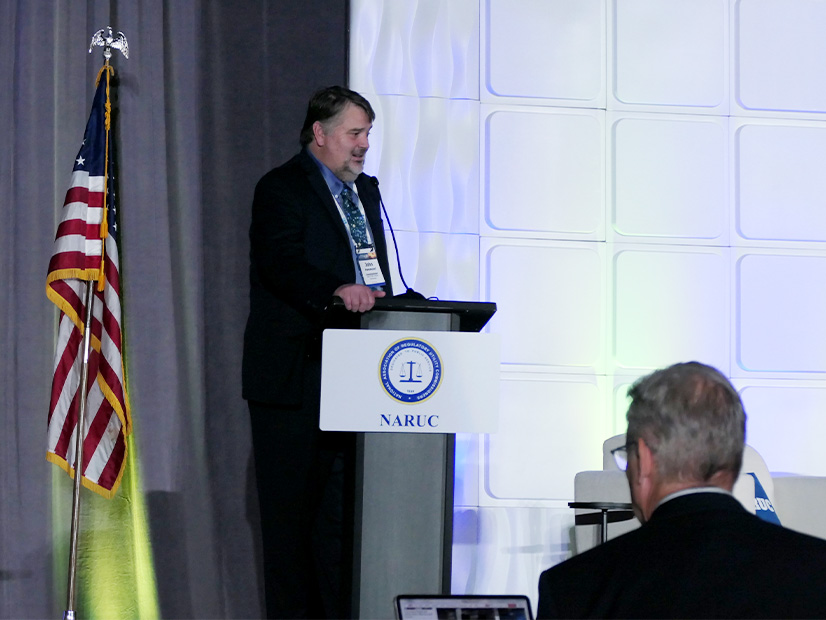
SEATTLE — The National Association of Regulatory Utility Commissioners passed a resolution urging FERC to resist the Department of Energy’s push to give itself jurisdiction over large loads interconnecting with the grid — an authority historically belonging to state regulators.
NARUC’s Board of Directors approved the measure (EL-1) in a Nov. 11 vote at the organization’s Annual Meeting.
The vote comes just over two weeks after Energy Secretary Chris Wright issued an Advance Notice of Proposed Rulemaking (ANOPR) pressing for FERC to extend its jurisdictional authority to include the interconnection of large loads — including hyperscale data centers. (See Energy Secretary Asks FERC to Assert Jurisdiction over Large Load Interconnections.)
DOE argued the new rules would be in the public interest and align with the Trump administration’s goals of reviving U.S. manufacturing and dominating the development of artificial intelligence.
But through the NARUC resolution, state regulators are asking FERC to “preserve and affirm states’ retail regulatory authority under the Federal Power Act” and “ensure that large load interconnections do not compromise grid reliability or impose undue costs on retail customers, and respect state tools for promoting system flexibility and equitable cost allocation.”
The resolution provides NARUC a foundation for developing initial comments on the ANOPR, Idaho Public Utilities Commissioner John R. Hammond Jr., chair of the group’s Committee on Electricity, told RTO Insider at the conference.
“We know the resolution is broad. We wanted it to be nimble,” said Virginia State Corporation Commission Judge Kelsey Bagot, who guided the document through the committee to gain consensus ahead of the board vote.
“We did get a lot of collaboration among NARUC members” on the resolution, Bagot said.
Hammond agreed that the group found a lot of “commonality” on the issue.
Comments on the ANOPR are due Nov. 21, which Bagot acknowledged is a “tight deadline.”
‘Unprecedented Expansion’
In an Oct. 23 letter to FERC accompanying the ANOPR, Wright contended that “the interconnection of large loads directly to the interstate transmission system to access the transmission system and the electricity transmitted over it falls squarely within the commission’s jurisdiction.”
The ANOPR offered a handful of legal justifications for the change, saying that:
-
- large load interconnections are a critical component of open access transmission service that require minimum terms and conditions to ensure non-discriminatory transmission service;
- interconnection of large loads directly affects FERC-jurisdictional wholesale rates, over which the FPA has granted the commission exclusive authority; and
- the rule change would not violate state jurisdiction over retail sales.
The ANOPR also said that any views controverting the changes would conflict with the FPA’s core requirement that FERC have exclusive jurisdiction over transmission in interstate commerce.
But with the NARUC resolution, state regulators are clearly disputing those points.
A draft of the resolution said the proposed rulemaking “represents an unprecedented expansion of federal jurisdiction and potential intrusion on the states’ historic retail regulatory authority under the Federal Power Act, introducing potential confusion, unintended customer consequences and/or legal uncertainty where none currently exists.”
But the final resolution removed that language — and toned down other statements, instead saying “it is imperative that FERC, in any final rulemaking, make clear that it is affirmatively not asserting jurisdiction over end-use sales, which falls squarely within the exclusive jurisdiction of state retail energy regulatory authorities.”
The resolution goes on to explain that state regulators exercise oversight over resource adequacy, grid reliability and maintaining affordability for retail customers. It says their authority over integrated resource planning stems from their “reserved jurisdiction” under Section 201(b) of the FPA, “enabling states to oversee utilities’ long-term forecasting of electricity demand and evaluation of supply- and demand-side resources to meet that demand in a cost-effective, reliable and sustainable manner.”
The resolution notes also that NERC’s most recent Long-Term Reliability Assessment shows electricity demand is growing at the fastest rate in two decades, with especially steep increases expected for winter peaks. It cautions that “large load interconnections without sufficient available generation capacity could threaten reliable power service to existing retail customers,” with grid operators potentially lacking sufficient resources to maintain system stability during peak demand and extreme weather events.
The regulators warn also that the costs for large load interconnections, presumably mandated by FERC — including needed transmission upgrades — could unfairly fall to retail ratepayers “if not properly allocated.”
The resolution points out that at least “at least 20 states have approved or have pending large load tariffs or similar measures, which may include financial commitments, curtailment protocols and minimum contract terms to allow for the rapid interconnection of large loads without compromising grid reliability or unduly burdening existing retail customers.”
Drawing a Line
Judge Bagot expressed confidence that FERC can “find a solution states can be comfortable with,” noting the commission’s recent decision on Tri-State Generation and Transmission Association’s High Impact Load Tariff (HILT) could offer perspective on where the commission will stand.
In that order, FERC rejected the HILT, saying “certain aspects” of the proposed tariff “appear to present an impermissible intrusion on retail rate regulation” by state commissions. (See FERC Rejects Tri-State’s ‘High Impact Load Tariff’ Aimed at Data Centers.)
State regulators think “a line can be drawn” that preserves state authority but “allows the feds to be involved” with large load interconnections, Bagot said.
An earlier version of this article contained language from a draft version of the resolution. The story has been updated to reflect the wording in the final document.