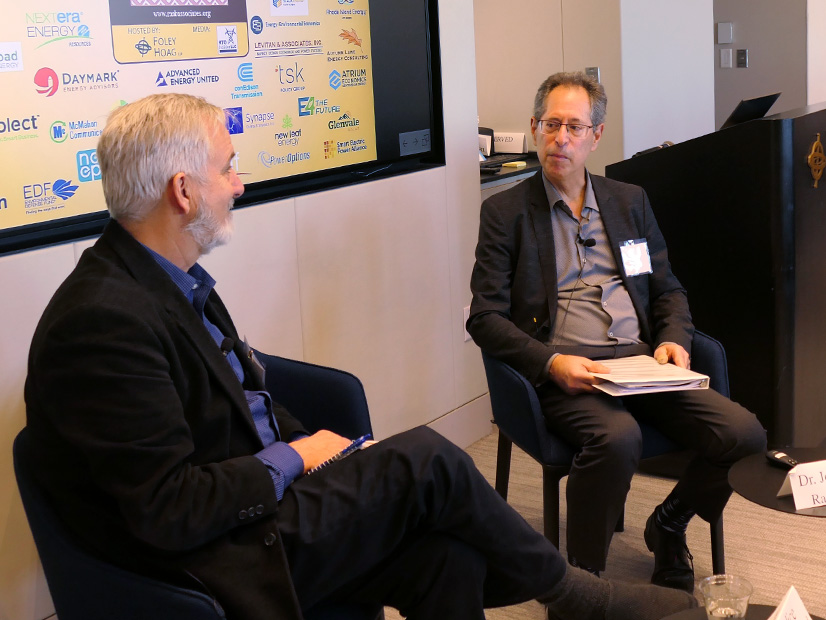
BOSTON — Raab Associates held its final New England Electricity Restructuring Roundtable on Dec. 5, bringing reflections from speakers about the legacy of restructuring and the future of the power sector in the region.
Several speakers praised the Roundtable for consistently bringing together a wide range of perspectives and interests, and helping to promote collaboration and consensus among stakeholders.
“The diversity of perspectives that are at the table is pretty incredible,” said David Cash, former EPA regional administrator for New England. “There are people here who have sued each other; there are people here who are competitors.”
Dan Sosland, president and co-founder of the Acadia Center, said the Roundtable has been somewhat unique among power industry events for its inclusion of climate and environmental perspectives.
“At the Roundtable we were co-equals,” Sosland said. “We were included, and that’s a testament to” Raab Associates President and Roundtable convenor Jonathan Raab.
The Roundtable was founded in 1995 to bring stakeholders together to discuss the details and challenges of electricity industry restructuring. It opened to the public after Massachusetts passed its restructuring law in 1997, and Raab Associates formally took over the event from the Massachusetts Department of Energy Resources in 2000.
As the states worked through the kinks of restructuring, the Roundtable gradually became “much more of a policy forum,” said Raab, who helped found the Roundtable and moderated the events for most of the 30-year run.
In 2026, the consulting firm Apex Analytics will take control of the Roundtable. The company was selected through a competitive request for proposals and plans to hold its first event in March.
“The Roundtable’s strength lies in its adaptability and commitment to discussing meaningful substance around the evolving energy landscape,” said Matt Nelson, principal at Apex and former chair of the Massachusetts Department of Public Utilities. “Our team is committed to maintaining that core while thoughtfully exploring ways to evolve and provide relevant content as industry needs change.”
Reflections on Restructuring
The event also may mark ISO-NE CEO Gordon van Welie’s last public appearance at the helm of the RTO he has led since 2001. (See Retiring ISO-NE CEO van Welie Reflects on 25 Years at the RTO.)
He emphasized the progress that has been made around collaboration in the region, saying, “Even when things do seem a bit tense, we’ve developed mechanisms to deal with those frictions.”
Restructuring and the move to wholesale markets have brought customers significant savings, though not all initiatives have worked as well as he would have liked, he said.
“I would say we made a mistake in going to the Forward Capacity Market back in 2004,” van Welie said, adding that it “became too much of a crutch” for ensuring resource and energy adequacy.
ISO-NE’s proposed move to a prompt capacity market will “hopefully stimulate bilateral contracting,” he said. “The market needs to invest more on a foundation of bilateral contracting with the spot capacity market really being a deficiency charge for somebody who’s not fully hedged.”
Rebecca Tepper, secretary of the Massachusetts Executive Office of Energy and Environmental Affairs, praised ISO-NE’s reliability record.
“ISO-NE has never had to call a control outage in its history,” Tepper said. “It’s something that we shouldn’t take for granted and a huge benefit for consumers.”
“Some of it has been luck — we dodged the bullet once or twice — but a lot of it has been operational awareness and market design,” van Welie said.
Tepper said it has taken longer to get the retail side of restructuring right, pointing to the lingering problem of predatory supply practices that target residential customers. The growth of municipal aggregation programs in Massachusetts in recent years has enabled better protections and options for residential customers, she said.
As the ongoing deployment of advanced metering infrastructure in the region enables new rate designs that incentivize shifting demand away from peak hours, van Welie said New England should consider “a more command-and-control structure for [demand response],” allowing customers to give up some control of their home appliances in exchange for a lower rate.
Looming Supply Challenges
Both van Welie and Tepper also emphasized the need to focus on bringing in new sources of supply to meet rising demand, and Tepper said regional collaboration will be essential to addressing looming supply challenges.
Katie Dykes, commissioner of Connecticut’s Department of Energy and Environmental Protection, said the states are “working on multiple multistate RFPs; that is becoming much more of the norm than the exception.”
Several speakers stressed the importance of demand-side innovation, new programs and rate reforms to help prevent supply issues in the coming decades.
While most demand growth projections forecast peak demand to roughly double by 2050, “I don’t think these have to be written in stone,” said Jamie Dickerson, senior director of energy and climate programs at Acadia. He pointed to a Brattle Group study indicating that grid flexibility could reduce New York’s 2040 winter peak by about 21%. (See Study Finds Considerable ‘Grid Flexibility’ Potential in New York.)
Jesse Jenkins, a Princeton University associate professor focused on the decarbonization of energy systems, echoed Dickerson’s comments and said even greater demand flexibility gains may be achieved if costs come down for technologies like thermal storage.
“There are lots of ways we can cut [peak demand forecasts], including ground-source geothermal, which is often twice as efficient, if not more, than air-source heat pumps,” he said.
Dickerson also stressed the importance of energy efficiency investments while urging policymakers to find more progressive ways to fund expanded EE programs, including through the tax base.
“We do need to lean on those with a greater ability to pay,” he said.