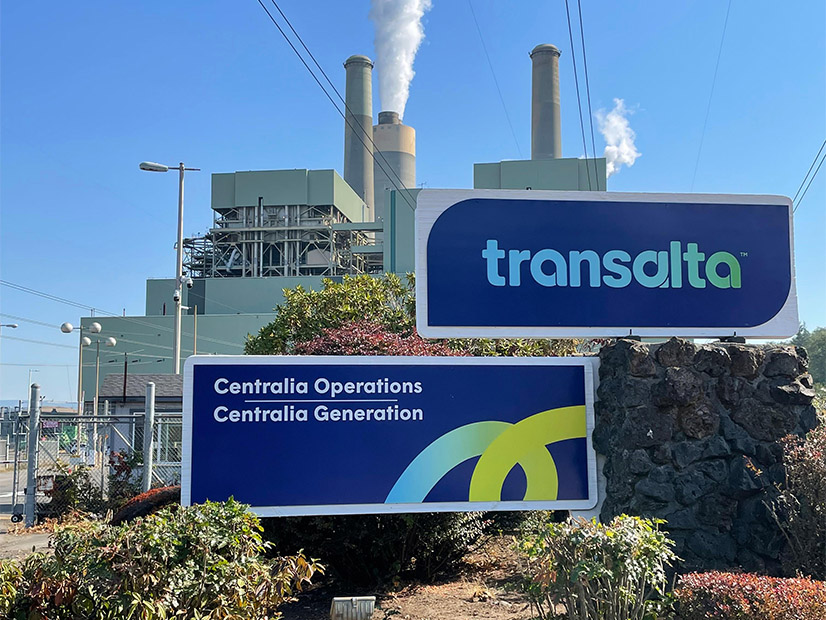
Citing an energy “emergency” in the Pacific Northwest this winter, the U.S. Department of Energy ordered TransAlta to continue operating Washington state’s last coal-fired generating plant for three months beyond its scheduled retirement.
Unit 2 at the Centralia Power Plant was slated for closure at the end of December based on a 2011 Washington law and subsequent agreement between the state and TransAlta.
But in a controversial move that has sparked the ire of environmental groups, DOE on Dec. 16 directed the company to keep the 670-MW unit running until March 16, 2026. Unit 1 at the facility was shut down in 2020 as part of the first phase of the plant’s retirement.
“The reliable supply of power from the Centralia coal plant is essential for grid stability in the Northwest. The order prioritizes minimizing the risk and costs of blackouts,” DOE said in the press release accompanying the order (202-25-11), which follows similar orders to extend the operation of older fossil fuel plants. (See DOE Issues 3rd Emergency Order to Keep Michigan Coal Plant Open and Energy Secretary Wright Issues 3rd Order Keeping Eddystone Open.)
Energy Secretary Chris Wright took the opportunity to criticize Democratic environmental policies that he said have forced the closure of coal generators across the country.
“The last administration’s energy subtraction policies had the United States on track to experience significantly more blackouts in the coming years. Thankfully, President Trump won’t let that happen,” Wright said in the release. “The Trump administration will continue taking action to keep America’s coal plants running so we can stop the price spikes and ensure we don’t lose critical generation sources.”
The order comes a week after Alberta-based TransAlta announced it had signed a long-term tolling agreement with Puget Sound Energy that enables the plant to be converted to a 700-MW natural gas-fired facility.
“TransAlta is currently evaluating the order and will work with the state and federal governments in relation thereto. The coal-to-gas conversion project, announced on Dec. 9, 2025, remains a priority for TransAlta,” the company said in a statement. “Further information regarding the order will be provided as it becomes available in due course.”
The company declined to answer questions about its readiness for keeping Centralia operable for the winter.
‘Sudden Increase’
In describing its rationale for the order, the department pointed to NERC’s 2025-2026 Winter Reliability Assessment released in November, which included WECC’s Northwest region among seven in North America that are at “elevated” risk for grid outages during “extreme weather.”
That risk stems in part from an expected 9.3% increase in regional peak electricity demand, accompanied by tightening supplies. Still, NERC’s assessment did not find any regions to be at “high” risk for outages — including the Northwest. (See NERC Winter Reliability Assessment Finds Many Regions Facing Elevated Risk.)
Quoting from the assessment, DOE noted NERC found that the Northwest should have “sufficient resources” for expected peak load conditions but that the region’s balancing authorities were “likely to require external assistance during extreme winter weather that causes thermal plant outages and adverse wind turbine conditions for area internal resources,” with that assistance possibly compromised by a “regionwide” extreme event.
DOE’s other justification for the order: a September 2025 study on Northwest resource adequacy by Environmental and Energy Economics that found “accelerated load growth and continued retirements create a resource gap beginning in 2026 and growing to 9 GW by 2030” and that “load growth and retirements mean the region faces a power supply shortfall in 2026.” (See 9-GW Power Gap Looms over Northwest, Co-op Warns.)
The order contends that Section 202(c) of the Federal Power Act authorizes the energy secretary “to require the continued operation of Centralia Unit 2 when the secretary has determined that such continued operation will best meet an emergency caused by a sudden increase in the demand for electric energy or a shortage of generation capacity … Such is the case here.”
The order calls for TransAlta “take all measures necessary” to ensure Centralia is “available to operate at the direction of either” the Bonneville Power Administration in its role as a BA or CAISO in its role as the reliability coordinator. It also requires the plant to comply with “applicable environmental requirements” and directs TransAlta to provide DOE with information about its operations plan by Dec. 30.
The department also directed BPA to “facilitate” Centralia’s transmission service “as needed.”
Asked about the roles outlined for BPA and whether DOE had consulted with the federal power agency before issuing the order, BPA spokesperson Kevin Wingert said it still was reviewing the text and directed questions to DOE.
CAISO spokesperson Jayme Ackemann told RTO Insider the ISO was made aware of the order only after it was issued and was still reviewing it.
The department did not respond to questions about what Western electricity sector entities it consulted before issuing the order.
‘Incredibly Unproductive’
Environmental groups lashed out at the order, with the Environmental Defense Fund calling it an “illegal mandate.”
“Once again, the Trump administration is upending state and local decisions to force an aging, costly, polluting coal plant to stay open,” Ted Kelly, EDF’s director and lead counsel for U.S. clean energy, said in a statement.
EDF pointed to DOE’s repeated extension of emergency orders for the J.H. Campbell coal plant in Michigan and the Eddystone oil-and-gas plant in Pennsylvania, “despite evidence that both plants are unreliable, highly polluting facilities and are not necessary to meet near or long-term energy needs.”
“Let us be clear: There is no ‘energy emergency’ in the Pacific Northwest that would justify forcing the continued operation of an old and dirty coal plant that endangers public health, worsens climate pollution and has long been slated for retirement,” Sierra Club Washington State Director Ben Avery said in a statement. “All the evidence shows that when Centralia shuts down, customers’ costs will decrease and air quality will improve. Instead of lowering bills or protecting families from harmful pollution, the Trump administration is abusing emergency powers to prop up fossil fuels at any cost.”
“This federal overreach is incredibly unproductive,” said Lauren McCloy, utility and regulatory director at the NW Energy Coalition. “People across the industry in the Northwest are working hard to plan for, acquire and build the resources we need to have a clean, affordable, reliable electricity grid. The closure of this plant has been planned for over a decade, and keeping it running beyond its useful and economic life is not the answer.”
“The shutdown of Washington’s last coal plant has been in the works for nearly 15 years,” Earthjustice attorney Patti Goldman said. “Washingtonians don’t want or need coal in their stockings this year.”