WASHINGTON — The challenges and opportunities of meeting demand from new large loads like data centers took center stage at the National Association of State Energy Officials’ recent Energy Policy Conference.
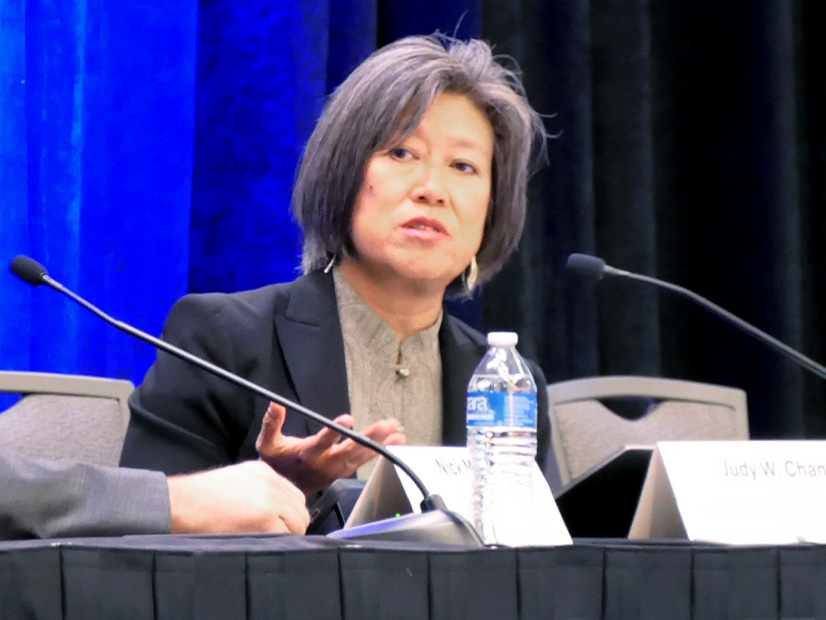
“I think there’s an opportunity right now to think about how the transmission system can be enhanced while we’re going through this growth,” FERC Commissioner Judy Chang said Feb. 4. “So, there is an opportunity where when large loads come in, it can actually keep rates steady while we enhance the grid.”
Regulators could get it wrong and miss that opportunity, leading to higher rates for all consumers, she added. When large loads, potentially paired with their own generation, come online, they will trigger the need to upgrade the transmission system, and it is important that regulators get it right, she said.
Data center developers are flush with cash and have said they are willing to pay their fair share of incremental costs to serve their demand, which in FERC lingo is “beneficiaries pay,” Chang said. “So, beneficiaries should pay for the incremental cost of generation and transmission, but if they also are willing to support the system enhancement overall, it could put downward pressure, or at least leveling pressure, on the rates for all.”
The biggest item in front of FERC is the Advance Notice of Proposed Rulemaking from the Department of Energy, which asked the commission to assert jurisdiction over large loads to the transmission system.
Historically, states have always overseen the process of connecting new customers to the grid, and they might be putting in new processes, as the number of large loads and their speed-to-market concerns are new phenomena for the industry, Chang said.
“I’m still trying to understand that current practice and how this ANOPR will respect — I think that’s the best way to think about this — how to respect the current practices,” Chang said.
To submit a commentary on this topic, email forum@rtoinsider.com.
How Load Growth is Impacting PJM
Maryland Energy Administration Director Kelly Speakes-Backman recalled that just a few days after she started her job, she received directions from Gov. Wes Moore (D) on working toward ensuring reliability and affordability in the state. (See Maryland Governor Issues Executive Order on Affordability and Reliability.)
“As a member of PJM … 40% of our power is imported from states like West Virginia, and so you can imagine that transmission is a very important issue for us that we are facing right now,” Speakes-Backman said. “Also, as a member of PJM, we’ve seen electricity prices just skyrocket.”
The executive order Moore signed in 2025 seeks immediate relief to the high prices in the short term, while connecting distributed energy resources in the medium term and building transmission in the long term.
West Virginia wants to be one of the sources of electricity being shipped over the transmission serving Maryland and other importing states in PJM, said Nicholas Preservati, director of the state’s Office of Energy. The state already has 40% more generation than it needs, which is exported to the rest of PJM, but load growth forecasts there mean it needs to build many more generators.
“You look at PJM, and they need 100 GW by 2050 to meet peak load,” Preservati said. Along with “58 GW coming offline by 2035, there’s a real problem that we see.”
West Virginia is home to 15 GW of generation, but its 25-year energy plan calls for it to get to 50 GW by 2050.
“People told us we lost our minds,” Preservati said. “But when you look at the need and PJM, someone has to do it, and we can’t do it all, but we’re going to try to step up.”
Federal Government’s Use of Emergency Powers
DOE has signaled it wants to stop all coal plant retirements and has used its authority under Federal Power Act Section 202(c) to effectuate that, said Melissa Birchard, director of the Georgetown Climate Center’s Mitigation Program.
“Imagine a state that is planning to replace an old, unreliable power plant with a new generator, perhaps as part of the utility’s integrated resource plan, perhaps consistent with the large load tariff,” Birchard said. “But if there is a 202(c) order in place that is repeatedly renewed, the state can’t transition the physical use of the site. The state can’t reduce costs for ratepayers by substituting a cheaper plant. They can’t free up interconnection capacity [and] grid capacity, which are extremely valuable right now, in order to put something more efficient and more reliable on the system.”
DOE has issued six such orders so far, but 23 more plants are scheduled for retirement in 2026, with pending retirements in May and others in August, October or December. Those retirements could lead DOE to issue more 202(c) orders to keep the plants open.
After the orders pausing coal plants retirements in Michigan and Pennsylvania, Indiana decided to work with DOE and explain which of its retiring plants made the most sense to keep open given load growth, said Jon Ford, executive director of the state’s Office of Energy Development.
Then DOE on Dec. 23 issued a 202(c) order keeping the R.M. Schahfer and the F.B. Culley plants open as an “early Christmas gift,” Ford said. (See DOE Orders Two Indiana Coal Plants to Stay Open Through Winter.)
“We had really gone through and analyzed all of our coal-fired plants and then provided DOE with a list that — if they were going to do this, here are our rankings of the units,” Ford said. “Schahfer was at the top of the list, [but Culley] was at the bottom of the list, so we’re not quite sure how they ended up picking” them.
Indiana also asked its utilities to seek grants and work with DOE, which is why Duke Energy decided to keep an existing coal plant running while it builds a natural gas unit, set for completion in 2031, at the same site, instead of at the older facility, he added.
The 202(c) orders came after President Donald Trump issued a Day 1 executive order declaring a national energy emergency, which has been renewed this year. Despite working for the administration briefly, Cato Institute Energy and Environmental Policy Studies Director Travis Fisher said he disagrees with the policy-by-executive-order approach.
“I don’t think governing by emergency is a good idea in general,” Fisher said. “I will happily eat my hat, though: This past 10 days or so have shown that sometimes that emergency authority is very helpful.”
Energy Secretary Chris Wright issued more traditional 202(c) orders during the recent winter storm, while also using the authority to let large customers offer their backup generation be available to meet elevated demand.
“There’s all sorts of novel applications that we can do, and some of them are scary. Some of them are terrifying,” Fisher said. “I’ve heard people talk about using 202(c) in a blanket nationwide fashion, to put a moratorium on coal plant closures. That’s obviously a terrible idea.”