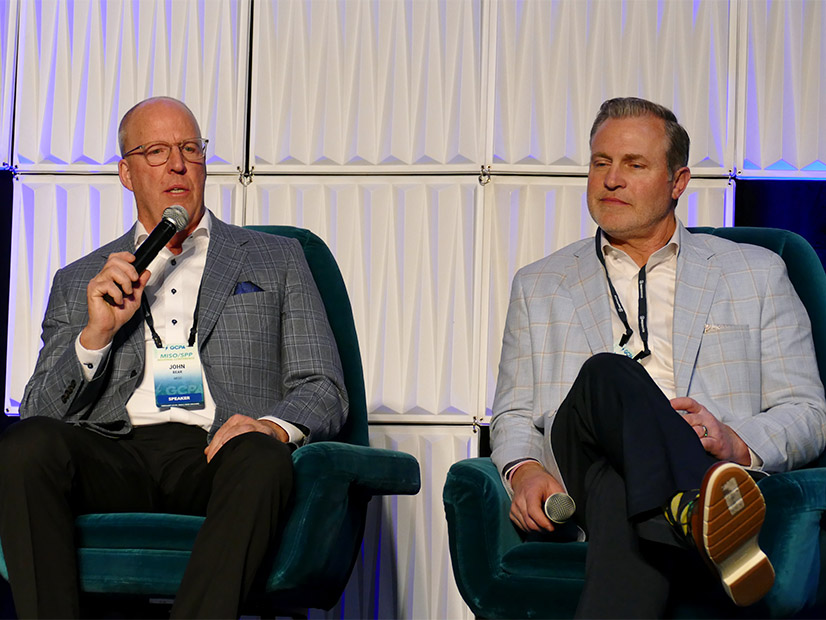
NEW ORLEANS — MISO’s and SPP’s CEOs are confident their interconnection queues will be up to the task of meeting new data center load once their respective special expedited lanes wind down. SPP CEO Lanny Nickell and MISO CEO John Bear also touched on interregional planning and questions about NERC predictions, and offered advice for Western counterparts on how to resolve adversarial, inter-RTO relationships.
Moderating the dual CEO discussion Feb. 23 at the Gulf Coast Power Association’s MISO-SPP conference, GCPA Executive Director Barbara Clemenhagen asked if the “gobbling up gigawatts” by Meta, Google, Amazon and other tech companies in the RTOs’ footprints could become a positive economic growth story without reliability pitfalls.
“We want the economic growth, but we have to have the reliability,” Nickell said. He said large loads could help reduce others’ rate burdens “if they commit to their share” of costs.
“We need the economic development for sure, and we’re on the path to do it reliably,” Bear said. He said that by the end of 2026, MISO should be caught up with its backlogged generator interconnection queue and have slimmed future cycles to a one-year process. The RTO is simultaneously processing its 2025, 2023 and 2022 project entrants while wrapping up studies on some projects from its 2021 cycle. (See MISO Pushes Interconnection Queue Timelines Back Again.)
However, Nickell said the traditional generator interconnection queue “just doesn’t work.” He said it began to slide into dysfunction when developers started flooding lineups with speculative projects. That led SPP to pursue its Consolidated Planning Process (CPP), which merges transmission planning with its generator interconnection procedures. The new process is awaiting FERC approval.
ERAS to Remain Fleeting
In an interview with RTO Insider following their dialogue, the CEOs pledged that their RTOs’ respective expedited interconnection queues will be one-time processes despite a nearly insatiable demand for new generation.
Nickell said that after SPP collects 10 to 13 GW from its Expedited Resource Adequacy Study (ERAS) process, it plans to use its CPP to ensure more timely queue processing. He also said SPP will rely heavily on artificial intelligence offered by Hitachi and Nvidia to land on faster and smarter upgrade solutions.
On the other hand, Bear said MISO has no plans to embark on anything like the CPP anytime soon. He said when it retires its expedited queue process, the RTO will rely on a svelte, one-year queue process to accept generator interconnections.
MISO shelved an idea to create a consolidated transmission planning process in 2023.
The RTO will announce another round of approved expedited generation projects in March, expected to total 6 GW. It will continue announcing rounds of projects quarterly until the end of August 2027, or until it hits a predetermined, 68-project cap.
MISO said 4.7 GW of expedited projects have already struck generator interconnection agreements and are expected online by the end of 2028.
NERC Friction
Both CEOs questioned NERC’s 2025 Long-Term Reliability Assessment, which categorized MISO as being at “high risk” and SPP at “elevated risk.”
Bear sent a letter to NERC calling for a more nuanced approach to the assessment and taking issue with the ERO apparently ignoring MISO’s expedited generation process, which he argued would more than eradicate NERC’s predicted 7-GW shortfall beginning in winter 2028/29.
He also said NERC’s conclusion essentially ignored the annual resource adequacy survey the RTO produces in partnership with the Organization of MISO States. The most recent OMS-MISO survey showed the potential for anywhere from a 11.4-GW surplus to a 14.1-GW deficit by the 2030/31 planning year.
“The truth is neither one of us has a long-term problem, and if we do, we’re going to solve it,” Bear said of MISO and SPP. He said MISO “doesn’t need a third party who’s not involved” with day-to-day decisions issuing predictions.
Bear argued that maintaining margins near requirements — the most affordable and lowest-cost route — requires hard work.
Nickell said he agreed that “the whole story isn’t being told,” particularly when it comes to NERC not factoring ERAS projects into SPP’s capacity projections.
But Nickell said he wasn’t surprised at NERC ratcheting up SPP’s vulnerability meter and said it’s clear that system dynamics are flashing warning signs.
Speedier Stakeholder Process?
GCPA’s Clemenhagen said the RTOs might be fielding “dangerous levels” of data center demand, especially considering that MISO’s reserve margins have fallen from about “24% to potential shortfalls in a short period of time.”
Bear said the most challenging part of the moment is addressing all industry headwinds at once through a rigorous stakeholder process. He said no one includes “speed” and “stakeholder process” in the same sentence, a reality that must change.
“It’s not just the speed of the change; it’s the complexity,” Nickell added. “Load growth has become astounding and never seen before in our careers.”
Nickell said it’s hard to believe that a decade ago, SPP reduced its reserve margin requirement. Now, he said, SPP is exponentially more likely to experience a loss-of-load event and is doing “all we can” to avoid one.
He said he lies awake at night with thoughts of “have we done enough today? Have we done enough this month? Have we done enough this year?” He said load growth is pushing the RTO to rethink everything.
Nickell said the two RTOs must put more ideas through their stakeholder processes faster, but he cautioned that — likening it to running — moving from a recreational 14-minute/mile pace to a demanding seven minutes/mile is risky.
“We need to make sure we don’t run away from stakeholders. They need to be with us. They need to be alongside us as we solve these challenges,” he said.
Bear said market and planning improvements at MISO over the years have been designed by staff and stakeholders who presume they are at a safe place, pin down a solution and “analyze it, analyze it, analyze it, analyze it.” MISO no longer has that kind of time, he said.
“The presumption that we’re in a safe place is false,” Bear said. However, Bear said, MISO and SPP are not struggling with data centers competing with retail load.
For the sake of comparison, Nickell mentioned PJM as an outlier, with its multitude of data centers. (See Can Restructured Markets Meet the Challenge of Data Center Demand Growth?)
Emphasis on Interregional Transfers
Neither CEO sees the need anytime soon for a second Joint Targeted Interconnection Queue transmission portfolio, which helps get generation connected at the seams. Instead, they said they plan to focus on broadening interregional transfer capability in the near term.
Bear said MISO and SPP are open to using the seven transmission benefits established in FERC Order 1920 to assess new interregional transmission projects.
“There might be a little bit of smoothing out that we have to do,” Bear said of benefit metrics. Nickell said SPP would emphasize “reliability and resilience.”
Until now, the RTOs have considered only adjusted production costs when evaluating possible interregional projects through their Coordinated System Planning.
Getting Along
Finally, the pair had advice for burgeoning markets in the West.
Bear said MISO and SPP have gone from frosty distrust to planning transmission together and touching base several times as weather events unfurl.
“We had lunch today without food tasters,” Bear joked. “I think there’s trust there, and there’s collaboration.”
“There was a time when SPP and MISO could barely say each other’s names in public,” Clemenhagen kidded.
“There’s not a choice there. If we survive, we survive together. If we fail, we fail together,” Nickell said.
Nickell said a stronger relationship and communication improvements during past winter storms have allowed the grid operators to share their supply more effectively. He said MISO had excess power to hand off to SPP during Winter Storm Uri in early 2021, while SPP had spare power to deliver during Winter Storm Fern in late January 2026.
“Without those seams agreements in place, that power would not have been exported or imported,” Nickell said. “At some point, you have to get comfortable that seams exist.”
Nickell said unlike MISO and SPP’s relationship, the West is still settling into the idea of the existence of more than one market. He advised that collaboration would make them stronger.
“Competition makes us better,” Nickell said. “That realization has to hit first.”