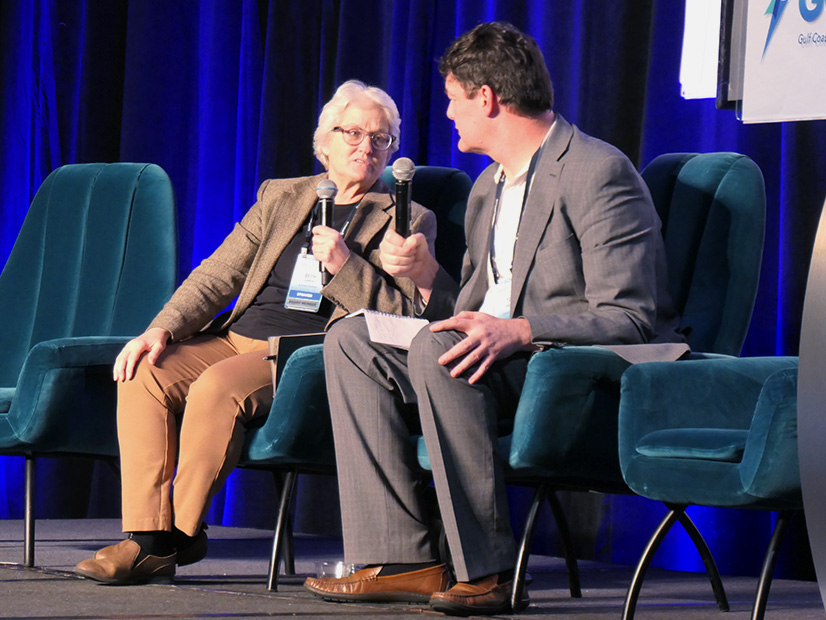
NEW ORLEANS — The Gulf Coast Power Association’s MISO–SPP Regional Conference showcased the rush to add resources, and panelists mused on which new trends could take hold in resource expansion.
David Mindham, a senior director at EDP Renewables North America, said today’s characterization that a sudden, steep demand for electricity emerged from nowhere is intellectually dishonest. He said more generation than what has been developed was essential for years.
“We have systematically built the shortage into the system today … by poor planning decisions,” Mindham said during the Feb. 23-24 conference. RTO planning relies on the “most conservative set of assumptions you could ever make” and keeps the system chronically underbuilt, he argued.
Far from its intended cost effectiveness, the lack of proactive planning is squeezing customers financially, he said. “We’ve actually needed the generation for decades.”
Wisconsin Public Service Commissioner Marcus Hawkins mulled whether “speed is a premium product” for which generation developers should expect to pay.
“Speed should be the expectation,” Mindham responded, adding that MISO and SPP contain many inefficiencies. He said developers flock to ERCOT not merely to site projects in Texas but because the grid operator offers speedy interconnections.
“If you want two-day shipping, you have to sign up for Amazon Prime,” Hawkins retorted jokingly.
Travis Kavulla, head of policy at the Texas-based Base Power, which installs whole-home batteries for a subscription, suggested that RTOs try holding interconnection rights auctions. He said developers could bid on incremental capacity in auctions, similar to the Federal Communication Commission using competitive bidding to assign spectrum licenses. He said auctions would weed out any unserious large load developers.
“That solution is so obvious, but no one has pursued it with dynamism,” Kavulla said.
Beth Garza, a senior fellow at R Street Institute, said she still is waiting on the “too cheap to meter” nuclear generation that was promised in the 1950s. She said the industry might be at a tipping point where it is ready to embrace new technology and that small modular reactors could be the answer.
Energize Strategies’ Ted Thomas said he worries the industry has become too natural gas-heavy and that he plays scenarios in his head before going to bed in which gas costs spike. Resource planners adding copious amounts of gas-fired generation are doing so based on assumed capacity factors, he argued. He predicted that gas capacity factors will “flatten out” and expose which gas plants ultimately were necessary.
Thomas cited President John F. Kennedy’s famous saying, “A rising tide lifts all boats,” before noting Warren Buffett’s retort on economic vulnerabilities: “It’s only when the tide goes out that you learn who has been swimming naked.” He predicted that some new gas plants will in time “show that we’ve been swimming naked.”
Southern Renewable Energy Association Executive Director Simon Mahan said that adding more generation, particularly battery storage, and interregional transmission is crucial.
“If these extreme weather events are going to keep happening, we need to be better prepared. … People are going to get hosed when they get their bills next month,” Mahan predicted of the late January 2026 winter storm. Gas prices that shot to $7 to $8/MMBtu during the winter storm are a “straight pass-through” on bills, he said.
Those who can afford it are increasingly turning to home battery purchases. “Everyone is getting nervous that the system, today’s system, is inadequate,” Mahan said.
America’s Power CEO Michelle Bloodworth argued that the industry’s saving grace, as shown in NERC’s Long-Term Reliability Assessment, are the delays in planned coal plant retirements across 19 states. She said the postponements kept regions from going even redder in NERC’s assessment.
Bloodworth argued that coal plants can be modernized and cleaned up to run for another 30 years, with the help of the Department of Energy’s more than $500 million in funding. She said it’s going to take “time and sustained investment” to bring in new baseload power to replace coal.
Mahan said subsidizing coal plants should take place at state-level proceedings, not federally. He also said NERC’s LTRA has “significant deviations from reality,” noting that it ignored MISO’s expedited interconnection queue.
“There’s a disconnect between the visuals and the narrative that’s going on in that report,” Mahan said. He said coal lobbyists and environmental advocates can agree on the destination — a reliable, decarbonized grid — just not the timelines they envision to get there.
The Queues
Natasha Henderson, SPP’s senior director of grid asset utilization, said the 108 GW of nameplate capacity in her RTO’s queue is about twice its current load.
SPP also has 40 GW of signed interconnection agreements under its belt, the bulk which are slated to be online by 2030. But Henderson said the RTO forecasts its demand will be 93 to 100 GW by 2035. She likened the queue to “a bit like a bubblegum machine,” where it can be shaken and just a few gumballs pop out.
Of SPP’s 40 GW in generator interconnection agreements, only 7% represent thermal resources, Henderson said. Meanwhile, she said, SPP’s fast-track interconnection queue comprises 70% thermal generation. In its regular queue, SPP is seeing fewer standalone solar or storage projects and more hybrid formats.

Henderson said it’s not a controversial statement that the current transmission infrastructure won’t be able to handle the demand that’s being planned. “The longer we wait to build, the less load we’re going to connect.”
MISO’s queue, on the other hand, contains 190 GW, down from a peak of more than 300 GW in 2025.
“The interconnection queue has been one of the most visible challenges for MISO,” said Robert Kuzman, executive director of external affairs.
Kuzman said MISO remains challenged by 70 GW of generation projects that have signed interconnection agreements but remain unbuilt or unfinished. He said developers behind those projects should answer hard questions as to whether their projects are viable and withdraw them if not. That way, he said, transmission capacity might be freed up for other generation proposals.
The queue has shrunk rapidly on the Trump administration’s announcement that it would phase out renewable generation tax incentives, Kuzman said. He added that although MISO’s expedited queue comprises mostly gas generation, proposed battery storage is also taking up a small chunk.
Kuzman said MISO likely could have benefited from four-hour battery storage during Winter Storm Fern in late January. The RTO might not have had to call up load-modifying resources if it had a larger storage fleet, he said.
“It’s something that’s coming in MISO. There’s definitely a place for it as we continue to add as much solar as we are,” he said.
Henderson agreed that storage would be useful at SPP, though its market ruleset isn’t fleshed out. She said the resource type could help with ramping needs and likely could bridge a gap in intermediate planning needs.