PJM’s Independent Market Monitor warned that the cost of wholesale power in the RTO will continue to rise with the rapid addition of data center load without enough capacity to serve it.
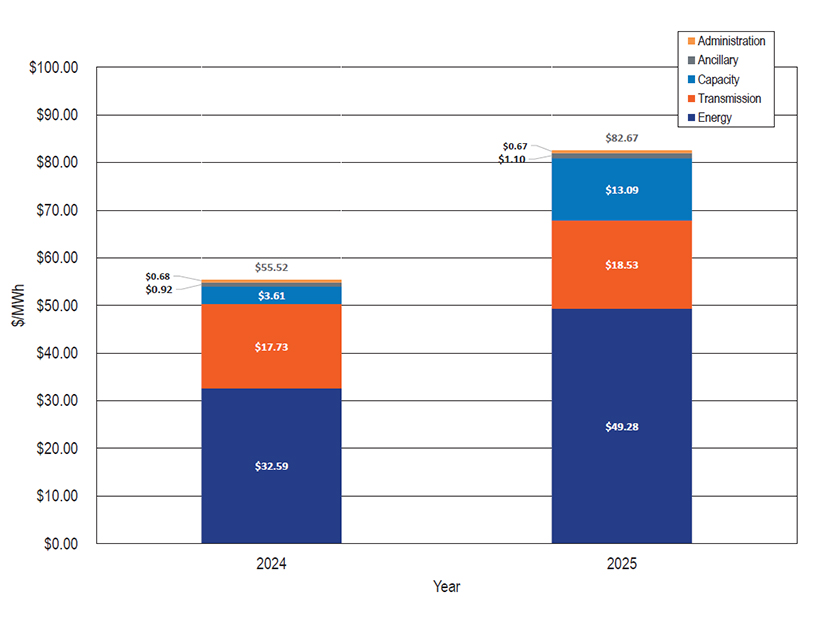
According to the Monitor’s State of the Market report for 2025, released March 12, PJM’s total cost of power rose nearly 49%, from $55.52/MWh in 2024 to $82.67/MWh in 2025. Of that, the cost of capacity rose 262%, from $3.61 to $13.09, after two Base Residual Auctions that saw record clearing prices.
The second capacity auction, held in December for 2027/28, procured 6.6 GW less than PJM’s Region Reliability Requirement. (See PJM Capacity Auction Clears at Max Price, Falls Short of Reliability Requirement and PJM Capacity Prices Hit $329/MW-day Price Cap.)
“Data center load growth is the primary reason for recent and expected capacity market conditions, including total forecast load growth, the tight supply and demand balance, and high prices,” the Monitor wrote. “But for data center growth, both actual and forecast, the capacity market would not have seen the same tight supply demand conditions; the same high prices observed in the 2025/26 BRA [held in 2024], the 2026/27 BRA and the 2027/28 BRA; and the currently expected tight supply conditions and high prices for subsequent capacity auctions.”
In both the report and in a teleconference with reporters, Monitor Joe Bowring blasted PJM for “continuing to simply accept the interconnection of large data center loads that cannot be served reliably because there is not adequate dispatchable capacity.”
“But the consensus seems to have moved to, ‘Well, let’s interconnect them, but let’s curtail them whenever that capacity is needed by other customers,’” Bowring told reporters. “That’s easier said than done.”
The high capacity prices have had a direct effect on retail prices, with ratepayers seeing spikes beginning June 1, 2025. “Just a simple fact,” Bowring said. “There’s been a lot of attempts to confuse the issue. … It is entirely about data centers.”
The Monitor urged changes to the capacity market to account for data center load before the next BRA in June. It also argued that its proposal for the reliability backstop auction, instigated by the governors of PJM’s member states and the White House, is the only one consistent with both the principles laid out by the government and the Ratepayer Protection Pledge signed by several large tech companies.
To submit a commentary on this topic, email forum@rtoinsider.com.
Those documents “establish two essential core principles: that the data centers must bear their own costs and risks and not shift them to other customers, and that the data centers must bring their own new generation in any one of a number of forms or be fully curtailable,” the Monitor wrote. “The temptation to create complex regulatory structures to shift data center costs and risks to other customers should be resisted. … Other PJM customers, whether residential, commercial or industrial, should not be treated as a free source of insurance for data centers.”
Bowring was blunter on the teleconference: “Really the only purpose of running this backstop auction is for data centers that have not managed or don’t want to be involved in negotiating bilateral contracts with generation developers to meet their demand.”
A reporter asked about data centers’ opposition to long-term bilateral contracts with utilities, as they argue load forecasts are uncertain. Instead, they want PJM to act as the counterparty for a predetermined amount of capacity in the backstop auction. (See PJM Plans to Release Reliability Backstop Design in April.)
“I mean, think about what that’s saying: that individual data centers don’t know what their demand is?” Bowring replied. “That’s not a plausible statement. I think part of what the data centers are doing is trying to make things sound more confusing than they are in order to avoid taking responsibility for their load.”
Making the RTO a counterparty “makes every other customer in PJM a source of free insurance for the data centers, which is ironic because these are some of the biggest, most profitable companies in the world,” he said.