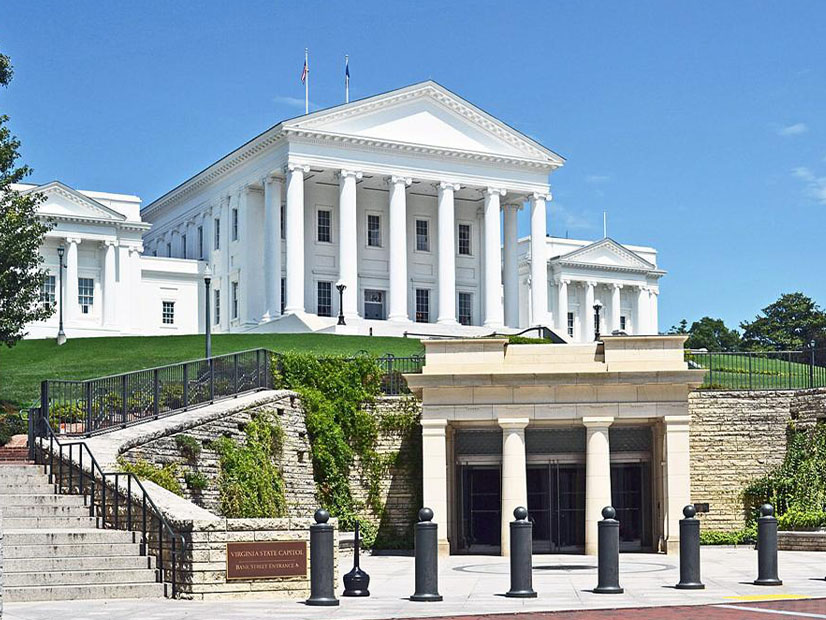
The Virginia Legislature wrapped up its main session with Democrats taking advantage of a wider margin in the House of Delegates and recently elected Gov. Abigail Spanberger (D) to push through bills favoring clean energy.
“The General Assembly has passed a slate of legislation squarely focused on making life less expensive for Virginians,” Spanberger said in a March 14 statement. “I’m particularly proud to see lawmakers pass our entire Affordable Virginia Agenda to drive down housing, healthcare and energy costs for Virginians across our Commonwealth. High costs are top of mind in every community — and our agenda directly responds to those concerns.”
She’s reviewing the legislation, which awaits her signature, with an eye toward advancing her affordability agenda, the governor added.
“We have a governor now, who got sworn in shortly after the session started here, too, who’s more supportive of clean energy solutions than her predecessor,” Advanced Energy United’s State Lead for Virginia Jim Purekal said. “‘Her’ predecessor — I like saying that, right? And, also, this governor is more engaged with the General Assembly than her predecessor was.”
While Democrats grew their majority in the House, the commonwealth staggers its state elections, so the Senate was unchanged, he added.
House Bill 397 and Senate Bill 809 are companion bills that require state agencies to develop regulations around re-entering the Regional Greenhouse Gas Initiative, which Spanberger called for after Virginia pulled out of the cap-and-trade market under previous Gov. Glenn Youngkin (R). (See Va. Air Board Approves RGGI Withdrawal.)
“For me, this is about cost savings. RGGI generated hundreds of millions of dollars for Virginia — dollars that went directly to flood mitigation, energy efficiency programs, and lowering bills for families who need help most,” Spanberger said in a speech shortly after taking office in January. “Withdrawing from RGGI did not lower energy costs. In fact, the opposite happened — it just took money out of Virginia’s pocket. It is time to fix that mistake.”
The legislature passed HB 895, which requires Dominion Energy to procure at least 16 GW of short-duration batteries (with 10 or less hours of storage) and 4 GW of long-duration batteries (greater than 10 hours) by 2045.
Other bills are meant to grow solar’s role in Virginia, with HB 711 requiring localities to review projects adequately before they can reject them and HB 807expanding the shared solar program for Dominion.
While Dominion has gotten approval for one natural gas plant through the State Corporation Commission and has plans for more in its integrated resource plan (IRP), Purekal said the focus of Democrats who control the government is on affordability and clean energy.
“We’re seeing a greater appetite for affordable options, and so that’s where the clean energy solutions really come into play,” Purekal said. “Because, you know, 10 years ago, we weren’t able to have this conversation about clean energy solutions. We’re seeing pivotal and drastic drops in cost now for solar and for storage and for wind. But we’re primarily talking about solar storage, really.”
Solar and storage are the fastest resources to deploy on a system seeing substantial demand growth from data centers, he added.
If Virginia doesn’t build its own natural gas plants, it will rely on imports from other states in PJM that are interested in building the facilities, said Stephen Haner. Haner is a former lobbyist who got to know energy policy in Virginia by working for Newport News Shipbuilding and now writes for the web publication Bacon’s Rebellion.
“There’s nothing passing that would ease the path for gas,” Haner said. “There are a number of things passing that create new impediments to gas. They’re rewriting the entire Integrated Resource Plan statute.”
HB 429 would amend the IRP process by requiring the use of the social cost of carbon and limiting Dominion’s options for flexibility around the Virginia Clean Economy Act, he added. It passed both houses on the session’s final day.
Rejoining RGGI when the states that historically shipped excess power east in PJM are not joining will lead to leakage, Haner said.
“You can see the pattern for the years before we were in RGGI,” he added. “You see one output for Dominion plants in the three years in RGGI, those plants all dropped, and then as soon as we got out of RGGI, those plants output went back up again — the gas plants that they’ve got. And that’s what’s going to happen.”
Data centers are driving the load growth in Virginia. SB 253 shifts grid upgrade and capacity costs onto them, Haner said. The bill passed both houses March 14.
The State Corporation Commission recently approved a new rate class for data centers. Judge Kelsey Bagot talked at EPSA’s conference earlier in March about how the regulator is dealing with the growth in data centers. (See EPSA Summit Held with ISO/RTOs in the Middle of the Political Debate.)
Dominion has about 20 GW of new demand under contract and more than 40 GW in its interconnection queue, but it’s unclear how much of that is “real.” New data centers must wait years to connect. They have the incentive to claim a large amount of capacity so they’re not left short when they get to the front of the line, Bagot said.
“You have that incentive on the data center side, at the same time that there truly is this demand that we need to build for,” she added. “And so, you’re trying to balance those two things. I think what we’ve really been working a lot with Dominion and our utilities on; is how can we shift some of that risk onto those entities that are asking for that new capacity? As opposed to having the other captive ratepayers cover the risks associated with potentially over-building for what folks in line say they need.”
Uncertainty around future demand is ubiquitous. It takes four to seven years to power a greenfield facility, while data centers can go up in two, Data Center Coalition CEO Josh Levi said at EPSA’s conference. Uncertainty is also present in the regulatory structure.
“The Virginia State Corporation Commission issued a ruling four months ago on large load tariffs. The General Assembly is in the process of rewriting it,” Levi said. “I mean, uncertainty is very much in play right now.”