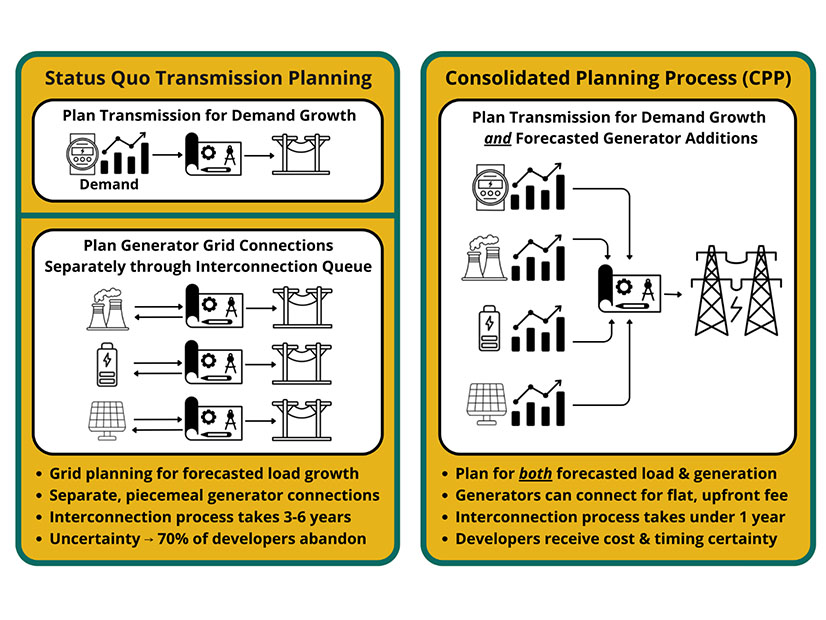
FERC conditionally approved SPP’s streamlined generator interconnection and long-term planning processes in what the commission said is a “bold step” in addressing the needs of the electric system.
The commission found in its March 13 order that SPP’s Consolidated Planning Process (CPP) complies with FERC Order 1000’s regional transmission planning and cost-allocation requirements and that its generator interconnection (GI) procedures satisfy the independent entity variation standard for deviations from Order 2003 (ER26-414).
However, it directed the grid operator to submit a compliance filing by April 14 addressing several errors outlined in a December 2025 deficiency letter. FERC also ordered SPP to clarify that some interconnection customers may be directly assigned network upgrade costs for upgrades with a nominal operating voltage of 100 kV or below.
The CPP will replace the grid operator’s separate interconnection requests and annual Integrated Transmission Plan (ITP) with an “innovative approach” to regional planning that forecasts overall needs and takes all grid requirements into account. SPP said it will provide more certainty to investors in planning their budgets, and a revamped funding structure to address the region’s historic load growth and challenges interconnecting generation and load in a timely manner.
“FERC’s approval of SPP’s CPP filing marks a defining moment, further demonstrating the value of a regional transmission organization,” Casey Cathey, SPP’s vice president of engineering, said in a statement. “The CPP unlocks the ability to plan and build the grid at a scale and speed the future demands. It’s a powerful step toward a more reliable, resilient and valuable system that can meet unprecedented load growth and connect the next generation of resources.”
Commissioner Judy Chang concurred with SPP’s “bold step” and encouraged other grid operators to “explore comparable reforms.” She said the RTO’s proposal addresses upgrade cost uncertainties, the “core issue that has been delaying the interconnection of new generation.”
“Facing rapid load growth and the need for new resources, we must meet this moment, and proposals like SPP’s put us on the path to do so,” Chang wrote.
‘At the Forefront’
Commissioner David Rosner issued a separate concurrence with the order, calling the CPP a “major step forward” in improving speed and efficiency in the GI and planning processes that “promises to deliver the electrons our country so badly needs.”
“Faced with electric demand growth at levels not seen in 25 years, SPP and its stakeholders have risen to the occasion with one of the most innovative, common-sense proposals presented to the commission since the inception of open-access transmission service,” he said. “This proposal will get transmission built smarter and connect new generation faster, helping to make energy more reliable and affordable in the SPP region.”
Rosner noted the CPP won unanimous support from both SPP’s member states and stakeholders. In an emailed statement to RTO Insider, the Sierra Club and Natural Resources Defense Council said the “historic level of consensus” reached during the stakeholder process sets a “high standard for future SPP policy initiatives.”
“Today’s decision places SPP at the forefront of ongoing efforts across the country to address over-burdened resource interconnection queues that have held back the clean energy transition our country so desperately needs for over a decade,” Sierra Club Senior Attorney Greg Wannier said. “CPP is a game-changer, and we encourage other grid operators across the country to take note as this process moves forward.”
“By breaking down siloed processes, CPP will cut years of wait time to get clean energy on to the power grid and ensure transmission planning drives optimal, long-term, high-value transmission projects,” said Annie Minondo, of NRDC’s Sustainable FERC Project.
Under the proposed CPP framework, SPP will conduct a long-term transmission assessment over a 20-year horizon, with a focus on both extra-high-voltage (300-kV and above) and high-voltage (above 100-kV and below 300-kV) facilities, and a 10-year assessment in the planning cycle’s first year. The grid operator will also conduct annual CPP-10 assessments in the second and third years of each planning cycle.