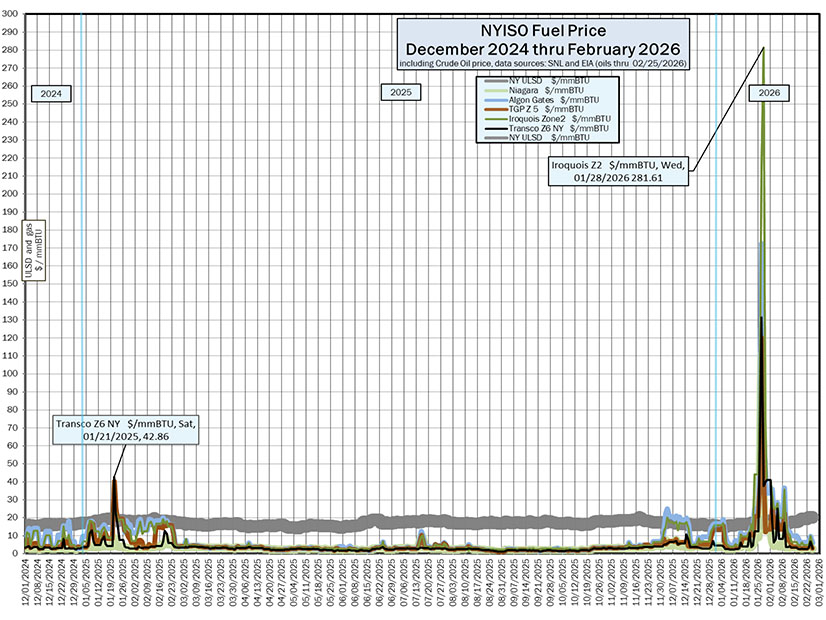
RENSSELAER, N.Y. — NYISO presented a detailed breakdown of systemwide issues in response to multiple calls from stakeholders for more granular information about conditions during the late January winter storm.
In a previous discussion, stakeholders had asked where unavailable capacity was during the storm, dubbed “Fern,” and subsequent cold snap. (See NYISO Exceeded Peak Winter Load Forecast in Early February.)
The weather encompassed most of the East Coast for a sustained period that lasted into early February. The already-gas-constrained Northeast was pressured even more, leading to near-record electricity costs and a reliance on oil for fuel. (See: NYISO: Gas Demand Soared Across Eastern U.S. During Fern.)
During the chill, liquid fuel provided roughly 2 million MWh of energy, while wind and solar collectively supplied roughly 500,000 MWh, according to NYISO. Only three other winters since 2013/14 have burned anywhere near that much fuel, with most only burning about half as much, Aaron Markham, NYISO vice president of operations, told the Operating Committee on March 19.
“Because of the constraints on the gas system, we had to make [dispatch] decisions early after the day-ahead when there was going to be more certainty about what was going to be unavailable,” Markham said. “If we don’t make those scheduling decisions and get the units working to get gas pretty timely in the gas nomination cycle, there [would be] no gas available.”
Markham also provided new insight into how and when NYISO called supplemental resource evaluations, a process by which the ISO can commit additional resources outside of the normal day-ahead scheduling process. They are activated only when day-ahead reliability criteria violations are forecast after the normal scheduling process has begun or when the ISO detects a reliability violation within the next 75 minutes. NYISO called SREs every day from Jan. 24 to Feb. 9.
January also set a record for the largest weekly natural gas withdrawals from storage. By Feb. 9, oil reserves were the lowest they had been since NYISO began tracking fuel inventories in 2016.
“During that cold snap, not only was it cold in New York, but [so was] the eastern part of the continent,” Markham said. “That drove gas prices to pretty high levels,” between $50 and $250/MMBtu. Heavy strain on the gas system caused pipeline operators to issue operational flow orders. That, combined with limited supply, forced some generators offline or to switch to oil.
Albany spent Jan. 23 through Feb. 10 at below-freezing temperatures, making the 19-day cold snap the longest seen since 2011. New York City spent nine days between Jan. 24 and Feb. 1 below freezing, the longest stretch for the city since the 2017-18 season.
During the worst of the cold Feb. 7, a Saturday, the fuel mix was 28% oil, 26% natural gas, 16% hydro, 14% nuclear, 10% imports and 6% wind. This coincided with the winter peak of 24,317 MW. Without demand response, the peak would have been 24,717 MW, according to NYISO. Three daily peaks in the cold snap exceeded 22,000 MW.
“We do estimate that if those similar weather conditions had occurred on a weekday, the load would have been in excess of 25,000 MW,” Markham said. That is “pretty close to the 90/10 load forecast for the winter.”
Most of the generator outages were concentrated in Zones F to K, an area encompassing the Capital District, the Hudson River Valley, New York City and Long Island. Most of the generators in the zones are natural gas- or oil-burning.
Stakeholders once again tried to get even more specific information on the outage locations, but Markham rebuffed them, saying it could identify individual facilities. He was able to say there were strong correlations between interruptions on the gas system and forced outages.