ALBANY, N.Y. — Each year brings new progress and challenges for those planning, building, regulating and running New York’s grid.
Whether it balances out in one direction or another is a matter of opinion as much as detail.
As the 2026 New York Energy Summit opened April 14, the state has a new framework in place to expedite transmission development, its governor is steering away from some of the statutory requirements for power generation and the Coordinated Grid Planning Process has progressed significantly.
But tariffs and vanishing federal tax credits have altered the finances of many projects years in the making, and New York remains a costly and complex place to do business, even with the progress it has made.
Finding the balancing point was a recurring theme at the Infocast event.
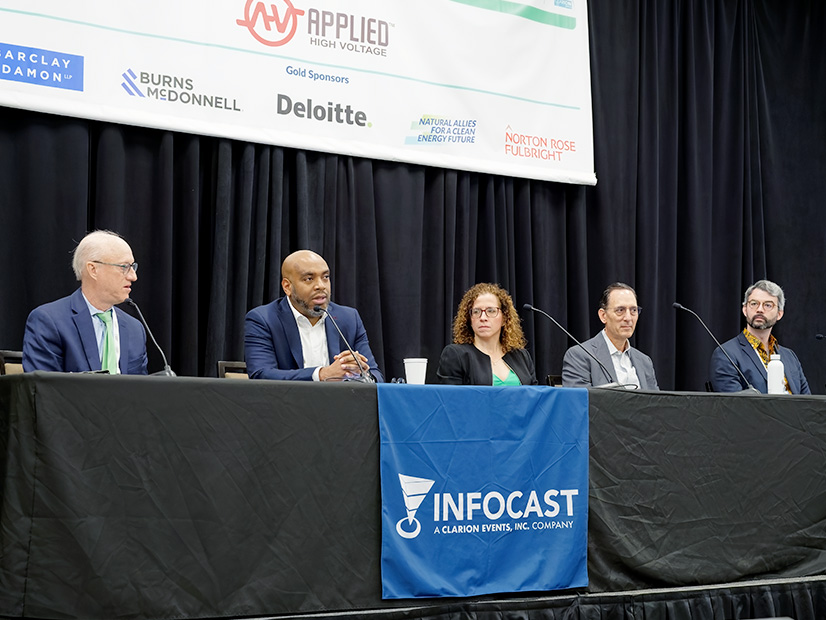
“If it was easy, anyone could do it; I think we have to continue to think big, and get big things done,” said Stuart Nachmias, CEO of Con Edison Transmission.
His suggestion — expand transmission headroom at the geographic confluence of customer demand and community support for meeting that demand — is at once logical to pursue and difficult to achieve.
“And we should build big when it comes to building transmission so that we have room for growth,” Nachmias said. “And I think that’s really something that we have not done well. It also seems to take too long, but we know what we can do, and we should just start doing that.”
This potentially bumps against the imperative to go easy on ratepayers in a state with some of the most expensive electricity in the U.S.
What should the state be doing now to address the soaring costs of the renewable energy it has been pushing so hard to build? moderator Robert Rosenthal of Greenberg Traurig asked his panel.
Nachmias didn’t sugarcoat his answer.
“Prices for everything have gone up. So I think it’s relative, and trying to mitigate the cost doesn’t mean they’re not going to go up, but to go up less.”
Stephane Desdunes, EDF Power Solutions’ vice president of development for Canada and the northeast U.S., said he has seen project costs jump $80 million over the course of 48 hours.
“When you look at what’s happening here in New York, across the U.S., we’re trying to clear a construction cliff. We’re trying to manage permitting risk. We’re trying to absorb tariffs while still trying to meet our contractual [commercial operation date]. I would say every day we wake up, we’re kind of hoping that the day goes well and the project won’t get canceled today.”
The continuing problems developing renewable energy in New York have set the stage for consideration of what until recently was a remote or even implausible concept: new gas-fired generation.
“That actually provides room to have the pragmatic discussion around, what can we bring to the table now to ensure that we have a reliable and resilient grid in this transition period?” said Sarah Salati, chief commercial officer of National Grid Ventures, which operates a gas-fired fleet in southern New York.
Some of those facilities have been in service for more than 50 years, she said, and repowering them would not only improve reliability but reduce emissions while renewable energy development gets back on track.
“We’ve estimated that if we repowered the assets that we have on Long Island, that it would be equivalent to basically taking 570,000 vehicles off the roads over a 15-year period,” Salati said.
Rosenthal flagged a detail of the state’s landmark 2019 climate law: New York must generate its electricity with zero emissions by 2040, which he said is a deterrent to any significant investment of funds in new gas-fired generation in 2026. He asked the panel if the Public Service Commission should exercise its authority to modify the 2040 target.
No one gave him a “yes” or “no,” but the clear sense was that natural gas should not be excluded from consideration.
“Without directly answering your question,” Nachmias said, “I would say reliability is paramount, and I think the state and the NYISO has been ringing the bell here.”
“It’s an optimization problem,” said Tom Vaccaro, vice president of development for TDI-USA Holdings. “The engineer in me knows that if you take resources off the table before you do the optimization calculation, you’re more likely to come to a suboptimal outcome.”
The grid is the most complex machine in human history, he said, and the clean energy transition is a fundamental reworking of it. No effort on that scale has ever proceeded on schedule or on budget, and the plan for achieving it will change over time even as the end goal does not, he said.
Zeryai Hagos, executive director of the state Office of Renewable Energy Siting and Electric Transmission, gave an update on the RAPID Act (Public Service Law Article VIII), the state’s effort to streamline permitting of large-scale transmission projects in the same manner it streamlined permitting of large-scale renewable generation.
The first set of regulations implementing the law took effect in March.
“As of right now, we are working with the first wave of utilities who are preparing to enter the pre-application process for the first Article VIII siting projects,” Hagos said.
Proposals along new rights of way may not advance any more quickly than under the old system, he said, but those that would follow existing rights of way and create no new impacts are expected to see a 50% reduction in their construction timelines.
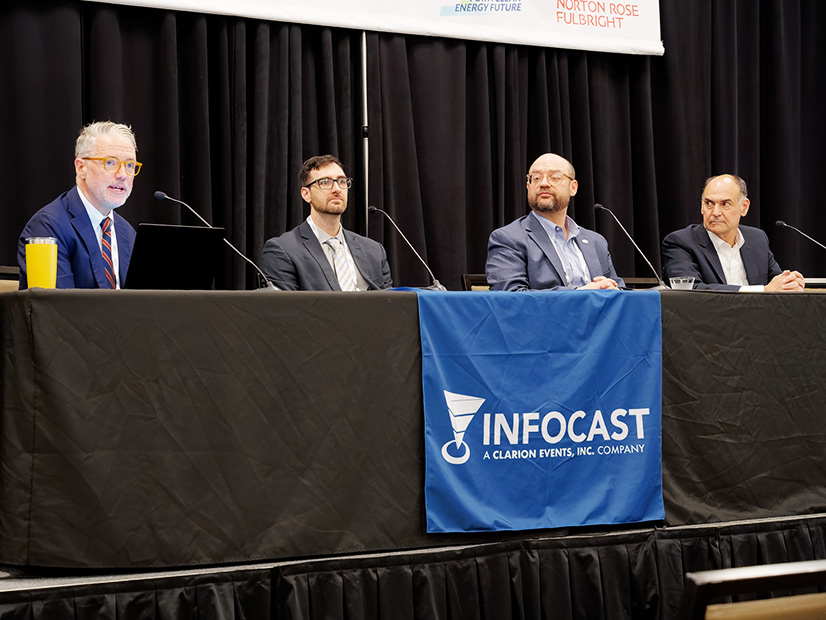
Another moderator, John McManus of Harris Beach Murtha, framed his panel discussion as a look at the difficulty of hitting a moving target amid changing rules of engagement.
“The result is a transmission system that is actively being redesigned, not only while it’s being expanded and rebuilt, but also while it’s being used,” he said. “This panel is about that tension: How do you plan, finance and permit energy infrastructure in a world where the regulatory and policy landscape is still in flux?”
McManus asked Paul Haering, vice president of capital investment for New York Transco, whether he thought permitting would be faster under Article VIII, or it would just look faster because so much of the process would be moved from the application phase to the pre-application phase.
“I think we’ll have to see,” Haering said. “From our perspective, I think the level of effort is still going to be about the same. It just becomes a matter of the sequencing.”
He said he does like the concept, however. “I think a single one-stop shop for permitting for large infrastructure projects makes the most sense. At the end of the day, hopefully that results in a more efficient process. But I think the jury is going to still be out until we actually get through an Article VIII siting process.”
Schuyler Matteson, clean energy planning lead at the state Department of Public Service, picked up on Haering’s point: The RAPID Act is not just an attempt to speed the process but to reduce its internal friction.
“We don’t want people bouncing around between processes,” Matteson said. “Having a centralized place where everybody can go [and a] clearly understood process I think [are] very, very important. So even if it takes a similar amount of time, if it’s much, much clearer and it reduces risk, I think that’s going to be a win overall.”
McManus raised the often cited prospect of optimizing the existing grid with more speed and less money than would be required to expand the grid. Are grid-enhancing technologies an interim solution while new transmission is built or are they a replacement? he asked.
“Yes,” said John Bernecker, director of large-scale resources at the New York State Energy Research and Development Authority.
“We shouldn’t view it as one or the other,” he explained. “A lot of the barriers are, frankly, regulatory and market barriers that we should be focusing on addressing. A number of these technologies are quite mature and have significant deployment in other regions, and so we need to be focused on addressing some of the cultural challenges or resistance to their deployment where it exists.”
McManus broached another hot button issue: “Are any of you concerned that the pace and the scale of large load growth, as well as the economics and politics behind that, create pressure to make transmission planning decisions faster than may be prudent?”
Haering said New York seems unlikely to become a hotbed for data centers, but the concerns centered on their development are valid.
“I think the whole issue is cost causation and responsibility,” he said. “You don’t know how long some of these entities will be around for. Is their load really going to be their load? Is their load factor exactly what they said? Getting in front of this and making sure the policy’s set so that ratepayers don’t share the cost, I think, is critically important.”