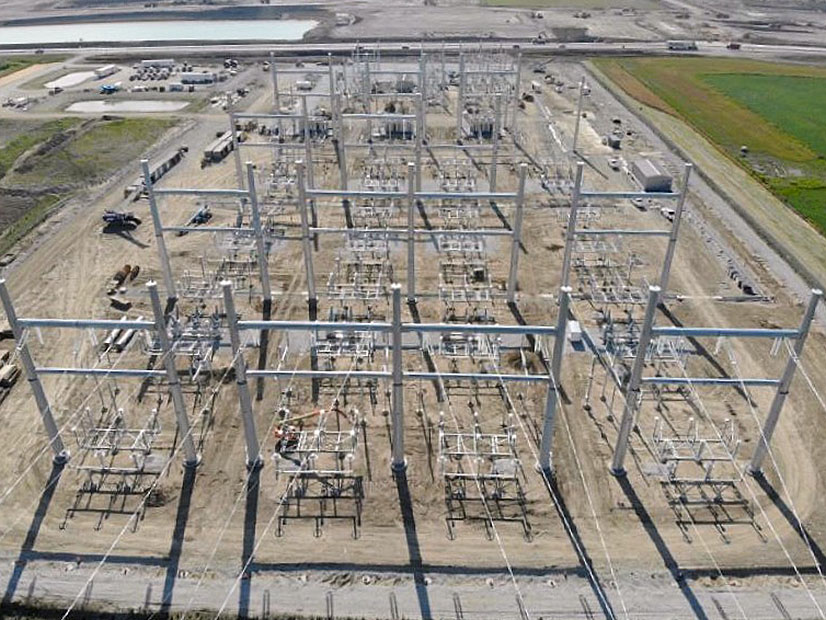
MISO announced it will reassign multimillion-dollar substation work in Wisconsin to American Transmission Co. in order to meet a sped-up construction timeline for data center load.
The grid operator decided to pull Chicago-based developer Viridon Midcontinent from a portion of the Wisconsin Southeast (WISE) project, which consists of 106 miles of 345-kV lines and four 345-kV substations valued at $350 million.
The WISE project is a subset of the South Fond du Lac-Rockdale-Big Bend-Sugar Creek-Kitty Hawk Long-Range Transmission Project in southeastern Wisconsin, one of the projects approved as part of MISO’s $22 billion long-range portfolio at the end of 2024.
MISO opened a variance analysis on the project at the end of February because it said its selected developer, Viridon, “is unlikely to attain the regulatory requirements in Wisconsin” in time to build three of the substations on an accelerated timeline. The substations are needed by the end of 2027 for new data center load that ATC is handling. The RTO originally expected the project to be in service in mid-2033. (See MISO Opens 3rd Tx Project Review as Data Center Plans Conflict with Long-range Tx Timeline.)
Enter ATC’s Ozaukee County Distribution Project, which is at the heart of the controversy. ATC proposed the project — which involves rebuilding and upgrading existing 345-kV lines and constructing up to five new substations at a cost of $1.36 billion to $1.64 billion — in September 2025 on an expedited basis to meet anticipated data center load. The Ozaukee project relies on three of the substations in the WISE project.
MISO conducts variance analyses on regionally cost-shared transmission projects when they encounter schedule delays, permitting challenges or substantial design changes or experience at least a 25% cost increase from original estimates. The studies also are triggered when developers find themselves unable to complete the project or if they default on the terms of their selected developer agreement.
After an analysis, MISO can either let projects stand, develop a mitigation plan for them, cancel them or assign them to different developers, if possible. A committee of RTO employees selected by leadership determines projects’ fates.
In this case, MISO’s Competitive Transmission Executive Committee (CTEC) investigated the situation brought on by the accelerated in-service date and “determined that Viridon is unlikely to satisfy the Wisconsin regulatory requirements in order” to finish the substations by Dec. 1, 2027. The committee said ATC was a better fit for the project in light of the expedited data center needs.
According to MISO’s tariff, the committee has “exclusive and final authority” over variance analysis outcomes.
“CTEC determined that incumbent transmission owner and authorized Wisconsin public utility ATC is better positioned to attain the necessary regulatory approvals in Wisconsin and achieve the accelerated in-service date,” MISO said in its public determination. “As such, CTEC has determined that the most suitable outcome to meet the accelerated-service date is to reassign these facilities to ATC as reassignment will most likely result in the successful completion of, or increase the ability to complete, the facilities and will alleviate the ground for variance analysis.”
MISO said the remainder of the WISE project — a substation and the 345-kV line work — will “continue to be constructed, implemented, owned and operated by Viridon.”
Viridon was founded in 2023 and is owned by Blackstone Energy Transition Partners, one of Blackstone’s private equity funds.
MISO said it considered other outcomes beyond reassignment of the trio of substations. It said it eliminated a “no action” outcome because of the urgency of the new data center load and that a mitigation plan was impractical because it’s unrealistic to expect Viridon to clear the necessary regulatory approvals on an expedited or prioritized basis from the Wisconsin Public Service Commission.
The RTO also said project cancellation was out of the question because of the footprint’s dependency on the long-range transmission portfolio, in addition to the anticipated data center load relying on the construction.
MISO said it will coordinate and execute the necessary documents with Viridon and ATC “in due time” to reassign the substation portion of the project.
Viridon said it accepted MISO’s decision.
“We are confident in our ability to have executed successfully on the accelerated timeline for the substations. That said, we respect MISO’s decision. We look forward to completing the remainder of the WISE project on time and on budget, including the Big Bend substation and the 345-kV transmission lines,” Viridon said in a statement to RTO Insider.
MISO has completed 11 variance analyses to date. Until now, it has never reassigned a project developer, despite having the authority to do so. The RTO historically has chosen either to create mitigation plans with the existing developer or to allow the project to stand. In one instance, MISO canceled a 500-kV project because of a new right-of-first-refusal law in Texas. (See FERC Rejects Last-ditch Effort to Save Tx Project.)
ATC said it is “pleased with the outcome of MISO’s variance analysis.”
“Our focus remains on maintaining a safe, reliable grid, and meeting our customers’ needs,” ATC said in a statement. ATC said it would roll the substations into its application for a certificate of public convenience and necessity for the Ozaukee County project. The company said it plans to have the substations “in service by the date needed to serve the load.”
ATC did not answer RTO Insider’s question on whether it was involved in the variance analysis process.
ATC is among a group of Midwestern utilities rumored to be asking FERC and the Trump administration to suspend competitive bidding so the grid can be built out faster to accommodate the data center explosion. The company, along with Xcel Energy, ITC Holdings and Ameren, have reportedly taken their request to the White House’s National Energy Dominance Council.
MISO Issues Mitigation Plan for Other Long-term Tx Project
Relatedly, MISO rounded out a second variance analysis it conducted on the 345-kV Morrison Ditch-Reynolds-Burr Oak-Leesburg-Hiple line in Illinois and Indiana, which jumped from an estimated $261 million to a $675 million cost estimate in 2024. The project was approved in 2022 under MISO’s first long-range transmission plan portfolio.
MISO said it was able to work with developer Northern Indiana Public Service Co. on a mitigation plan that should reduce the cost of the long-range transmission project to $477.8 million.
After its variance analysis investigation, MISO said it “observed higher estimated costs for construction matting, technical services and contingency, as well as additional costs associated with securing and permitting the transmission line right of way.”
NIPSCO leadership and MISO were able to identify “cost savings and efficiencies” that would lower estimated project cost through adjustments to the scope of work, reductions in construction costs “as discrete contracts are executed and reductions in contingency costs as the project was further developed with fewer unknowns,” according to the RTO.
The grid operator opened the re-examination of the project in late 2024. (See Cost Overruns on Project in 1st LRTP Prompt MISO Analysis.)
Again, MISO said it considered all possible outcomes under the variance analysis. It deemed no action unacceptable because of the sheer size of the cost increase. It said it could not reassign the project because of Indiana’s ROFR law, which rendered the facilities ineligible for competitive bidding.
Finally, MISO once again said cancellation was not a realistic option because of the interconnectedness of the Morrison Ditch project with the rest of the long-range transmission portfolio.
MISO said once it and NIPSCO sign the mitigation plan, it will reflect the new estimated cost in its database of transmission project status reports.