NEW ORLEANS — In a case of déjà vu, MISO announced that NERC is poised to issue a follow-up to its Long-Term Reliability Assessment that stands to lower the RTO’s reliability vulnerability from “high risk” to “elevated.”
MISO Vice President of System Planning Aubrey Johnson said NERC would issue the updated findings in early May.
Speaking at a March 24 meeting of the System Planning Committee of the MISO Board of Directors, Johnson said this time around, NERC would factor in MISO’s interconnection queue fast lane, which boosts supply adequacy.
A NERC representative confirmed the agency would issue a special assessment in April.
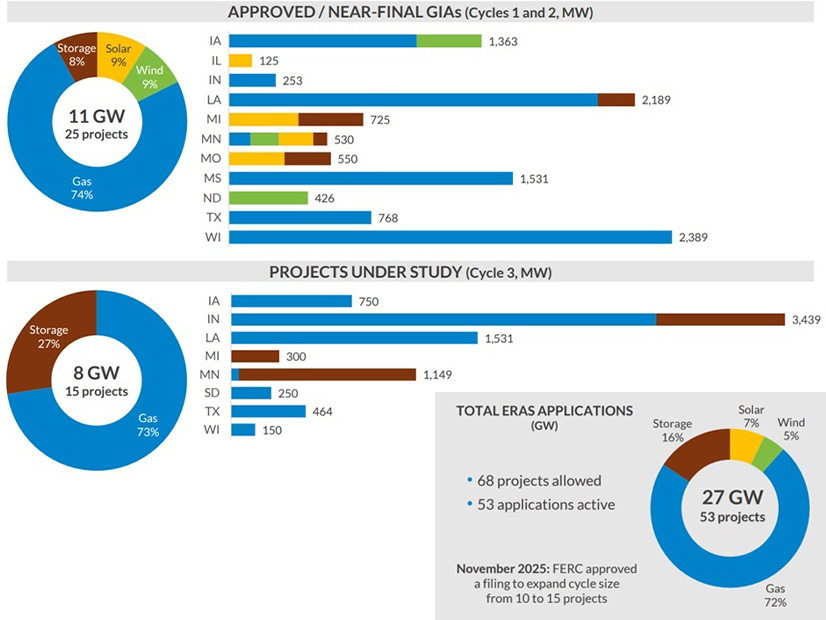
MISO’s separate, expedited interconnection queue has attracted 27 GW worth of proposals across 53 generation projects, 72% of which is natural gas, 16% storage, 7% solar and 5% wind. So far, MISO is ready to clear or has cleared 11 GW of nameplate capacity to connect and is studying an additional 8 GW for interconnection. (See MISO’s 3rd Expedited Queue: 8 GW of Gas and Batteries.)
MISO Director Nancy Lange said NERC’s initial decision to ignore contributions from the expedited queue in its assessment is “puzzling.” NERC officials have said the organization enforces a cutoff date for information that informs the assessment.
To submit a commentary on this topic, email forum@rtoinsider.com.
Director Mark Johnson said even the improved standing to “elevated risk” is “still a discount to what’s being done” by MISO and its members to address reliability.
MISO Independent Market Monitor (IMM) David Patton told the RTO’s board, executives and stakeholders he continues to believe NERC was off base to designate MISO a high-risk area.
Patton said “probably the most significant” consequence of NERC’s LTRA is the U.S. Department of Energy issuing several 90-day retirement delays for coal plants in MISO’s territory. He said the orders are racking up extraordinary costs.
The U.S. Department of Energy reupped stay-open orders March 24 for NIPSCO’s R.M. Schahfer Generating Station and Centerpoint’s F.B. Culley Generating Station through June 21, 2026.
“It’s pretty easy to come the conclusion that none of these orders are actually needed,” Patton said at a March 24 meeting of the Markets Committee of the MISO Board of Directors.
Patton quipped that “nobody reads the report” and instead focuses on the vibrant colors on NERC’s indicative map.
Multiple state regulators belonging to the Organization of MISO States sent a letter in February to challenge NERC’s results and the omission of MISO’s fast-tracked interconnection process. (See MISO States Dispute ‘High Risk’ Designation from NERC.)
But at a March 25 Advisory Committee meeting, Clean Grid Alliance Executive Director Beth Soholt criticized MISO’s efforts to bring more supply online for translating overwhelmingly into new gas generation.
“I’m wondering where the balance is in this ‘all of the above’ approach,” Soholt said.
NERC similarly downgraded MISO’s alert level in the LTRA in 2025 through an after-the-fact supplement. In that case, the IMM criticized NERC’s original conclusion and pointed out an error: NERC used unforced capacity values for MISO when calculating a margin that it ultimately compared to an installed capacity requirement.
In that instance, after a back-and-forth between MISO and NERC, the reliability corporation ultimately downgraded MISO from “high risk” to “elevated risk.” (See IMM: NERC Reliability Assessment Still Overstating MISO Risk.)
In February, MISO Senior Manager of Market Design Neil Shah told the Entergy Regional State Committee the RTO was in contact with NERC to hopefully improve assumptions used in the latest LTRA.
Shah said including the generator interconnection express lane would likely “close the gap” in the NERC report. However, he said uncertainty remains due to the potential for additional large loads claiming spots on the grid.
MISO expects the first projects from its expedited generator queue to come online in 2028. Beyond that, Shah said, “MISO is projecting higher rate of new resource additions in 2026” than have historically come online annually from 2022 to 2025.
Large Loads, Uptick in Supply Additions
NERC’s revised findings are set to arrive as large loads continue to ratchet up in MISO and the RTO sets sights on record-setting capacity additions.
MISO’s Advisory Committee at its March 25 meeting voted to create a Large Load Working Group, which would discuss ever-larger load integrations and report to the Advisory Committee. The new stakeholder group doesn’t yet have a charter or management plan, but it will likely help develop ideas to better integrate demand.
MISO has indicated it will introduce reliability requirements for large loads at the time of interconnection and could file a proposal with FERC in late 2026.
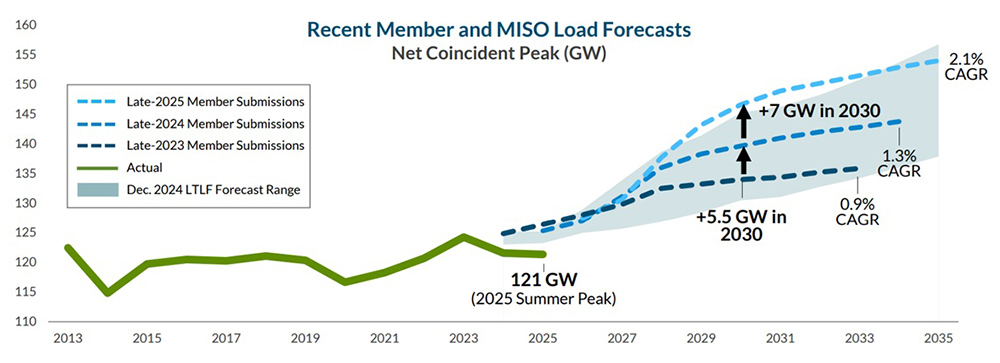
During Board Week, MISO said its recent load estimates and its members’ load forecasting show it could have more than 145 GW in load by 2030 and about 155 GW in 2035.
MISO expects to add about 15 GW of capacity by the end of 2026. If realized, it would be a record for the RTO.
“The systems are responding. The work we’re doing is really coming to fruition,” Aubrey Johnson said of MISO’s interconnection process.
MISO’s legacy interconnection queue contains 192 GW, but the RTO expects that number to continue declining as federal tax credits are phased out. The grid operator faced a more-than-300-GW queue at one point in 2025.
MISO has recently issued $60 million in refunds to withdrawing interconnection customers, a figure significant enough to be featured in the RTO’s financial updates.
Relatedly, the grid operator now has 76 GW in generation with approved interconnection agreements but has yet to be built.
“We predict that we will have close to 100 GW … by the end of the year,” Johnson said at the System Planning Committee meeting.
Of the 76 GW, MISO reported that 42 GW are delayed three years or more beyond their stated commercial operation dates. Johnson said developers remain dogged by permitting hurdles, supply chain issues and, in some cases, the lack of an off-taker for their planned projects.
However, Johnson said MISO was able to process the first study phase of the regular 2025 cycle of interconnection projects in just 54 business days.
“And that’s going to be the slowest we ever do it,” Johnson said. “Going forward, we expect to only have one open queue cycle per year.”
However, Soholt said she’s heard that some interconnection customers don’t trust the results Pearl Street’s SUGAR software (which MISO is using to automate studies) is producing, noting interconnection customers are having difficulty replicating the study results they receive.