NEW ORLEANS — A sitting state commissioner and two former regulators have asked MISO to publicly share any information it might gather on its Independent Market Monitor’s possible involvement in a five-state complaint against the RTO’s long-range transmission planning.
The regulators emphasized the need for transparency after emails surfaced pertaining to the drafting of the complaint.
Their requests come after Manifest Energy, a new group focused on ratepayer interests and industry transparency, in late March published a trove of emails from 2025 that circulated among state regulatory staff, outside counsel and consultants working on the complaint against MISO’s second, $22 billion long-range transmission plan (LRTP) portfolio approved in late 2024.
MISO Independent Market Monitor David Patton was included in multiple emails, including those that reference the LRTP complaint, contain invitations to a Microsoft Teams meeting and mention “edits” from Patton. (See Group Raises Questions over MISO IMM Involvement in $22B Tx Plan Complaint.)
State utility commissions from Arkansas, Louisiana, Mississippi, North Dakota and Montana filed their complaint in July 2025, asking FERC to order MISO to revoke the classification of its second, $22 billion LRTP portfolio and nullify the portfolio’s load-ratio share cost allocation.
The states contend MISO and its board erred by advancing transmission projects that will cost more than the value they can provide and said FERC should scrutinize all the RTO’s future business cases supporting LRTPs (EL25-109).
Around the same time as the emails’ release, MISO board members authorized a third-party review of IMM best practices. MISO has neither confirmed nor denied a link between the review and the email discovery.
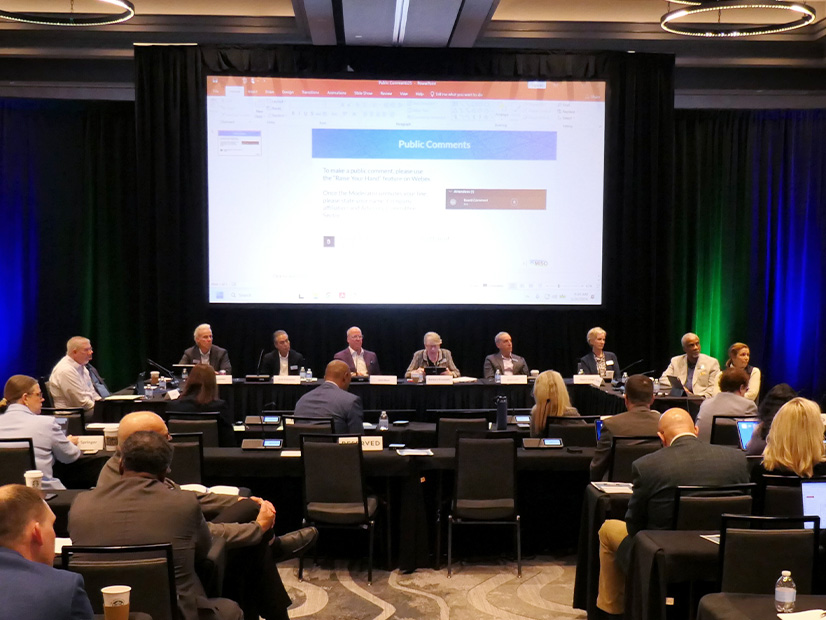
At a March 26 meeting of MISO’s Board of Directors, Director Theresa Wise said the best practices review is sensible given that the RTO subjects other vendors to such a standard.
Patton has said his involvement with the parties who authored the complaint was limited to explaining his own transmission cost-benefit analysis that the complaint relied upon. He said he neither strategized with the complainants nor helped them draft the complaint.
Norris: MISO ‘Well Within’ Scope to Prod
Speaking for the Natural Resources Defense Council, John Norris, a former FERC commissioner, Iowa Utilities Board member and president of the Organization of MISO States, said he is concerned about the “genesis and construction” of the LRTP complaint.
During the March 26 meeting, Norris urged the MISO board to be open about what they discover.
“That notion of secrecy and surprise … don’t devolve into that. There’s nothing to be gained from the element of surprise.”
Norris said MISO is “well within its scope” to ask for a complete report from the IMM that outlines when the engagement began and how long it lasted, the nature of the engagement, and “what input was provided on the construction and drafting of the complaint.” The RTO is “entitled to know” those details, he added.
MISO should “take the initiative” to uncover those details while the LRTP complaint remains outstanding, Norris said.
“I would encourage you to act on this right away. Transparency is critical to public trust in our process. Any divergence from that … should not be permissible,” he said. “As best I can tell in talking to folks, MISO wasn’t aware. That concerns me.”
Norris said if he were still a FERC commissioner, he’d be interested in what transpires.
“How do you give an independent assessment when there was at least some level of engagement that impacts your ability to provide an independent assessment?” he asked.
Norris said based on “what I’ve seen so far of the documentation provided … something does not add up.” He noted the engagement between Patton and those authoring the complaint seemed to span months based on email chains.
“It’s just, ‘Come clean,’” Norris said later in an interview with RTO Insider.
Speaking before the MISO board, Norris said the process behind the complaint “diverted from” what he remembered as a culture of mutual respect and openness while involved with OMS. He lamented that a majority of OMS members “this time weren’t a part of the conversation.”

“Transparency is essential for continuity of investment and for public trust,” he said. “That’s what troubled me about both the process and the complaint — is that all MISO states have been open with each other and shared positions and unequivocally accepted dissent, so what was the need for the secrecy around the action of six OMS members?”
Norris contended that MISO South’s aversion to transmission planning now stands to affect MISO Midwest’s transmission planning successes.
“The genesis of this complaint comes from MISO South, and it’s the same set of stall tactics that have prevented long-range transmission from ever getting off the ground in 13 years,” Norris said.
Entergy and others joined MISO in 2013, creating MISO South. Norris was one of the FERC regulators to approve the utility’s membership, but he has since criticized a lack of regional transmission planning in the South and has said given what he knows now, he would not have cast a vote for Entergy to join MISO.
Norris said one thought struck him while meeting with young members of MISO’s Environmental Sector during the RTO’s Board Week: “You’ll probably be middle-aged before a long-term transmission project is built in MISO South.”
Norris told the board he’s a “longtime believer of long-range transmission planning and building for the future.”
“Planning is critical. We owe it to the next generation to get this done,” Norris said.
Differing Views
On the other hand, former FERC Chair Mark Christie, now director of the Center for Energy Law and Policy, supported Patton on social media.
Christie said both the PJM and MISO monitors are “frequently attacked by interest groups who don’t like it when the IMMs do their jobs.”
“Their job is to put out the facts with independent analysis, regardless of which interests don’t like it,” Christie said, calling Patton an “invaluable neutral analyst.”
“Patton correctly understands that transmission planning, which costs consumers literally trillions of dollars, should be subject to the same scrutiny as markets,” Christie wrote in a March 31 LinkedIn post.
But Energize Strategies’ Ted Thomas, former chair of the Arkansas Public Service Commission, seconded the call for transparency.
“When you’re dealing with decisions of this scale, transparency is what gives the process credibility,” Thomas said in an email to RTO Insider. “If discussions involving the Independent Market Monitor occurred before FERC had issued an order clarifying its authority under the tariff to weigh in on transmission matters, that timing raises reasonable questions about role clarity and process.”
Thomas was referring to FERC’s July 2025 decision finding it appropriate for the IMM to analyze the value of MISO’s proposed transmission portfolios in addition to examining markets. (See MISO IMM Contends He Should Have Role in Tx Oversight and FERC Sides with Market Monitor over MISO in Compensation Dispute.)
“Stakeholders deserve transparency on that point,” Thomas said. “At the same time, we shouldn’t lose sight of the bigger picture — a reliable, well-planned transmission system is essential to keeping costs down. The goal should be disciplined governance and continued investment, not uncertainty that ultimately puts ratepayers at risk.”
Ham: ‘Clear’ the Perception
Minnesota Public Utilities Commissioner Hwikwon Ham said if MISO’s review delves into the extent of communications between the IMM and states regarding the LRTP complaint, then the RTO should present public findings to its stakeholder community. He said trust relies on public information.
Ham said it’s “too soon to tell if trust has been violated” regarding the IMM.
“I don’t think the IMM office’s intention is anticompetitive behavior. … But we need to make sure we have trust in the IMM’s office. At least if there’s some perception in the community, I think we need to clear that perception,” Ham told RTO Insider. “[Possibly] being associated with that kind of activity makes his office less credible — that’s my concern.”
Ham said the perception that the IMM could have “potentially taken a side” and engaged with testimony while later intervening in the complaint “makes me uncomfortable.” He added that he had no direct knowledge of the communications until the release of the emails.
Ham said he’s engaged the IMM for his advice many times over the years, particularly in regard to understanding the effect a sloped demand curve would have on MISO’s capacity market.
Ham said what appears unusual about this instance is that it involves parties protesting an adopted MISO stakeholder agreement. He said personally, he’s never heard of the IMM becoming involved in a protest of MISO processes.
Ham stressed that he and the Minnesota PUC “strongly support a market monitoring function at the RTO.”
Above all, the complaint is about allocating the cost of MISO’s long-range transmission lines, Ham said. He said the discord could mean it’s time for stakeholders to revisit MISO’s cost allocation methodologies.
“Hopefully people are more focused on doing it than fighting over this. That is my wish,” Ham said. “Hopefully, MISO and OMS can regroup and talk about long-range cost allocation. Hopefully, everybody can focus on the core issue, and everyone can agree on a solution to this. Because the nation needs those transmission lines.”
Ham said it’s not a problem that OMS contains differing views across the states.
“Overall, I think OMS is not a consensus organization,” he said, adding that he’s there to protect Minnesota’s best interests while other states act in their best interests.
Ham recounted that when he worked previously as a PUC staff member, he and now fellow Commissioner Joseph Sullivan spent about three years starting in 2020 trying to create cost allocation solutions that would work across the MISO footprint.
“I strongly believed we could do that,” Ham said. “That’s why it’s very painful for me to see this secondary legal challenge rather than solutions through the OMS process.”