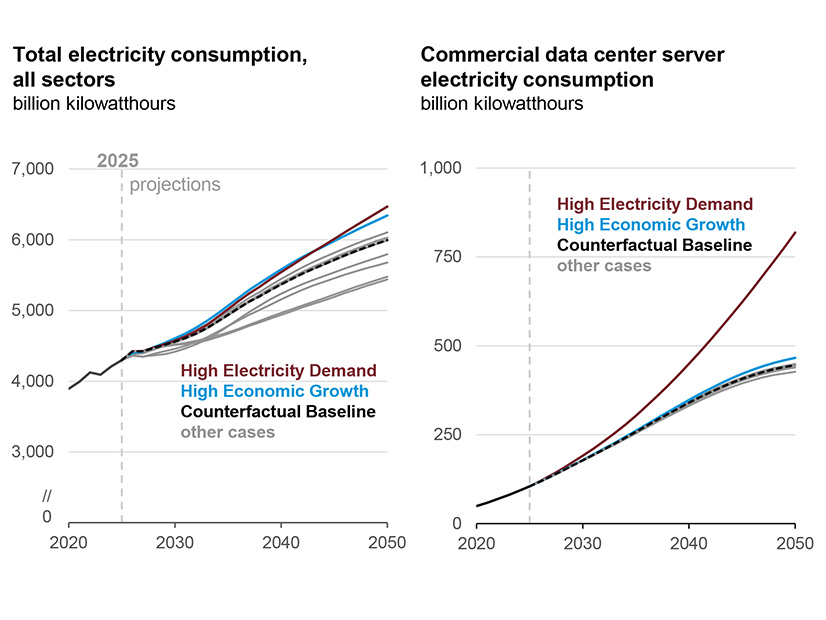
The Energy Information Administration’s 2026 Annual Energy Outlook, released April 8, includes forecasts for all kinds of energy out to 2050, and when it comes to electricity, the focus is on demand growth.
“After 15 years of nearly flat U.S. electricity consumption, demand has increased by 2.1%/year, on average, over the last five years,” EIA said in the report. “We project electricity consumption will continue growing through 2050 at a rate of 0.9 to 1.6%, with data center server energy use a major factor. Energy use in commercial buildings, home to data center activity, grows more rapidly than in the residential or industrial sectors in all modeled cases.”
Servers used for artificial intelligence are going to skew more energy intensive, and their stock is expected to grow exponentially through 2040 at least. In EIA’s High Electricity Demand case, that growth is assumed to continue through 2050 at least.
Data center energy use grows to 818 billion kWh by 2050 under the high demand case, which is 16 times more energy use from servers than in 2020. The high demand case shows 84% more data center server use than in the baseline case.
“In all cases, electricity use is highest in the commercial sector,” EIA said. “By case design, commercial buildings alone account for the incremental electricity growth in the High Electricity Demand case — largely to meet additional data center server and space cooling demand.”
Data center demand is the largest in the South Atlantic and West South Central census divisions, which are home to Virginia and Texas, respectively.
Another major source of demand in the projections comes from electric vehicles. EIA expects overall demand growth of 25 to 50% by 2050, with data centers and EVs making up 50 to 80% of that, but given how much electricity is used already, they represent only 10 to 25% of overall power demand in 2050.
The future of EVs in the report includes the end of tax credits, but it varies greatly depending on what EPA does with tailpipe emission standards going forward.
“We project about 53% of light-duty vehicles sold in the United States each year are electric by 2032 before stabilizing under those policies; without the policies, sales share gradually increases to around 20% by 2050,” EIA said.
Total generation is expected to grow between 25 and 50% through 2050, depending on the growth of AI and the broader economy.
“Natural gas, solar and wind generation increasingly meet U.S. power demand across all cases examined here,” EIA said. “The combined generation share of these technologies rises from about 60% in 2025 to around 80% in most cases by 2050; in the counterfactual baseline case, natural gas accounts for about 40%, wind for 20% and solar for 20% in 2050.”
Coal generation is expected to fall from 16% to 1% in 2050 if the federal government imposes a cost on carbon, but even without that, it would fall to 5%. Nuclear generation is flatter, but it is expected to drop from 17% in 2025 to 12 to 15% by 2050.
“Natural gas prices and technology costs affect the generation mix because of tight cost competition between natural gas and renewables for new power plant construction,” EIA said. “Wind capacity additions are very sensitive to natural gas price changes, with over five times more additions in the Low Oil and Gas Supply case than in the High Oil and Gas Supply case. Solar additions, meanwhile, vary by a factor of two across the cases and are less sensitive to natural gas prices in part because of their tendency to suppress peak mid-day electricity prices.”
Renewable capacity will increase in all regions, but they vary significantly. The Mid-Continent census division sees the most wind growth at between 20 and 170 GW, with between 75 and 300 GW of renewable growth overall.
Solar is expected to grow by 100 to 235% across the entire country, and the Southeast will see the highest growth at anywhere from double to sevenfold depending on the price of gas and the cost of solar technologies.